Do Ambiguous Eco-Labels Boost or Blur Consumer Trust?
Analysis reveals 9 key thematic connections.
Key Findings
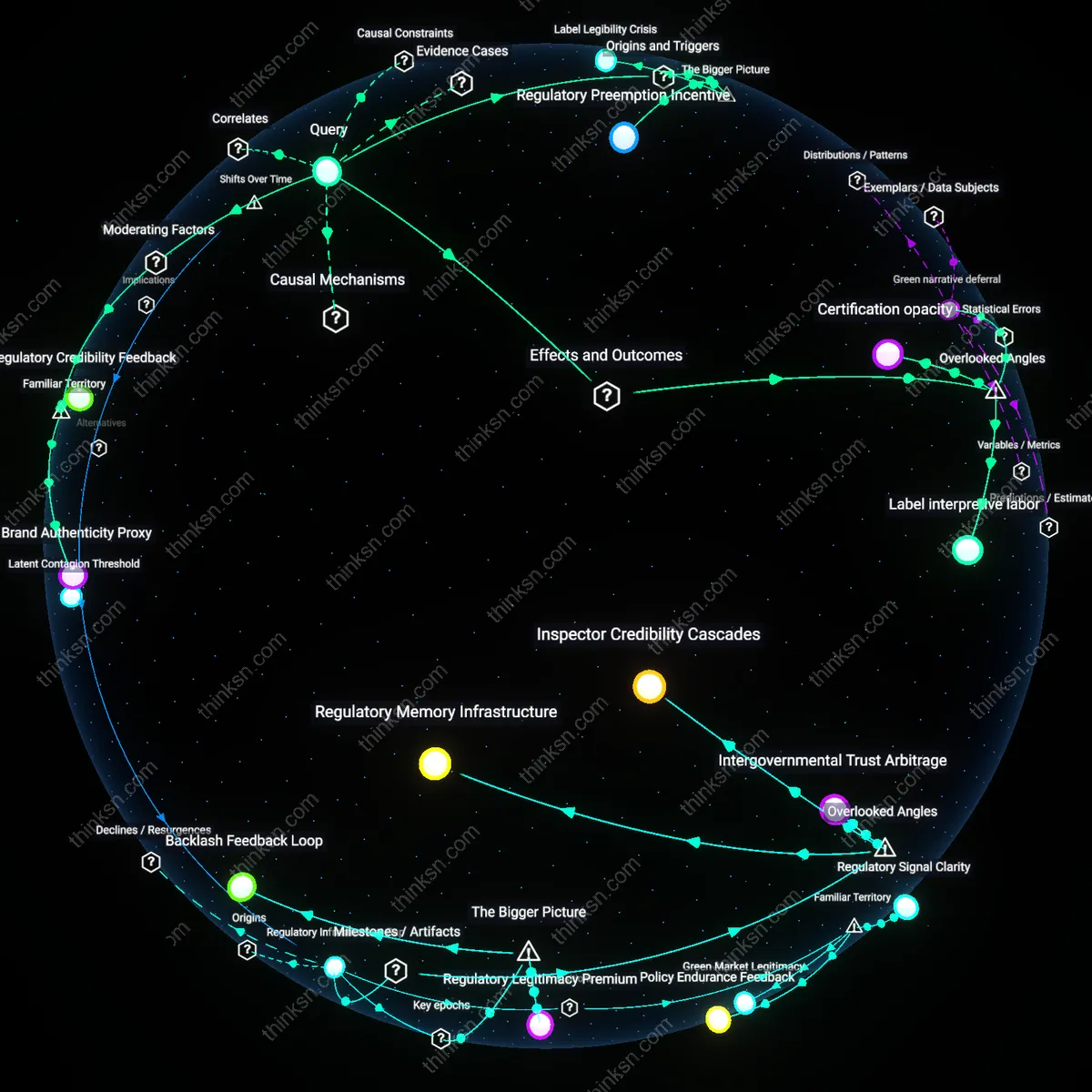
Regulatory Preemption Incentive
Rising consumer skepticism toward ambiguous climate labels pressures governments to preempt market fragmentation by establishing standardized certification regimes, as seen in the European Union’s proposed Green Claims Directive, where unresolved ambiguity risks eroding public compliance with broader climate policies; this dynamic positions regulation not as a response to public demand per se, but as a risk-aversion strategy by state institutions fearing loss of policy credibility in the face of private-sector greenwashing. The non-obvious element is that regulation emerges less from consumer advocacy than from state actors’ desire to maintain legitimacy in climate governance.
Trust Polarization Mechanism
Consumer skepticism fragments the green market into high-trust and low-trust segments, where elite or informed buyers shift toward third-party certified goods while mass consumers disengage, reinforcing a dual market structure that weakens collective support for green premiums; this mechanism, observable in U.S. household purchasing patterns for plant-based and carbon-offset products, reveals how skepticism does not uniformly demand regulation but instead enables regulatory inertia by undermining consensus on what ‘green’ should mean. The underappreciated consequence is that fragmented trust becomes a systemic barrier to universal standards.
Label Legibility Crisis
Ambiguous climate labels trigger a systemic crisis of legibility in consumer markets, where the inability of shoppers to compare products transparently leads not to stronger regulation but to market withdrawal by responsible producers unable to signal authenticity, as seen in the Nordic private eco-labeling sector’s declining participation post-2020; this erosion of signaling capacity reveals that the precondition for effective regulation—common epistemic frameworks—is destroyed by runaway label proliferation, making coordinated rule-making harder, not easier. The overlooked dynamic is that skepticism undermines the very data infrastructure regulation depends on.
Certification opacity
Consumer skepticism toward ambiguous climate-friendly labels increases reliance on third-party certification bodies, which in turn strengthens their market power and standard-setting influence. As consumers doubt corporate self-labeling, they delegate judgment to entities like the Forest Stewardship Council or CarbonTrust, unintentionally reinforcing a shadow regulatory tier that operates without public oversight or democratic accountability. This shift is non-obvious because most analyses frame regulation as a state function, while the real power increasingly lies in private, globally dispersed certification networks whose opacity shapes what counts as 'green' in supply chains from cocoa to shipping. The consequence is a quiet privatization of regulatory legitimacy, where mistrust of firms leads not to stronger state rules but to entrenched unelected authorities.
Label interpretive labor
Consumer skepticism forces households in urban retail environments to perform unacknowledged cognitive work to decode label meanings, redistributing the regulatory burden from institutions to individuals. Shoppers in supermarkets from Berlin to Portland must cross-reference labels like 'carbon neutral' or 'eco-conscious' with fragmented online databases, NGO scorecards, or social media commentary, turning routine purchases into acts of investigative reasoning. This dynamic is overlooked because policy debates assume regulation reduces complexity, but in practice, ambiguity shifts the cost of verification onto consumers—particularly disadvantaging those with less time, digital access, or scientific literacy—thereby deepening inequities in sustainable consumption and masking systemic failures behind a façade of personal responsibility.
Green narrative deferral
Consumer skepticism delays corporate investment in verifiable sustainability transitions by allowing firms to treat labeling disputes as matters of communication rather than performance. Companies like fast-fashion retailers or industrial food producers extend the lifespan of weak environmental practices by reframing consumer mistrust as a 'messaging challenge,' commissioning PR revisions instead of reducing emissions or overhauling supply chains. This deflection is rarely captured in regulatory analyses because it mimics responsiveness—launching new labels, sustainability reports, or partnerships with influencers—while avoiding material change, thus preserving profit margins and locking in carbon-intensive systems under the appearance of adaptation.
Label Clarity Threshold
Consumer skepticism toward ambiguous climate-friendly labels promotes stronger regulation when media scrutiny amplifies public outcry, because regulatory agencies like the European Commission respond to visible consumer confusion with stricter labeling standards such as the upcoming EU Green Claims Directive, revealing that public trust erodes only when enforcement lags behind scrutiny—what’s underappreciated is that people assume skepticism always weakens green markets, but under media spotlight, it becomes a catalyst for rule-making rather than retreat.
Brand Authenticity Proxy
Consumer skepticism toward ambiguous climate-friendly labels erodes trust in green products when firms prioritize marketing over measurable impact, because shoppers use label ambiguity as a heuristic to infer corporate dishonesty, especially in fast-moving consumer goods like fashion or packaged foods where greenwashing is common, and this dynamic is significant because the public conflates vagueness with deceit—even when regulation is absent, consumers act as de facto auditors, a role rarely acknowledged in policy debates dominated by institutional fixes.
Regulatory Credibility Feedback
Consumer skepticism toward ambiguous climate-friendly labels strengthens regulation only when third-party validators like NGOs or certification bodies are visibly aligned with scientific consensus, because entities such as the World Wildlife Fund or Carbon Trust lend interpretive authority that transforms public doubt into pressure for legislative clarity, and what’s overlooked is that people don’t just demand government action—they condition its legitimacy on whether independent experts endorse it, making the credibility of validators a pivot point between cynicism and reform.