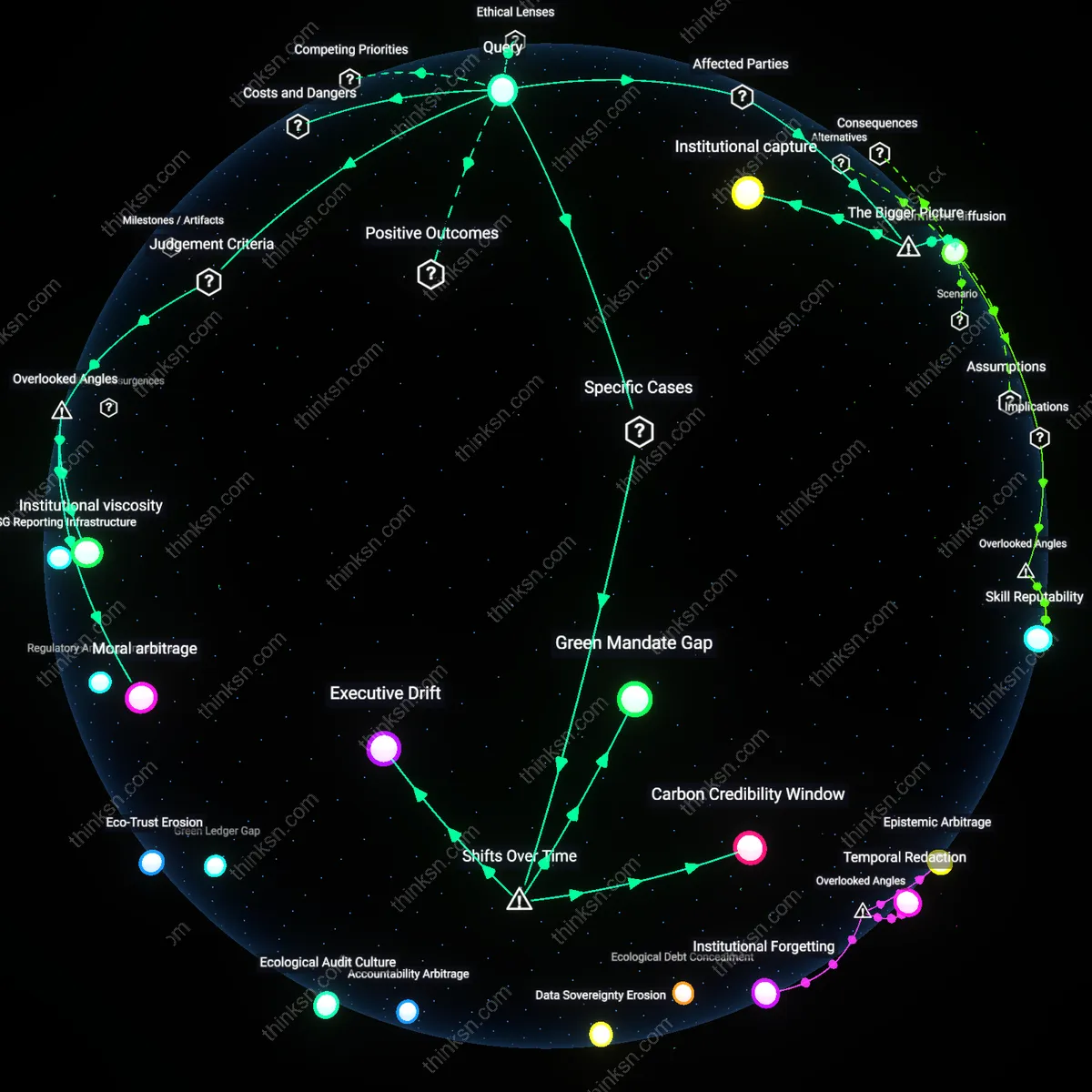
Senior Influence or Environmental Ethics: Which Wins?
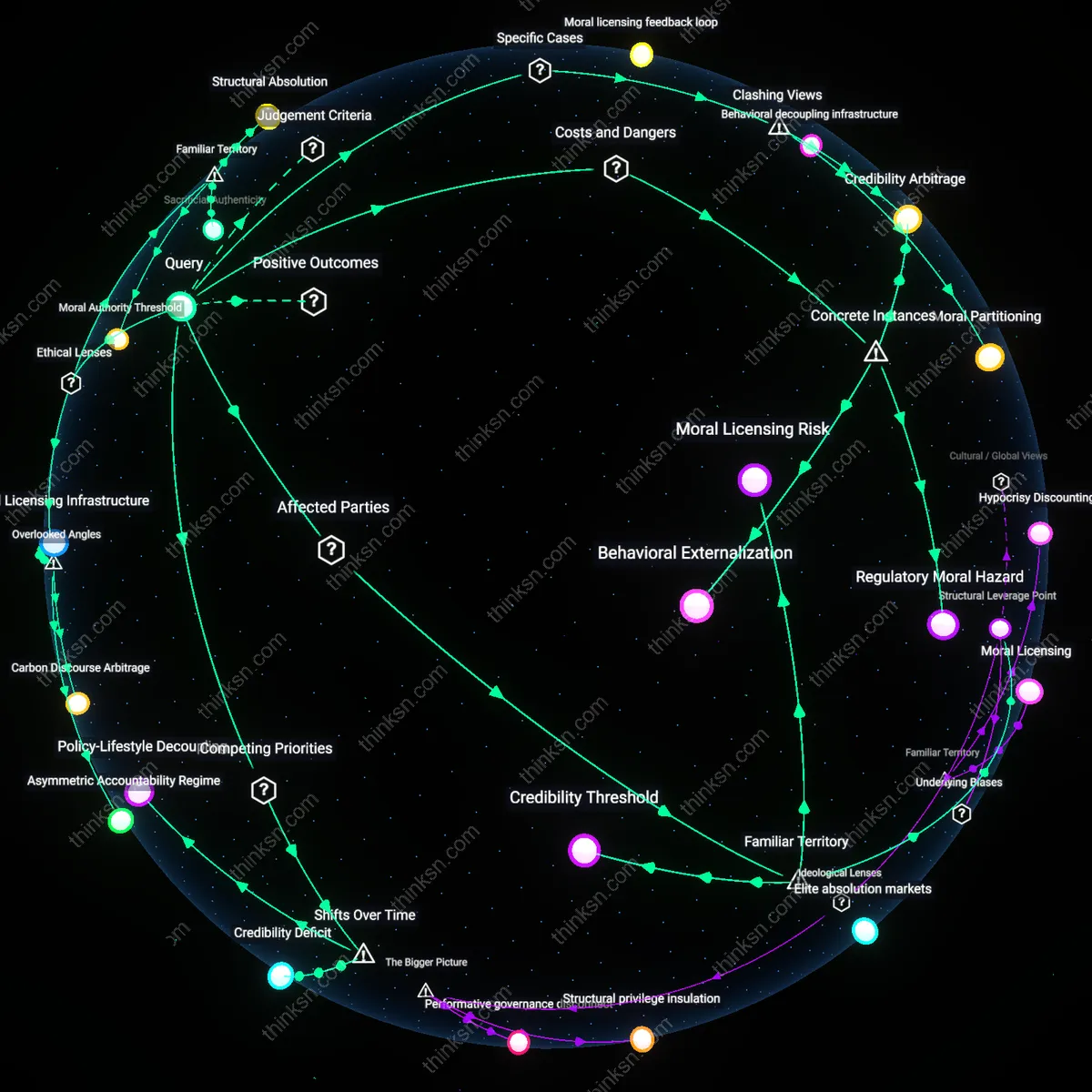
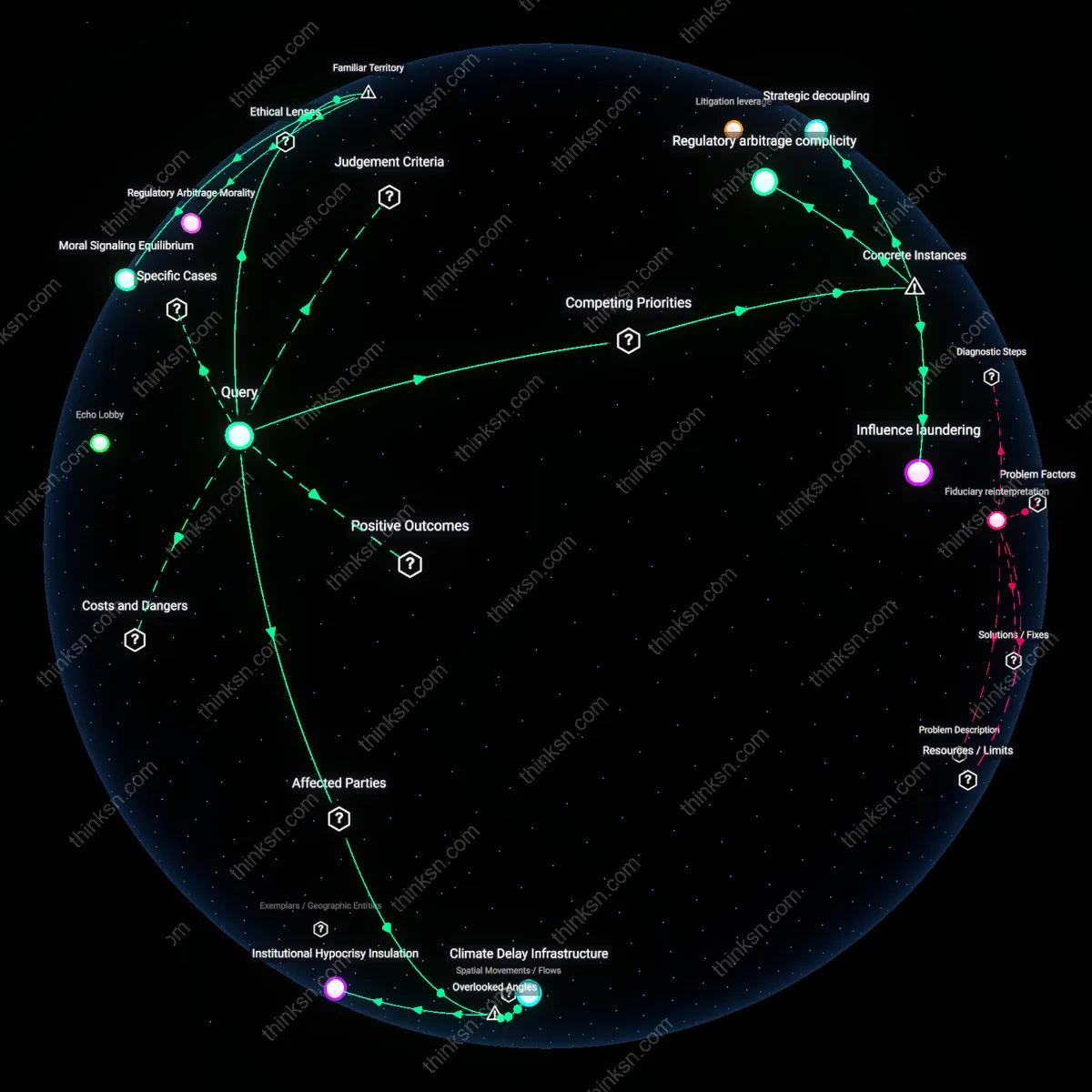
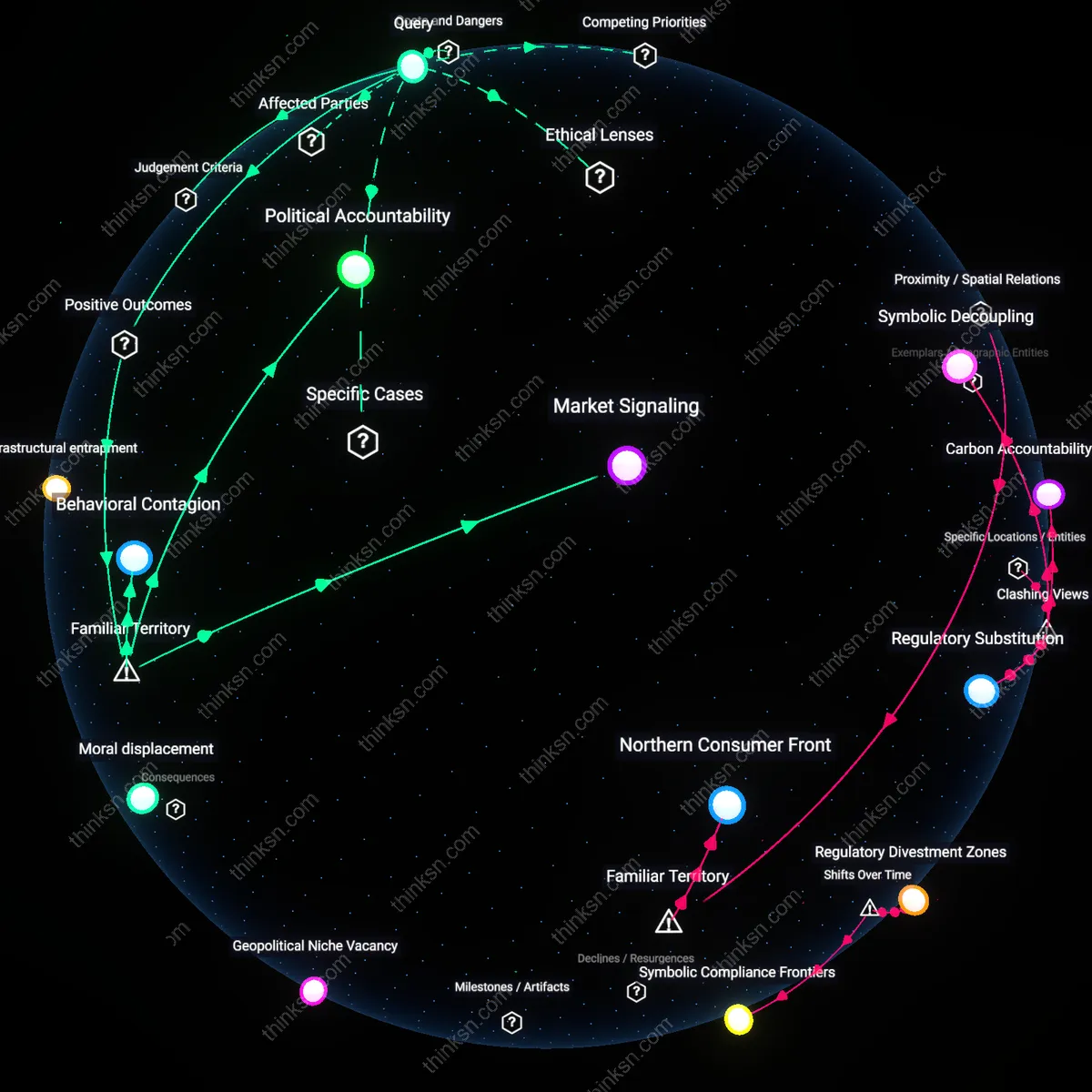
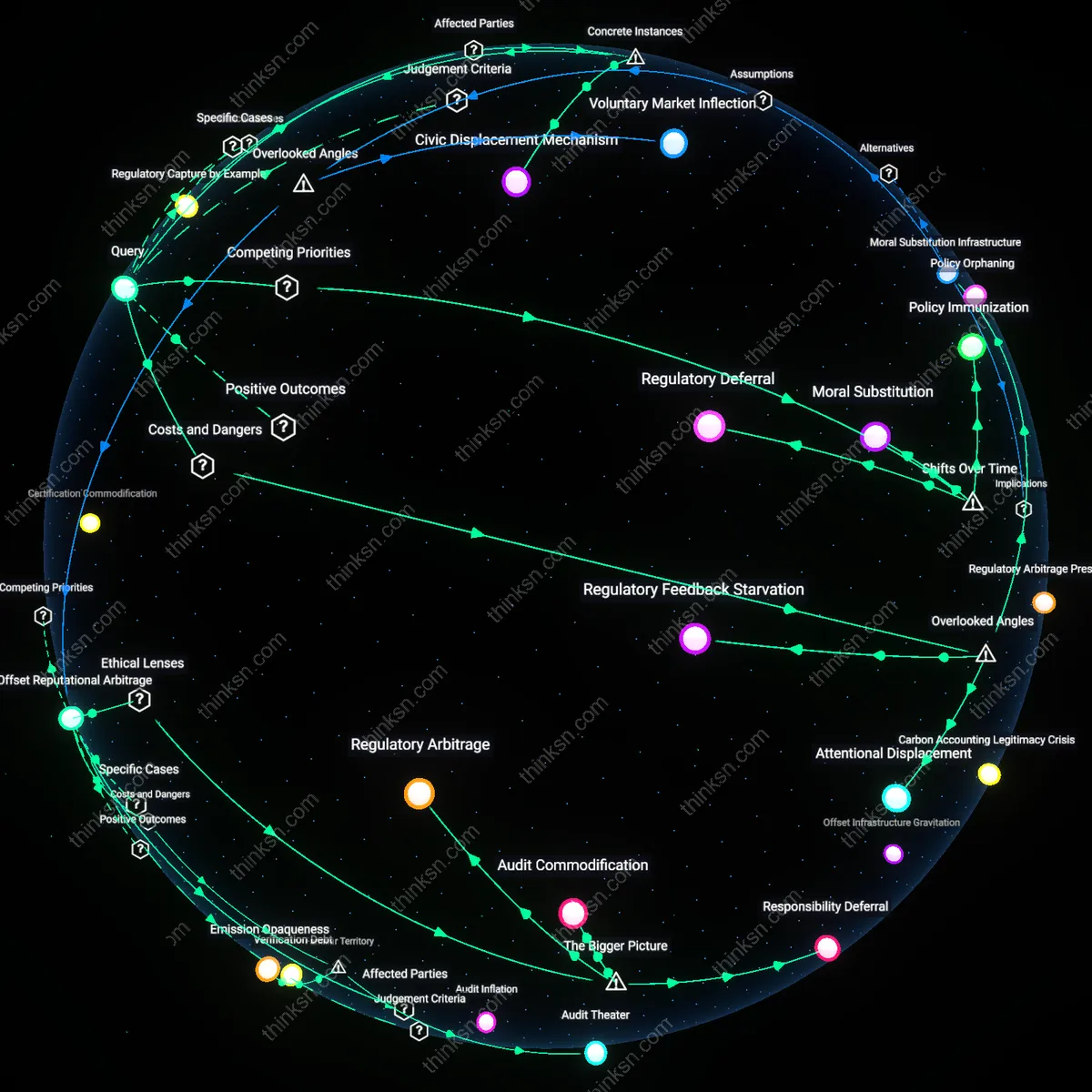
Analysis reveals 9 key thematic connections.
Key Findings
Institutional capture
One should not remain in a leadership role within an environmentally harmful industry because such positions often function to legitimize ecologically destructive practices through policy influence and public messaging, thereby insulating the institution from systemic change. Senior roles in fossil fuel firms or high-emission manufacturing embed individuals within networks that shape regulatory narratives—lobbying agencies, funding research, and co-opting sustainability discourse—such that leadership becomes a mechanism of institutional resilience rather than reform. This dynamic is non-obvious because leaders in these roles often believe they are pushing for incremental progress, while the system uses their credibility to delay transformation. The result is ethical compromise that reinforces the status quo under the guise of stewardship.
Normative diffusion
One should exit the role to strengthen the moral credibility of the environmental movement, particularly when symbolic resignations from influential posts can catalyze public discourse and shift social norms around professional complicity. High-visibility departures—like engineers leaving aerospace firms developing fossil-intensive technologies—signal breach of trust and intensify reputational risks for employers, prompting stakeholder scrutiny and employee attrition. This operates through media amplification and peer networks in technical fields, where individual exits aggregate into a signal of systemic illegitimacy. The non-obvious impact lies not in direct policy change but in altering the social license of industries by eroding internal talent retention and external public acceptance.
Moral arbitrage
One should remain in the career to convert leadership access into environmental leverage, as proximity to decision-making enables behind-the-scenes redirection of capital and policy toward sustainability. Senior roles in extractive industries, such as a VP at a fossil fuel firm, allow covert advocacy by embedding green mandates into procurement, R&D budgets, or executive reporting structures—mechanisms insulated from public accountability but highly sensitive to internal influence. This leverages the asymmetry between public ethical posturing and private operational control, a dynamic typically overlooked because moral discourse focuses on affiliation rather than embedded agency. The non-obvious value lies in exploiting institutional inertia to shift norms from within, turning ethical compromise into moral arbitrage.
Institutional viscosity
One should leave the career to avoid assimilation into a value-compromised system, because prolonged exposure to normalized environmental externalities erodes moral intuition through adaptive desensitization. Operators in logging, mining, or petrochemical sectors, even in leadership, gradually re-rationalize ecological harm as 'unavoidable trade-offs,' a shift reinforced by peer networks, performance metrics, and social rewards that privilege economic output over stewardship. This psychological drift operates below the threshold of conscious ethical conflict, making it more dangerous than overt wrongdoing; it is overlooked because most analyses assume values are stable rather than contextually deformed by institutional viscosity. The real cost is not in specific acts but in the quiet degradation of moral perception.
Epistemic asymmetry
One should remain in the career not to change the organization, but to gather and leak strategic environmental data that external movements cannot access. Executives possess granular knowledge—emissions loopholes, regulatory evasion tactics, future land-use plans—that can empower frontline activists, journalists, or regulatory bodies to act with precision. This intelligence asymmetry, such as internal climate risk models deliberately withheld from public disclosures, becomes a form of ecological leverage when transferred to adversarial but legitimate actors; it is typically ignored because ethical debates frame leadership as a position of control, not as an epistemic node in a broader resistance network. The overlooked opportunity is the leader as embedded informant, transforming career position into a conduit of subversive knowledge.
Influence Trap
One should not remain in such a career because the promise of future environmental impact through leadership is systematically exploited to justify ongoing complicity in ecological harm. Corporate environmental damage often accelerates under the veneer of 'responsible leadership'—as seen in fossil fuel companies appointing sustainability officers to greenwash extraction agendas—where decision-making power is structurally constrained by shareholder imperatives, rendering ethical influence illusory. This dynamic masks the non-negotiable hierarchy of profit over principle, revealing that the real function of 'leadership within' is not change but institutional legitimation. What is underappreciated is that influence in compromised systems doesn’t enable transformation—it embeds and normalizes damage by recruiting idealism into containment.
Executive Drift
One should remain in such a career because accumulated corporate influence after the 1980s shareholder revolution enables executives to pivot internal ESG metrics retroactively—exemplified by Unilever’s Sustainable Living Plan under CEO Paul Polman, which repurposed growth mandates into environmental scaling mechanisms. This shift from externally compliant to internally transformative leadership emerged not from activism but through strategic co-option of financialized governance tools, revealing how ethical compromise can become a platform for stealth institutional conversion over decades.
Green Mandate Gap
One should leave the career because post-2015 climate accountability frameworks like the Paris Agreement have exposed a widening lag between corporate sustainability pledges and board-level enforcement capacity—visible in Shell’s continued Arctic drilling despite net-zero PR, enabled by legally insulated executive discretion. The emergence of state-backed climate litigation since 2020 has redefined complicity not as participation but as operational continuity, making prior assumptions about influence through proximity obsolete in this new regulatory phase.
Carbon Credibility Window
One should conditionally remain only during the narrow 2010–2025 window when fossil fuel firms like Ørsted (formerly DONG Energy) faced existential investor pressure, enabling internal actors to leverage leadership roles in decommissioning carbon infrastructure before capital reallocation closed the path—where former rig managers led offshore wind transitions. This fleeting period of financial vulnerability turned operational complicity into transitional leverage, a temporally bounded mechanism unseen before and unlikely to recur at scale.