Brand Risk vs Quick Cash in Housing Developer Settlements?
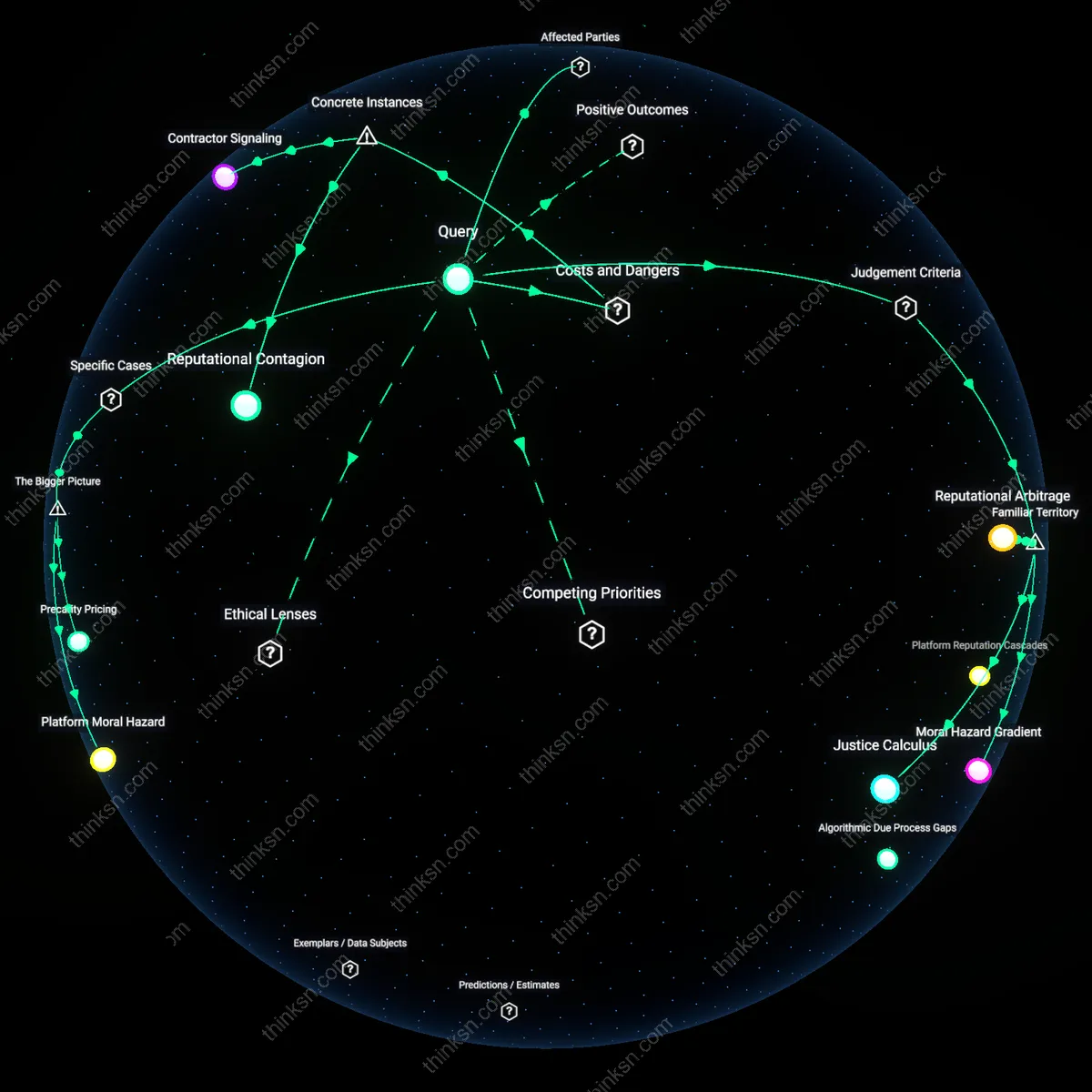
Analysis reveals 9 key thematic connections.
Key Findings
Settlement Horizon Bias
Prioritize public disclosure of settlement terms to preserve brand integrity over private reconciliation because housing developers operate within municipal approval cycles where future permit reviews are influenced by community trust thresholds managed by local planning boards. Most analyses focus on immediate cost containment or legal risk, but overlook how unmonitored settlements erode institutional memory in city agencies, creating a feedback loop where past compromises are forgotten while brand erosion persists through voter referenda on future projects—this dynamic distorts long-term project viability not through direct liability but through indirect political resistance rooted in lost community credibility. This reveals that the temporal mismatch between short-term settlement enforcement and multi-decade development timelines systematically disadvantages firms that prioritize legal finality over civic record continuity, making public accountability a signaling mechanism that recalibrates future stakeholder expectations in ways private agreements cannot.
Neighborhood Narrative Arbitrage
Treat private settlements as narrative liabilities that empower future community activists to redefine the developer’s role from builder to repeat offender because sealed agreements prevent civic sense-making and create fertile ground for interpretive contests during rezoning debates. Standard assessments assume brand is managed through marketing or CSR, but fail to account for how storytelling asymmetries in local civic forums allow grassroots groups to fill evidentiary vacuums with morally charged histories that reframe isolated incidents as systemic negligence—this narrative arbitrage emerges when residents leverage the absence of public records to position the developer as an opaque actor hostile to transparency, thereby increasing political organizing potency and raising regulatory lobbying costs for subsequent phases. The overlooked dependency is that silence multiplies interpretive risk in participatory governance systems where precedent is socially constructed, not merely legal.
Investor Accountability Gap
A developer’s reliance on private settlements widens the investor accountability gap because asset managers prioritizing short-term earnings cannot assess long-term ESG risks tied to unresolved community grievances, particularly in publicly traded real estate investment trusts (REITs) governed by fiduciary oversight mechanisms in markets like Toronto or Frankfurt; the lack of public adjudication prevents integration of social performance metrics into investment models, distorting capital flows toward ostensibly profitable but systemically vulnerable projects. This dynamic emerges from information asymmetries between corporate legal teams and institutional shareholders, where financial reporting frameworks do not require disclosure of non-material settlements—even as clusters of them indicate systemic operational flaws that later trigger large-scale devaluations, as seen in post-2017 cladding scandals across Europe. The critical insight is that immediate financial benefits from secrecy are extracted at the cost of distorting capital markets’ ability to price in long-term social risk, thereby misaligning investor incentives with urban sustainability.
Settlement Discounting
Prioritize immediate financial benefits through private settlements because neoliberal deregulation since the 1980s has redefined developer accountability as a market-risk calculus rather than a civic obligation, embedding short-term value extraction into housing finance models. Real estate firms now operate under shareholder primacy doctrines reinforced by legal frameworks that privilege contractual confidentiality over public transparency, effectively discounting long-term brand risk as an externality. This shift—from postwar municipal planning regimes focused on communal trust to asset-backed securitization logics—makes brand damage appear financially negligible in capital allocation decisions, obscuring how deferred accountability erodes regulatory legitimacy over time.
Brand Fiduciary
Balance settlement gains against brand impact by treating corporate reputation as a fiduciary trust, a norm that emerged after the 2008 foreclosure crisis reshaped public expectations of developer responsibility under communitarian interpretations of stakeholder theory. Municipal bond markets and urban regeneration programs in cities like Barcelona and Vancouver began demanding social return metrics by the mid-2010s, signaling a transition from developer-as-contractor to developer-as-steward. This evolution reveals that long-term brand value has become a governance mechanism, where the residual duty to maintain community trust functions as an informal regulatory layer beyond compliance.
Temporal Arbitrage
Exploit the gap between legal finality and public memory by settling privately now, leveraging the post-2016 era of digital amnesia and attention fragmentation, wherein short electoral and news cycles weaken cumulative accountability, a transformation enabled by platformized media ecosystems. Developers such as those in London’s oversupplied luxury sector have demonstrated that brand repercussions dissipate faster than litigation timelines, allowing firms to treat reputation as a depreciating asset to be managed, not preserved. This marks a departure from 20th-century corporate identity models, where brand consistency was linear, exposing a new regime of temporal arbitrage in urban development ethics.
Reputation Discount Rate
A housing developer should prioritize immediate financial benefits from private settlements when operating in markets where brand recognition is low and buyer turnover is high, as seen in speculative suburban developments by Lennar or DR Horton in Sun Belt cities. In these contexts, the speed of capital recycling and volume-driven profit models dilute the long-term weight of brand reputation, making quiet resolution of construction defects or zoning disputes more economically rational than public accountability. The non-obvious insight is that in high-velocity, commoditized housing markets, reputation does not compound—it depreciates like inventory, creating a measurable discount on future brand equity that favors short-term settlement efficiency.
Brand Coherence Threshold
A housing developer must forgo immediate financial gains from private settlements when operating luxury or master-planned communities like those by Toll Brothers in affluent northeastern corridors, where product differentiation hinges on perceived quality and legal transparency. Here, the expectation of public adherence to standards—reinforced by homeowner associations, architectural review boards, and local media scrutiny—makes undisclosed settlements appear covert and erode trust more severely than admitted flaws. The underappreciated dynamic is that once a brand positions itself as a curator of lifestyle integrity, any hidden resolution fractures the coherence between marketing claims and operational behavior, triggering disproportionate reputational spillover.
Regulatory Shadow Signal
A housing developer should treat private settlements as brand assets when regulatory environments, such as in post-Levittown-style public housing reforms or in UK Building Safety Act oversight zones, interpret undisclosed legal resolutions as tacit compliance rather than concealment, as seen with Barratt Redrow’s handling of cladding remediation cases. In these frameworks, avoiding litigation becomes a proxy for risk management competence, reinforcing investor and municipal confidence even in the absence of public disclosure. The overlooked mechanism is that in state-adjacent development ecosystems, silence functions as a signal of regulatory alignment—one that strengthens institutional trust more directly than consumer-facing brand narratives.