Long Commutes vs Office Visibility in Hybrid Work?
Analysis reveals 9 key thematic connections.
Key Findings
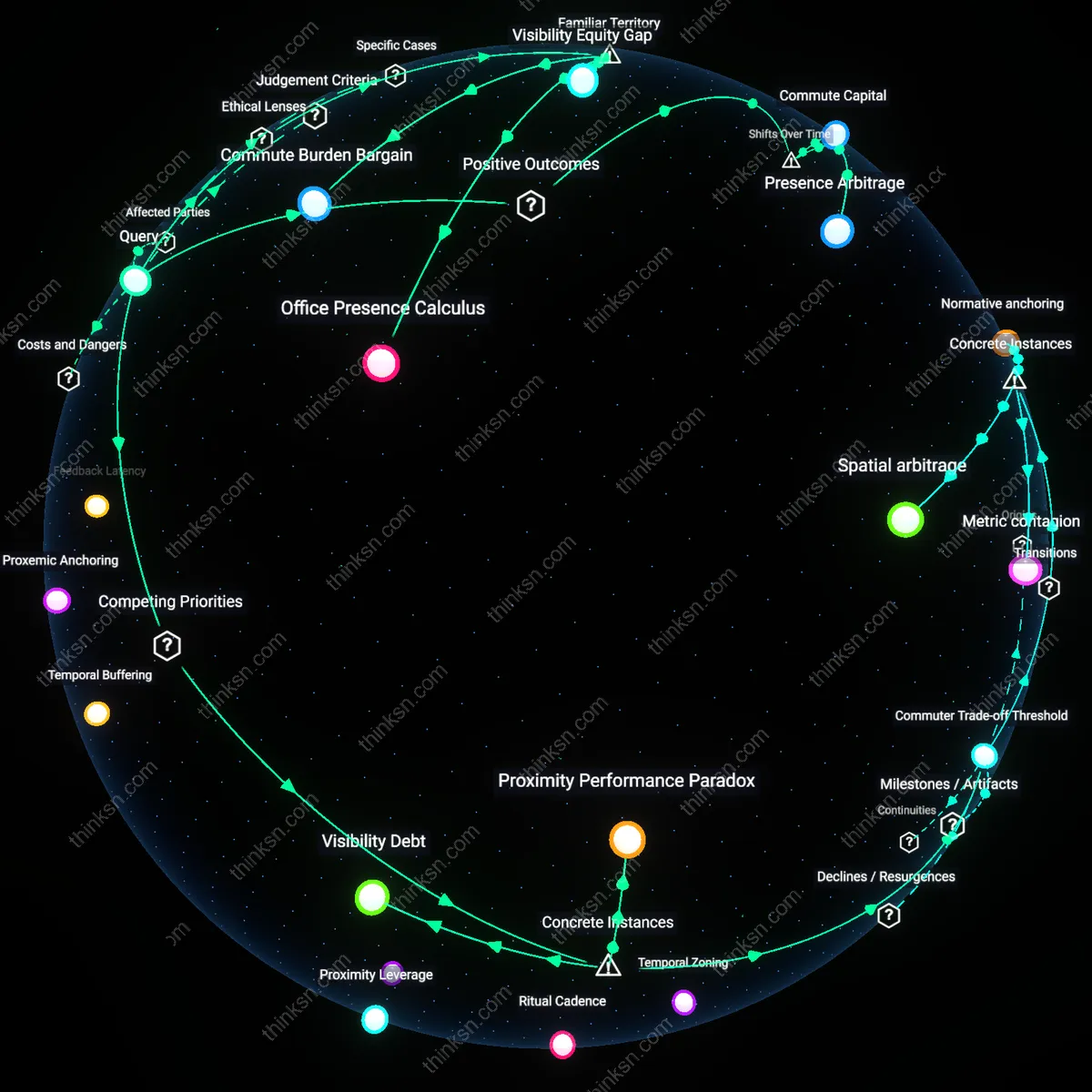
Commute Capital
A mid-level manager can maximize career benefits by selectively commuting during strategic inflection points in the fiscal calendar, such as performance review cycles or budget planning months. This practice concentrates physical presence when visibility most influences promotion and resource allocation decisions, leveraging the post-2020 shift toward outcome-based evaluation cycles that now tolerate intermittent office attendance. The non-obvious insight is that office presence has evolved from a symbol of dedication to a tactical signal, timed to coincide with institutional decision rhythms rather than routine attendance.
Presence Arbitrage
By aligning office days with emergent leadership opportunities—such as impromptu senior meetings or team crises that arose unpredictably after the normalization of hybrid work post-2022—a manager converts reduced commute frequency into higher-impact visibility. This behavior emerged as companies transitioned from rigid remote policies during the pandemic to fluid hybrid models, revealing that proximity advantage no longer depends on consistency but on coinciding with moments of organizational flux. The underappreciated shift is that visibility value is now nonlinear, peaking during volatility, not routine.
Temporal Proximity
Managers gain disproportionate career traction by compressing office time into pre-scheduled collaboration blocks established during the 2023 standardization of team anchor days, transforming commute cost into concentrated relational equity. This reflects a decisive break from the pre-2020 expectation of daily office anchoring, replacing spatial consistency with time-clustered presence that sustains team cohesion while minimizing transit burden. The key insight is that institutional trust now accumulates through synchronized, predictable bursts of proximity rather than continuous availability.
Commuter Trade-off Threshold
A mid-level manager at IBM during its hybrid transition in 2022 maximized office visibility every Wednesday for leadership roundtables, but capped commute duration at 75 minutes each way to preserve cognitive bandwidth—this deliberate boundary emerged when data from internal productivity metrics showed declining after-hour task completion among those with commutes exceeding 90 minutes, revealing that visibility gains collapse when exhaustion breaches a physiologically constrained threshold often ignored in promotion criteria.
Proximity Performance Paradox
A program manager at Basecamp in 2021 gained visibility by rotating quarterly into the Chicago office to align with executives, but colleagues who maintained asynchronous documentation practices were promoted faster—this inversion occurred because leadership increasingly referenced written contributions over real-time presence during promotion reviews, demonstrating that in flat-structured tech firms, deliberate information trail creation can outweigh physical proximity despite cultural assumptions favoring face time.
Visibility Debt
A regional operations lead at Unilever UK in 2023 accepted a 100-mile commute twice weekly to be seen in the Guildford office, accumulating severe personal strain that culminated in medical leave after six months—this case maps onto organizational patterns where short-term visibility accelerates appraisal outcomes but extracts uncompensated personal reserves, akin to financial debt, exposing a hidden ledger where career capital is built on unsustainable withdrawals from well-being.
Office Presence Calculus
A mid-level manager should calculate office days around executive exposure during critical decision-making windows. This means aligning in-person attendance with scheduled leadership meetings, budget reviews, or strategy rollouts—events where visibility maps directly to perceived contribution. Within utilitarian ethics, this maximizes career utility per commute cost by concentrating visibility where it influences resource allocation and promotion consideration. The underappreciated insight is that most employees assume presence is rewarded generally, but its value is spiked and event-locked, not continuous.
Commute Burden Bargain
Managers should negotiate commute trade-offs as part of a formal flexibility arrangement tied to performance metrics. Under deontological ethics, employers have a duty to avoid exploiting positional power by forcing proximity without compensating autonomy—thus, transparency in expectations justifies personal cost. Most people frame long commutes as individual sacrifices, but legally and ethically, they become burdens that demand reciprocal concessions, such as schedule control or remote leadership opportunities. The overlooked reality is that commutes function as implicit contracts, not incidental costs.
Visibility Equity Gap
Managers must advocate for standardized visibility metrics to prevent proximity bias from distorting meritocratic outcomes. From a Rawlsian justice perspective, career advancement should benefit the least advantaged within organizational hierarchies—here, those unable to commute frequently due to care responsibilities or geography. When hybrid policies allow informal, face-time-based evaluations, they violate fairness principles by privileging physical access over output. The unspoken issue is that visibility is often conflated with commitment, reinforcing an inequitable system masked as neutrality.