Travel Costs vs. Family Bond: Why Choose Sole Custody?
Analysis reveals 7 key thematic connections.
Key Findings
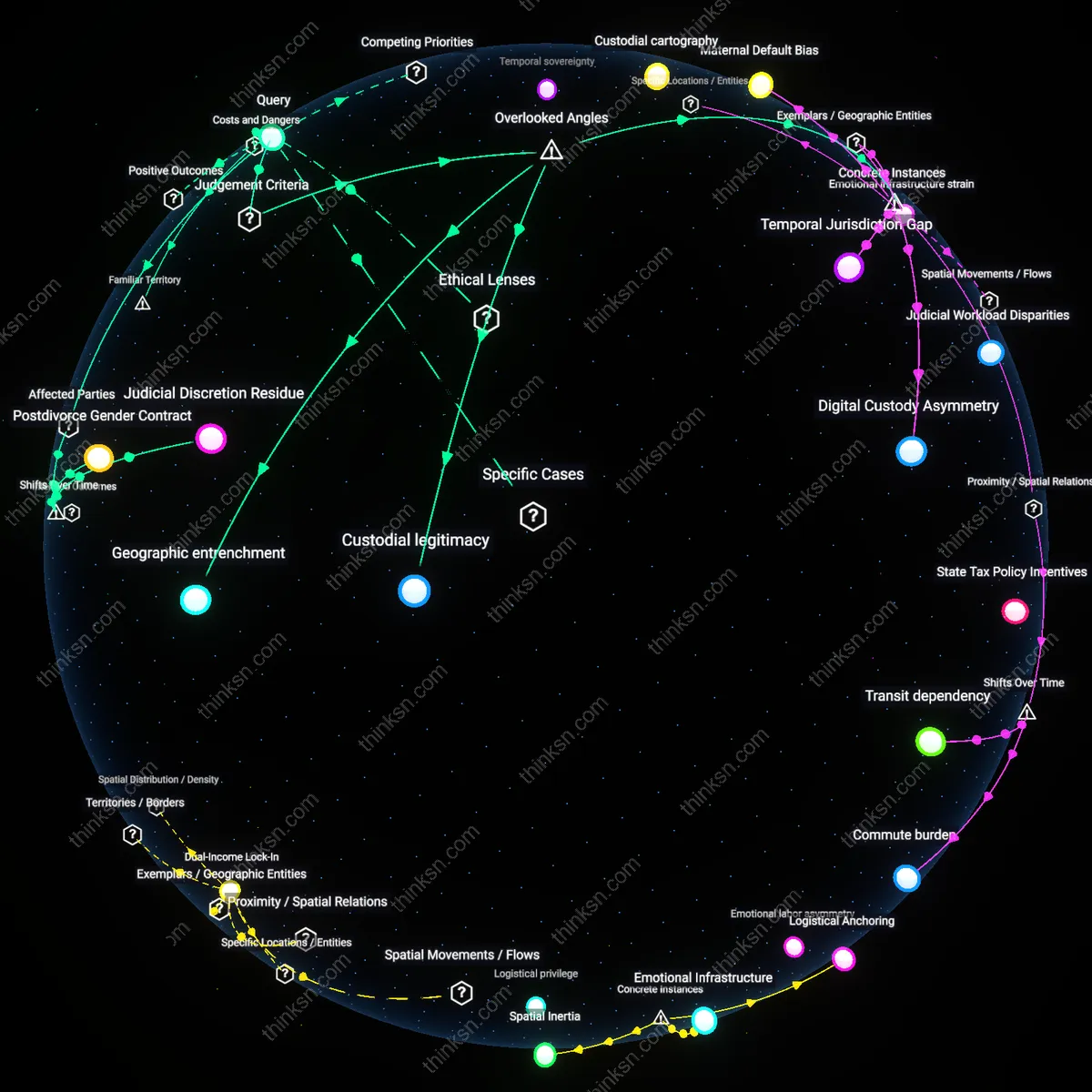
Postdivorce Gender Contract
A parent seeks sole physical custody to preserve asymmetric caretaking norms that emerged after the 1970s, when no-fault divorce expanded legal access but failed to redistribute domestic labor, leaving mothers as default caregivers despite evolving ideals of involved fatherhood. This arrangement persists not because father-child contact is unvalued, but because institutions—from family courts to school systems—routinely offload logistical and emotional coordination onto female parents, reinforcing a postdivorce gender contract where custody equals responsibility rather than relationship. The non-obvious consequence is that equal time schedules, though beneficial for children, destabilize this entrenched distribution of domestic accountability, making sole custody a defensive alignment with a historically sedimented division of labor.
Suburban Custody Penalty
Sole physical custody is increasingly chosen by parents in post-1990 metropolitan regions where job decentralization and segregated residential development have stretched commute times, making shared custody logistically punitive for lower-earning parents—often fathers—working in fixed-location, hourly-wage jobs. As employment geographies shifted away from centralized urban cores, the cost of cross-suburban travel became structurally prohibitive, not merely incidental, especially when school districts and childcare providers are tied to residential address; this entrenches residence-based custody as a pragmatic default. The underappreciated dynamic is that travel burdens are not neutral but are produced by regional planning decisions over decades, transforming what appears as a personal custody choice into a spatial compromise shaped by metropolitan fragmentation.
Judicial Discretion Residue
Parents pursue sole physical custody because the 1980s shift from paternal preference to 'best interests' standards in family law introduced subjective judicial discretion that, over time, fossilized into procedural habits favoring stability rhetoric and centralized residence, even as psychological research began advocating for dual-household continuity. Courts, lacking standardized metrics for measuring child well-being across homes, default to minimizing logistical complexity—a bias amplified by underfunded family service agencies unable to mediate shared arrangements. The overlooked result is that what appears as parental preference often reflects accumulated inertia in legal-administrative routines, where the residual authority of judges to define 'stability' quietly overrides emerging developmental consensus on bilateral attachment.
Custodial legitimacy
A parent may pursue sole physical custody to secure institutional recognition as the primary caregiver, which consolidates access to school, medical, and state-administered benefits that operate on a single-address assumption. Systems like pediatric healthcare and public education are structured around a normative custodial anchor—typically the mother—and navigating them with equal time arrangements demands continuous documentation, justifications, and administrative labor that can be prohibitively taxing, especially in under-resourced communities. This reveals that custody decisions are not only about emotional or logistical proximity but about securing legitimacy within bureaucratic infrastructures, a factor rarely weighed in public discourse on child welfare.
Emotional infrastructure strain
Sole physical custody can be chosen to preserve the parent’s own emotional infrastructure, especially when the other parent exhibits inconsistent reciprocity in caregiving despite equal capacity, creating asymmetrical emotional depletion that erodes resilience over time. Unlike financial or logistical strains, the cumulative toll of managing a child’s transitions between homes—attunement recalibration, behavioral resets, communication loops—is a hidden labor often absorbed entirely by one parent, typically the mother, and seldom accounted for in custody evaluations focused on fairness or time equity. This reframes custody as a question of affective sustainability, not just time division.
Geographic entrenchment
A parent may resist equal physical custody to maintain geographic entrenchment in a community that offers critical informal support networks—such as extended family, culturally specific institutions, or neighborhood-based safety—knowing that enforced travel would dilute access to these non-replaceable resources. Unlike financial costs, which are quantifiable, the loss of embedded social capital due to custody-mandated mobility is often invisible in legal assessments, yet it directly affects child stability, especially in marginalized families where formal services are inadequate substitutes. This shifts the focus from transport cost alone to the devaluation of place-based resilience in custody logic.
Custody Weaponization
A parent may withhold equal time to extract behavioral concessions from the other parent, leveraging the child’s routine as coercive currency. This strategy operates through family court’s enforcement gaps, where judges seldom penalize custodial interference unless egregious, enabling covert manipulation of contact schedules. The non-obvious risk is not overt malice but normalized passive-aggression—missed handoffs justified by trivial excuses—that erodes the child’s stability while preserving plausible deniability. What most people recognize as ‘difficult exes’ often masks a transactional use of proximity, where access becomes barter, not care.