Is Social Engagement Worth the Cost for Struggling Families?
Analysis reveals 5 key thematic connections.
Key Findings
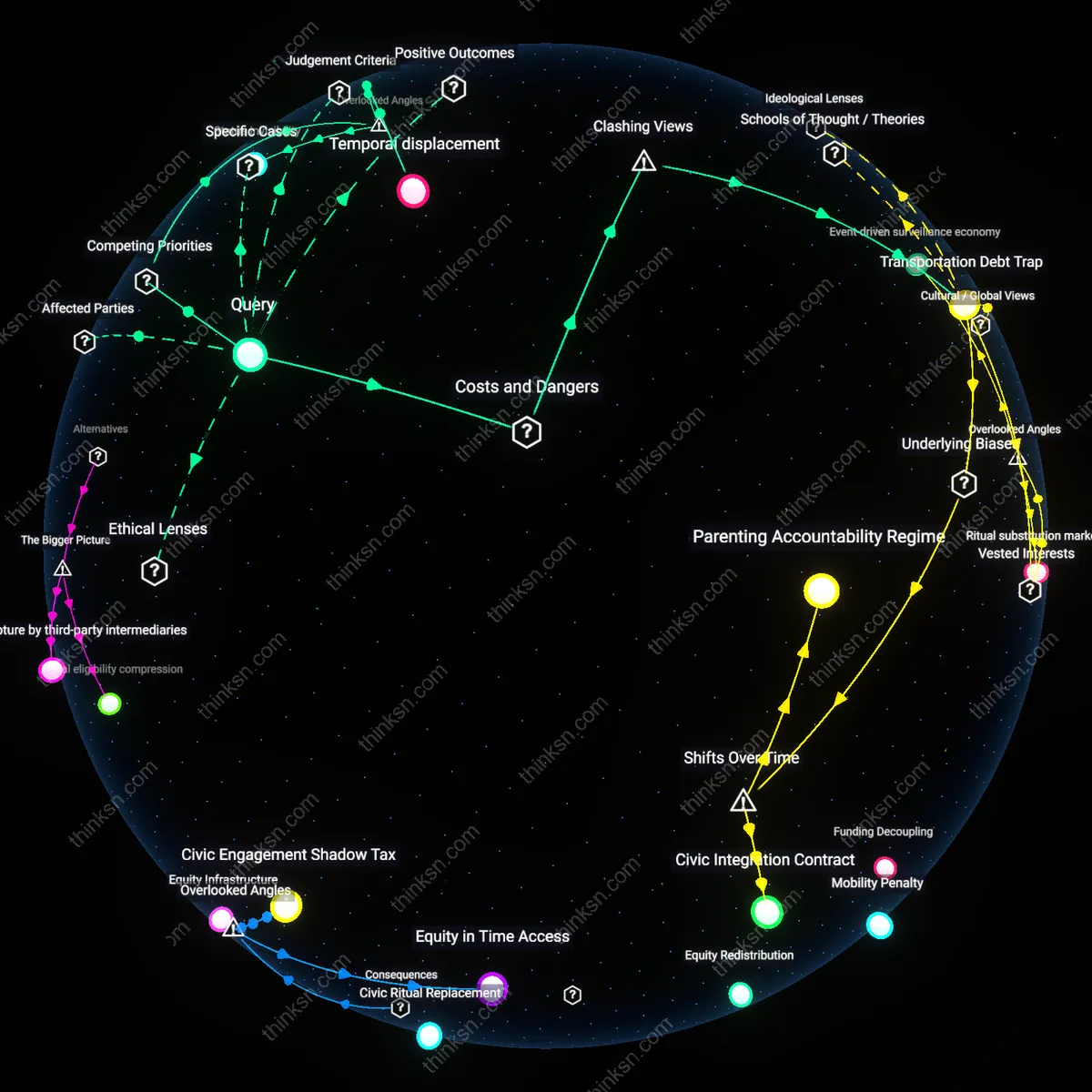
Transportation Debt Trap
Prioritizing a parent's social engagement by mandating transportation expenditure entrenches a cycle of deferred financial crises in low-income families. Publicly subsidized programs that encourage participation in community activities rarely cover transport costs, shifting the burden onto households who then resort to high-interest loans or erratic ride-share use, a survival mechanism that systematically deepens economic precarity—especially in urban peripheries like South Los Angeles, where transit deserts and predatory car-title lenders coexist. This reveals that the assumed social benefit of engagement functions, in practice, as a concealed tax on mobility, exploiting the necessity of participation to justify avoidable fiscal harm.
Engagement Penalty
Low-income parents who participate in socially valued activities—such as school meetings or job-training networks—often face direct financial penalties because their transportation spending pushes them over income thresholds for benefits like SNAP or housing assistance, a phenomenon documented in welfare audits in cities like Detroit. The system treats transportation as a discretionary cost rather than a foundational barrier, so any spending on it reduces effective eligibility, meaning socially compliant behavior triggers benefit cliffs. This demonstrates that the penalty for engagement is structurally coded into welfare design, turning social inclusion into a financially punitive act.
Temporal displacement
Prioritize shared transportation windows during non-peak social hours to reduce costs without sacrificing engagement. Low-income families often time social activities to align with rigid service schedules, inadvertently increasing transportation expenses through peak-demand surges; shifting engagement to off-peak times leverages underused transit capacity, cutting fares and wait times. This reframes social participation not as a static cost but as a time-variable exchange, exposing how temporal misalignment—not mere income—amplifies financial strain, an insight obscured in needs-based budgeting models that treat time as neutral.
Spatial choreography
Design reciprocal caregiving routes where parents collectively transport children to overlapping social sites, turning individual burdens into shared spatial infrastructure. In high-density neighborhoods like South Bronx public housing complexes, parents already informally cluster drop-offs, but without coordination tools, redundant trips persist; institutionalizing these patterns through community-led route mapping embeds social connectivity within mobility logistics. This reveals that transportation cost is less a financial metric than a negotiation of spatial trust—where unacknowledged proximity economies are lost when systems ignore micro-geographies of care.
Status invisibility
Link social engagement funding to anonymized utility records rather than self-reported need to reduce stigma-driven underuse of subsidized transit. In cities like Detroit, parents avoid discounted programs fearing surveillance or judgment, causing underutilization even when funds exist; using passive data signals (e.g., water and electricity usage patterns correlated with household density) enables automatic eligibility without disclosure. This shifts the conflict from resource allocation to information asymmetry, exposing how the visibility of poverty—not poverty itself—blocks access, a hidden barrier that fiscal models routinely ignore.