Does Automated Expense Reporting Overshare Your Finances?
Analysis reveals 8 key thematic connections.
Key Findings
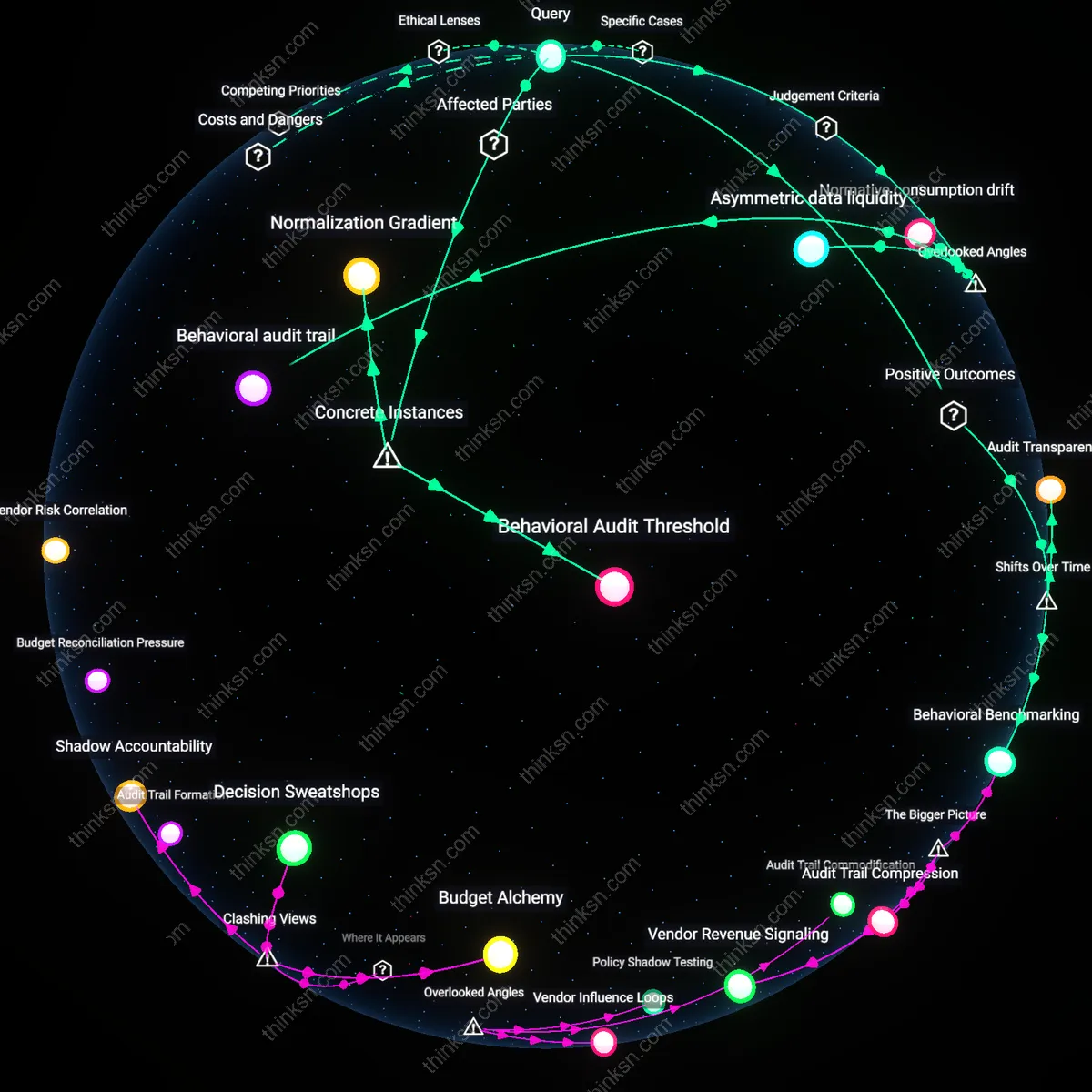
Behavioral Audit Threshold
The rollout of SAP Concur’s automated expense tracking at Unilever in 2018 created a de facto limit on employee spending autonomy, where granular data capture enabled management to flag not just policy violations but also deviations from spending norms—such as repeated use of premium transport or non-optimal meal choices—thereby recalibrating what constituted ‘acceptable’ personal discretion in work-related expenditure; this shift operated through centralized behavioral analytics dashboards accessible to HR and finance leads, revealing that surveillance precision can redefine compliance not as rule-breaking but as statistical outlier status, a non-obvious transformation where financial privacy loss becomes instrumental to cultural control rather than mere fraud prevention.
Institutional Data Asymmetry
When the UK government mandated the adoption of digital expense systems like Unit4 in public health trusts during the 2015-2017 austerity period, finance departments gained real-time visibility into clinician travel and supply claims, while staff remained blind to how their aggregated data informed top-down restructuring decisions—such as department closures or staffing reductions—demonstrating that automated systems function as one-way mirrors where data flows upward to managerial actors who retain interpretive authority, exposing how convenience serves as a legitimizing veneer for entrenched informational hierarchies that predate the technology itself.
Normalization Gradient
The integration of Expensify into gig contractor workflows on platforms like Upwork has incrementally eroded resistance to financial monitoring by bundling receipt scanning with fast payout processing, conditioning users—particularly in emerging economies like the Philippines and Nigeria—to accept persistent transaction logging as the cost of timely income, illustrating how voluntary adoption of convenience-driven tools cultivates acquiescence not through overt coercion but through a slow recalibration of privacy expectations, a dynamic where the immediacy of economic benefit masks long-term exposure to employer-adjacent data intermediaries.
Behavioral audit trail
The convenience of automated expense reporting does not justify the power imbalance because it creates a behavioral audit trail that extends beyond reimbursement into lifestyle pattern prediction, where employers gain inferential access to employees’ non-work activities—such as family care costs, religious donations, or political affiliations—through transaction metadata; this latent surveillance function operates through fintech APIs that retain granular geotagged, timed, and categorized spending data across personal accounts, which are repurposed under broad employee consent agreements; what is overlooked is that the system isn’t merely administrative but generative of new employer knowledge domains, transforming episodic expense claims into continuous financial behavior modeling.
Asymmetric data liquidity
The imbalance of power is unjustified because automated systems create asymmetric data liquidity—employers can instantly extract, analyze, and act on employees’ spending data, while employees have no reciprocal access to managerial financial behaviors or organizational spending ethics; this asymmetry functions through closed proprietary platforms like SAP Concur or Expensify, where data flows are one-directional and governed by corporate IT policies disguised as compliance; the overlooked dynamic is that liquidity, not just access, determines power, rendering employee financial opacity a structural liability rather than a privacy safeguard.
Normative consumption drift
Automated expense systems subtly reshape what counts as 'reasonable' spending by algorithmically flagging or approving items based on historical corporate averages, thereby inducing normative consumption drift where employees unconsciously align personal spending habits with corporate behavioral templates to avoid friction; this occurs through machine learning models that rank transactions by deviation from peer-group norms, effectively socializing employees into financially legible identities; the underappreciated outcome is that the system doesn’t just monitor but normatively produces financial subjectivity, making compliance feel like autonomy.
Audit Transparency
Employers adopting automated expense reporting after the 2008 financial crisis internalized standardized audit trails, shifting from discretionary reimbursement to systematic financial oversight, which reduced fraud and increased compliance efficiency. This transition, driven by regulatory pressure post-Dodd-Frank, embedded real-time financial visibility not as managerial surveillance but as institutional accountability infrastructure. The non-obvious outcome is that employees gained predictable, rule-based reimbursement—transforming power asymmetry into procedural fairness grounded in shared access to transaction data.
Behavioral Benchmarking
The integration of machine learning into corporate finance platforms since the mid-2010s converted individual expense data into aggregate spending models, enabling employers to detect anomalies and optimize travel policies. This shift from reactive accounting to predictive financial governance repurposed personal data into organizational intelligence, where employee behavior informs systemic efficiency rather than individual evaluation. The underappreciated dynamic is that granular access becomes less about monitoring people and more about calibrating corporate norms, redistributing influence through data-driven policy design.