Virtual Watercoolers: Preserving Culture or Failing in Remote Work?
Analysis reveals 4 key thematic connections.
Key Findings
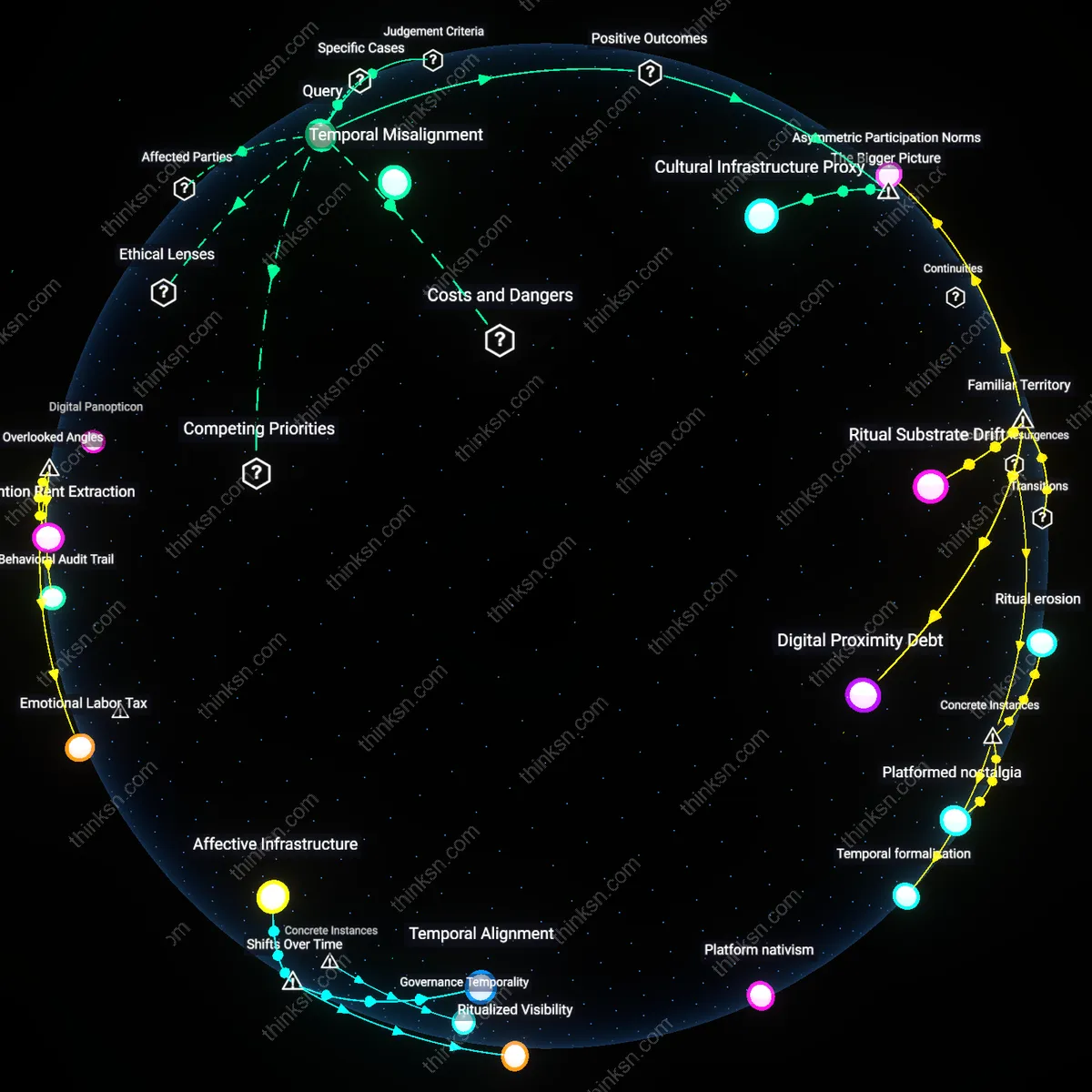
Temporal Misalignment
Virtual watercooler initiatives fail because they impose asynchronous participation on fundamentally synchronous cultural rituals, disrupting the real-time reciprocity required for micro-cohesion. These programs often deploy chat channels or delayed video clips meant to simulate spontaneous interaction, yet they bypass the biologically rooted expectation of immediate response that undergirds trust-building in face-to-face exchanges; this temporal disjunction is invisible in standard assessments of engagement but erodes the very spontaneity they seek to emulate. The overlooked dynamic is that organizational culture often coalesces not through content exchanged but through precisely timed behavioral mirroring—micro-nods, laughter cadence, turn-taking—which virtual formats cannot sustain without lag or scripting, thereby undermining perceived authenticity. This reveals a judgment based on psychological fidelity rather than communication efficiency.
Affective Debt
Organizations implement virtual watercoolers to discharge unacknowledged affective debt—the accumulated expectation of emotional labor owed to employees during dislocation—but do so in ways that inflate rather than repay the deficit. Remote work intensifies feelings of isolation and eroded belonging, prompting leaders to deploy token interactions like ‘fun Fridays’ or emoji-based check-ins as symbolic repayment, yet these micro-events demand emotional participation without granting corresponding autonomy or recognition, deepening exhaustion. The hidden mechanism is that such initiatives function less as culture preservation and more as extraction rituals, where employers expect gratitude for minimal affective offerings while avoiding structural changes like reduced hours or decision-sharing. This reframes cultural preservation as an accounting practice judged by reciprocity, not engagement metrics.
Cultural Infrastructure Proxy
Virtual watercooler initiatives preserve organizational culture by serving as a stand-in for the informal, spontaneous interactions that traditionally form collective identity in physical workplaces. When companies shift to remote work, the loss of hallway conversations and kitchen chats threatens the transmission of implicit norms and shared understanding—elements crucial to cultural cohesion. By deliberately engineering moments of unstructured digital interaction, organizations sustain micro-level relational patterns that reinforce belonging, often through platforms like Slack or Microsoft Teams where visibility and participation mimic proximity. This reveals a systemic adaptation in which cultural continuity is maintained not through top-down mandates but through distributed, low-stakes social rituals enabled by digital architecture and asynchronous affordances.
Symbolic Continuity Signal
Virtual watercooler initiatives function primarily as symbolic acts that reassure employees and leadership that organizational culture remains intact despite spatial dispersion, thereby stabilizing perception during periods of structural upheaval. In large enterprises undergoing digital transformation or post-pandemic restructuring, these rituals serve less as effective social catalysts and more as visible indicators of cultural stewardship, consumed by stakeholders as proof of managerial responsiveness. The persistence of such programs reflects a systemic need among corporate leaders to demonstrate control over intangible assets like morale and identity, especially when traditional levers of influence—like office design or in-person supervision—are nullified by remote work. This reveals that their value lies not in replicating serendipity but in fulfilling an institutional demand for observable continuity in times of change.