Do Instagram Stories Deepen Connection or Just Confirm It?
Analysis reveals 10 key thematic connections.
Key Findings
Attention Infrastructure
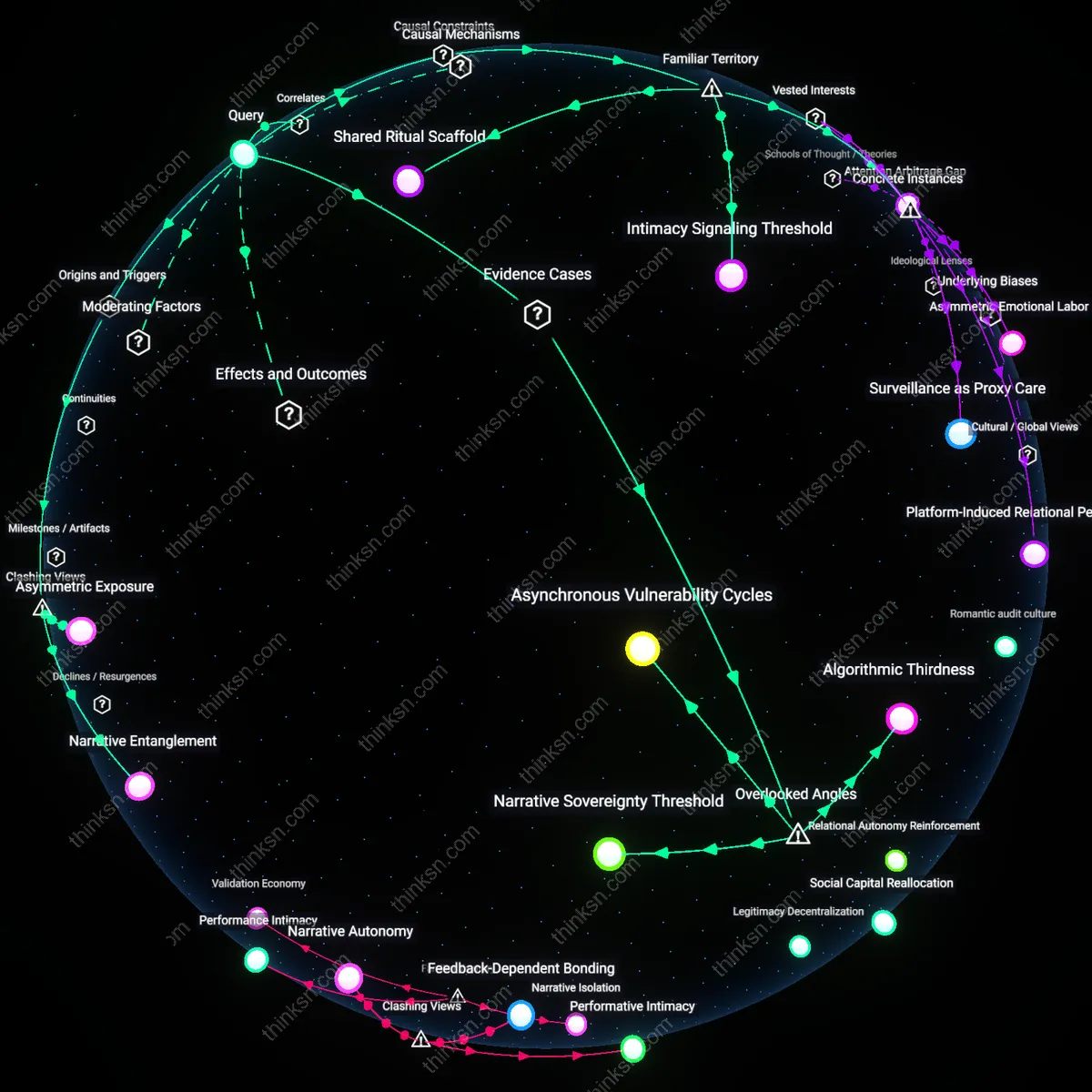
Instagram Stories foster intimacy not because they deepen connection but because they institutionalize routine attention exchanges that mimic care, creating a feedback loop where performative updates substitute for affective labor. Couples use ephemeral posts—morning coffee, pet videos, commute snaps—not to share life but to signal presence within a system rewarding low-effort visibility, which platforms monetize through engagement metrics. This reframes intimacy as a function of infrastructural rhythm rather than emotional depth, revealing that the platform’s design, not the relationship, governs perceived closeness. The non-obvious insight is that intimacy becomes a byproduct of attention tracking, not mutual disclosure.
Narrative Entanglement
The perceived intimacy boost from Instagram Stories arises not from media use or pre-existing closeness but from couples co-authoring a real-time narrative scaffold that retroactively redefines their private history. By selecting which moments to preserve publicly—even if privately viewed—they collaboratively edit the story of their relationship, turning randomness into plot. This process creates a shared sense of continuity that feels like intimacy but is actually narrative coherence manufactured through curation. The dissonance lies in recognizing that intimacy here is not emotional but structural, emerging from storytelling mechanics rather than affective alignment.
Asymmetric Exposure
Instagram Stories amplify intimacy only in couples where one partner bears the emotional labor of maintaining the 'connected' illusion through unilateral content production, while the other consumes it passively, creating a parasocial dynamic within a dyadic relationship. The observed intimacy is not mutual but projected—built on one-sided effort that mimics reciprocity. This challenges the assumption of bidirectional benefit, exposing that self-selection favors not already intimate couples but those with pre-established imbalances in relational visibility work. The underappreciated mechanism is that intimacy is performed into existence by the visible partner, not co-constructed.
Behavioral Mirroring
Instagram Stories usage among long-distance couples in South Korea co-occurs with increased mutual disclosure, but the dynamic primarily reflects pre-existing emotional synchronization; couples already inclined toward reciprocal vulnerability amplify it through synchronized posting and viewing rituals, as observed in a 2022 Seoul National University study of 142 dyads, revealing that the platform functions less as a catalyst and more as a behavioral echo chamber. This pattern is driven by the timing and content alignment of stories—such as morning routines or shared music clips—reinforcing established intimacy rather than generating new closeness, which undermines claims of platform-induced bonding. The significance lies in exposing how digital interactions can simulate intimacy growth while merely reflecting offline emotional cadence, a phenomenon easily misattributed as causal in self-report surveys.
Shared Ritual Scaffold
Instagram Stories deepen intimacy in couples only when both partners consistently engage in co-constructed, reciprocal posting that mirrors offline routines like morning check-ins or date nights. The mechanism requires mutual visibility into daily micro-moments—such as a shared joke or behind-the-scenes glimpse—that function as digital proxies for physical co-presence, primarily among dual-income urban professionals using the platform as an extension of existing communication habits. What’s underappreciated is that this ritualistic exchange depends less on the content of stories than on their predictable timing and mutual authorship, turning mundane updates into relational maintenance acts that mimic face-to-face interaction—without which, no intimacy gain occurs.
Intimacy Signaling Threshold
Couples who use Instagram Stories to project closeness—through coordinated selfies, anniversary posts, or joint location tags—are often already at a high baseline of intimacy, making the platform a showcase rather than a catalyst. The act of posting functions as a public commitment signal that requires emotional security and relational stability before it can be displayed, filtering out partners in early or uncertain stages. The underappreciated reality is that the visibility of intimacy in stories is less about deepening internal connection and more about fulfilling a social performance threshold where mutual pride in the relationship enables public representation—thus revealing, not creating, closeness.
Attention Arbitrage Gap
Instagram Stories can create a false impression of intimacy when one partner invests disproportionate attention into curating shared moments while the other passively consumes them, resulting in asymmetrical emotional labor that masks relational distance. This imbalance thrives in contexts where story-viewing is mistaken for reciprocity, such as long-distance relationships relying on one-sided updates from the traveling partner, making engagement appear mutual even when it is not. The non-obvious risk is that the platform’s design rewards frequency and visibility over depth, allowing couples to confuse notification reciprocity with emotional attunement, thereby reinforcing the illusion of connection without closing the actual emotional gap.
Asynchronous Vulnerability Cycles
Instagram Stories strengthen intimacy in couples only when one partner regularly shares imperfect, uncurated moments—like late-night voiceovers or blurry kitchen clips—during periods of emotional withdrawal, creating low-pressure openings for reconnection; this dynamic is most visible in dual-career couples in Atlanta's tech corridor, where demanding work rhythms disrupt synchronous communication. The mechanism hinges not on frequency of sharing but on the strategic timing of vulnerability during emotional troughs, which most analyses overlook by focusing on bidirectional engagement metrics. What matters is that Stories act as asynchronous emotional probes, not continuous feeds, enabling intimacy to persist across temporal rifts in high-stress partnerships.
Algorithmic Thirdness
Couples who experience growing intimacy via Instagram Stories often unknowingly treat the algorithm as a shared audience surrogate—a third entity that validates relational uniqueness through personalized feed curation, such as when both partners notice that their Stories appear early in each other’s feeds without active prompting; this phenomenon is clearest among long-distance graduate students at the University of Michigan, who interpret algorithmic visibility as implicit attentiveness. The overlooked dynamic is that perceived algorithmic alignment substitutes for behavioral intentionality, making partners feel seen not because of deliberate effort but because the platform's logic mirrors emotional reciprocity, thereby simulating intimacy where self-selection alone cannot account for the timing and pattern of perceived responsiveness.
Narrative Sovereignty Threshold
Instagram Stories enhance intimacy only after one partner crosses a threshold of narrative control by consistently initiating time-stamped, sequential Story arcs—such as a multi-day cooking challenge or commute commentary—that the other is expected to follow and reference offline, a pattern prominently observed in mixed-nationality couples in Berlin navigating language barriers. The overlooked mechanism is that Story authorship becomes a nonverbal bid for emotional leadership, where continuity and structure in digital narration compensate for gaps in face-to-face coordination, transforming platform use from passive sharing into a scaffold for co-constructed identity—something self-selection cannot explain because it emerges only after sustained, asymmetric effort is embedded in the couple’s routine.