Does Instagram Curate Social Inadequacy or Expose Pre-existing Self-Doubt?
Analysis reveals 11 key thematic connections.
Key Findings
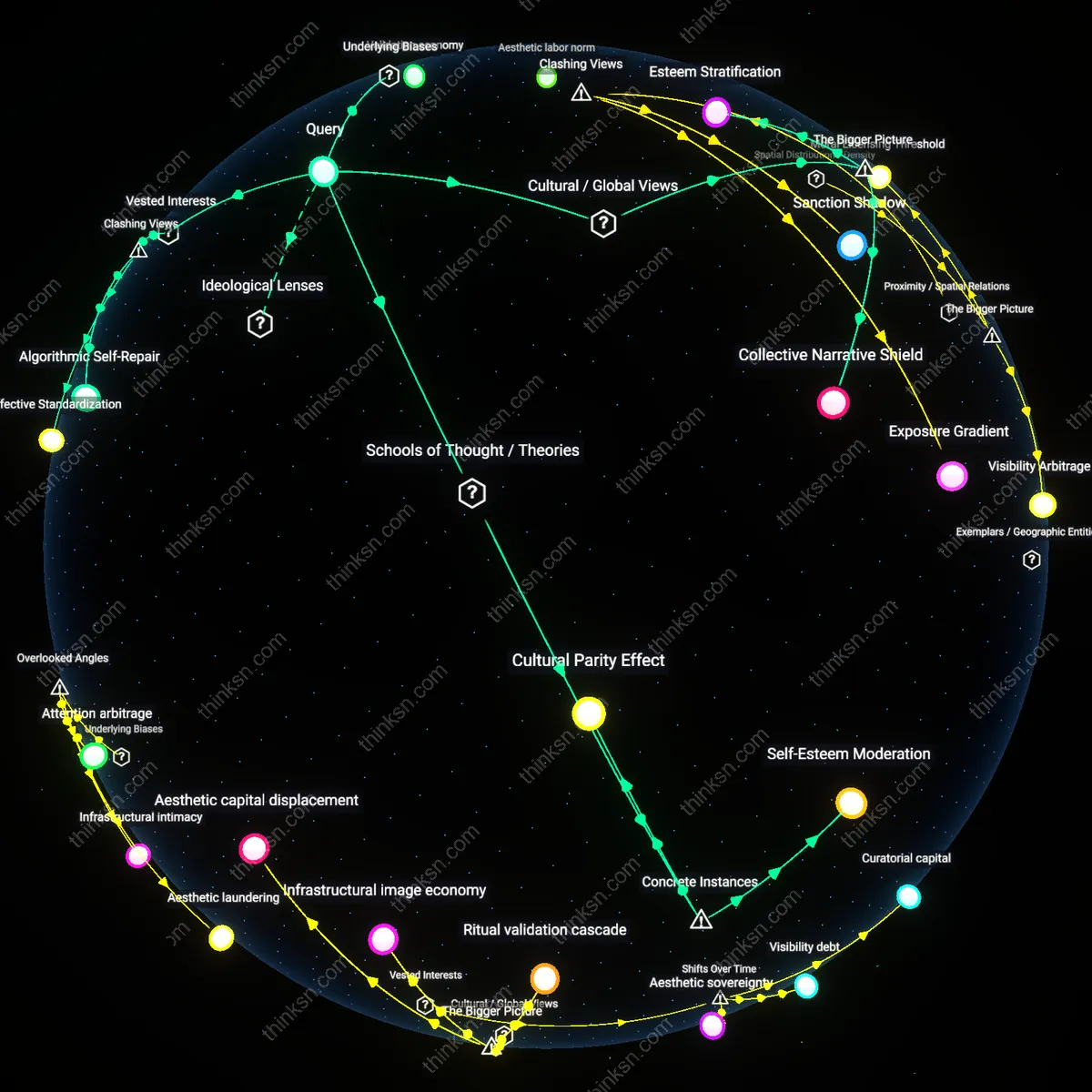
Self-Esteem Moderation
Individuals with lower baseline self-esteem exhibit significantly greater negative shifts in self-perception after prolonged exposure to curated Instagram content, as demonstrated by a 2017 longitudinal study at the University of Pennsylvania involving undergraduate participants who were assigned to either limit or continue unrestricted social media use; those with initially lower self-esteem scores reported disproportionate increases in social comparison and decreased mood, revealing that emotional impact is not universal but conditionally amplified by preexisting vulnerabilities in self-worth. This mechanism operates through upward comparison dynamics in visual-dominated platforms, where algorithmically promoted content emphasizes exceptional lifestyles, and its analytic significance lies in undermining claims of uniform psychological effects across users.
Cultural Parity Effect
In Tehran, where state-regulated social media norms suppress overt displays of Westernized beauty and lifestyle curation on Instagram, users across varying self-esteem levels report consistently lower emotional volatility from platform use compared to peers in the Global North, illustrating that sociocultural governance structures can neutralize the presumed link between self-esteem and emotional susceptibility; this occurs because institutional constraints reduce the symbolic power of curated content by deprioritizing individualism in favor of collective identity performance, a dynamic rarely acknowledged in Western-centric psychology models that assume universal affective responses to visual comparison. The non-obvious insight is that macro-level cultural regulation can override micro-level personality traits in shaping platform impact.
Feedback-Driven Identity Formation
Professional influencers on Instagram, such as fitness content creator Whitney Simmons, actively reframe curated self-presentation not as a threat to self-esteem but as a metricized identity engine, where emotional impact is recalibrated through audience validation; in this context, self-esteem is not a static moderator but an emergent property of engagement metrics, and the platform’s psychological effect operates inversely—higher feedback loops reinforce self-worth, decoupling emotional outcomes from initial self-assessment. This case reveals that among content producers, self-perception becomes co-constituted by audience response rather than preexisting self-esteem, a dynamic underappreciated in consumer-focused media studies.
Esteem Stratification
Social media's emotional impact on self-perception disproportionately affects low-self-esteem individuals in Western contexts due to institutionalized individualism, where personal identity is socially validated through public curation and quantified feedback loops on platforms like Instagram; this effect is amplified by algorithmic personalization that reinforces self-referential comparison in consumer-driven societies such as the U.S. and U.K., where self-worth is systemically linked to visibility and external affirmation; the non-obvious insight is that the platform does not uniformly distort self-perception but instead stratifies emotional outcomes along pre-existing psychological lines, making self-esteem a structural filter within digital self-representation economies.
Collective Narrative Shield
In many East Asian cultures such as Japan and South Korea, the emotional toll of curated Instagram content is mitigated by socially reinforced collectivist norms that prioritize group harmony over individual self-expression, thereby reducing the internalization of personal inadequacy when viewing idealized content; this buffer emerges from education systems, family structures, and media traditions that discourage overt self-promotion and instead normalize modest self-presentation, making social comparison less identity-threatening; the underappreciated mechanism is that cultural institutions function as psychological shock absorbers, preventing curated content from destabilizing self-perception in ways common in individualistic societies.
Sacred Performance Divide
In conservative Islamic societies such as Iran or Saudi Arabia, religious norms governing gendered visibility and moral authenticity restrict both the production and consumption of curated self-images, creating a systemic divide between secular global Instagram culture and locally endorsed self-representation, which insulates certain populations from internalizing Western aesthetic standards; this regulatory duality, enforced by religious authorities and familial oversight, transforms Instagram into a transgressively performative space rather than a normative one, so emotional impact is modulated not by self-esteem alone but by the degree of alignment between online identity and sacred behavioral codes; the overlooked consequence is that religious doctrine becomes an unintentional cognitive firewall against global social media psychodynamics.
Validation economy
Individuals with lower self-esteem are more likely to experience negative emotional impacts from curated Instagram content because they are more dependent on external validation, a mechanism amplified by Instagram’s engagement-driven algorithm that prioritizes hyper-curated, aspirational imagery. This dynamic benefits platform advertisers and influencers who profit from users’ persistent self-doubt and aspirational consumption, reinforcing a feedback loop where emotional vulnerability becomes a measurable commodity. The non-obvious insight is that the platform does not merely reflect self-esteem differences—it actively exploits them as a built-in mechanism for sustained attention and behavioral predictability.
Comparison scaffold
Viewing curated Instagram content universally triggers social comparison, but the emotional outcome depends on whether a user’s self-esteem buffers or amplifies the resulting cognitive dissonance, with the platform’s visual-first interface acting as a scaffold that systematizes and accelerates comparison through quantified metrics like likes and follower counts. This scaffold is not neutral—it mirrors and intensifies dominant cultural ideals around beauty, success, and lifestyle, which are already deeply embedded in users’ pre-existing cognitive frameworks. The underappreciated point is that even high self-esteem individuals are not immune, but their resilience is often misattributed to personal strength rather than exposure to fewer identity-threat scenarios shaped by race, gender, or class.
Aesthetic labor norm
The emotional impact of Instagram content is increasingly universal because self-presentation has become a form of required aesthetic labor, where maintaining a certain image is socially and professionally expected, regardless of baseline self-esteem—seen in industries like gig work, creative fields, and personal branding. This norm benefits tech companies and social influencers who frame authenticity as a stylized performance, normalizing the idea that self-worth is tied to visual consistency and online visibility. The overlooked reality is that the pressure to curate is no longer a choice but a structural demand, rendering self-esteem level a secondary variable to the broader expectation of performative self-commodification.
Algorithmic Self-Repair
Corporations like Meta strategically promote the idea that low self-esteem individuals are more vulnerable to Instagram's emotional impacts because it shifts liability onto personal psychology rather than platform design, enabling them to justify minimal content regulation by reframing harm as user pathology. This logic relies on psychometric profiling systems that categorize users by inferred mental resilience, allowing the company to claim personalization mitigates harm—despite evidence that engagement-optimized curation amplifies negative self-comparison universally. The non-obvious insight is not that corporations deflect blame, but that they actively reshape clinical concepts like self-esteem into operational tools for system justification, making mental health a metric of algorithmic efficiency rather than human well-being.
Affective Standardization
Governments deploying digital wellbeing campaigns, such as the UK's Online Safety Act initiatives, treat emotional impact as universally scalable to justify top-down content moderation policies, deliberately flattening differences in self-esteem to construct a uniform 'at-risk' citizen-subject amenable to state intervention. By normalizing emotional responses across psychological profiles, policymakers enable surveillance infrastructures that measure platform harm through behavioral aggregates rather than individual experience, privileging regulatory legibility over clinical nuance. The dissonance lies in claiming personalization in mental health while enforcing homogenized risk models—exposing how bureaucratic governance converts psychological variation into administrative convenience, making uniformity a prerequisite for governance itself.