Who Controls AI Patents and What It Means for Competition and Equity?
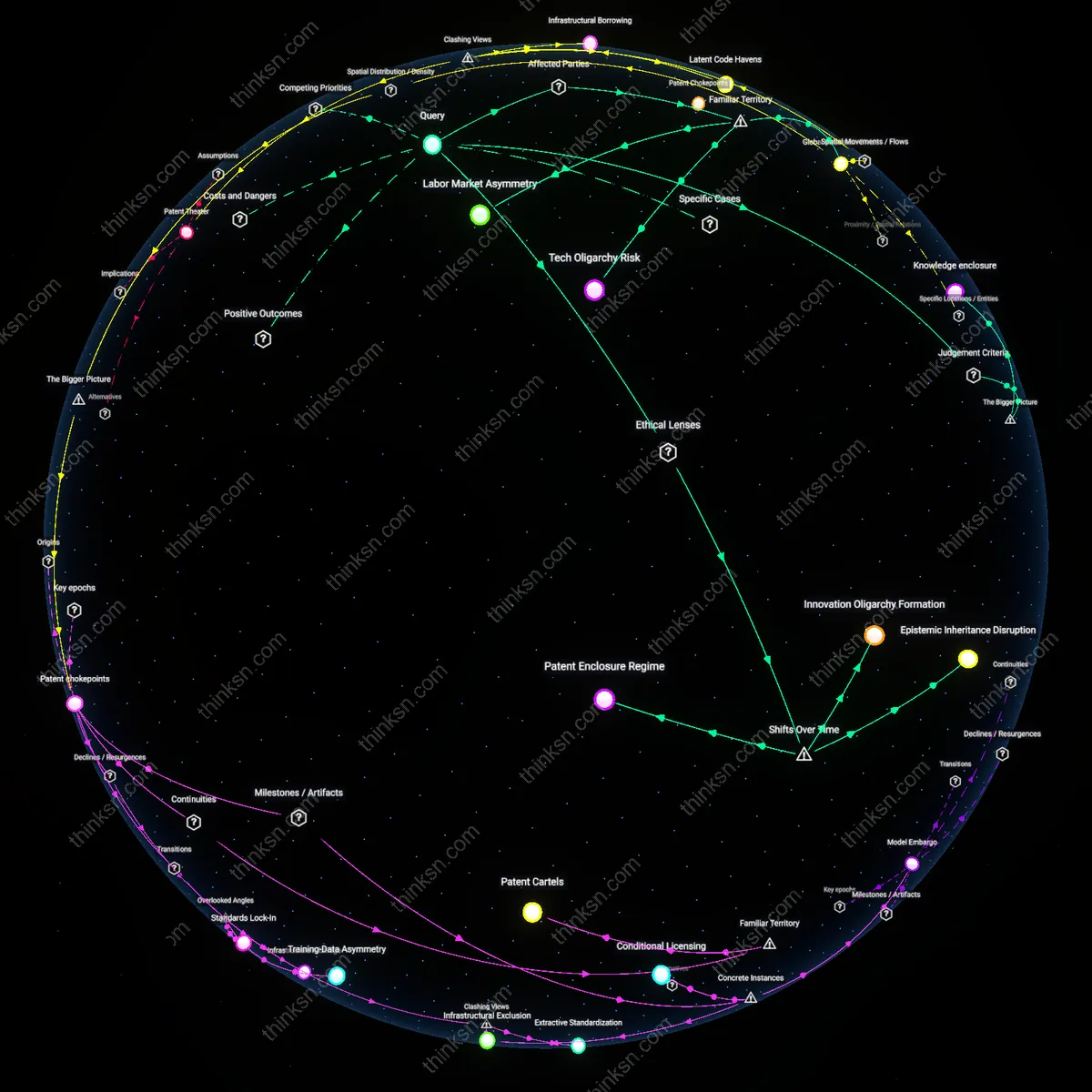
Analysis reveals 8 key thematic connections.
Key Findings
Tech Oligarchy Risk
Concentrated AI patent ownership enables a handful of dominant tech firms to control foundational AI capabilities, shutting out competitors and shaping market entry. Firms like Google, Microsoft, and Meta leverage patent portfolios to secure first-mover advantages, restrict open innovation, and influence standard-setting bodies—mechanisms that consolidate their influence over both product development and regulatory outcomes. The non-obvious element is that patents, typically seen as innovation incentives, function here as exclusionary weapons in a governance vacuum, transforming IP law into a tool for market preemption rather than diffusion.
Labor Market Asymmetry
Workers and mid-tier industries face diminished bargaining power as concentrated AI ownership enables capital owners to automate functions without shared gains. When a small set of patent-holding firms control AI tools that displace radiologists, coders, or customer service staff, the benefits of efficiency accrue narrowly while displacement costs spread widely. Most people associate AI with job loss, but the deeper issue is the structural misalignment—automation advances without institutional mechanisms to redistribute productivity gains, turning patent concentration into a silent driver of wage stagnation.
Global Innovation Divide
Developing nations and public research institutions are systematically excluded from AI advancement due to high patent barriers and licensing costs controlled by U.S. and Chinese tech conglomerates. Universities in regions like Sub-Saharan Africa or Southeast Asia cannot access core AI architectures, limiting local adaptation and reinforcing technological dependency. While the public often imagines AI as a universal tool, the reality is that patent concentration replicates historical patterns of colonial innovation flows—the center invents, the periphery consumes, and the gap institutionalizes.
Innovation mirroring
When a small set of firms holds most AI patents, public-sector and global South research labs abandon foundational research and instead redirect toward narrow, patent-avoidant applications—replicating core functions through structurally similar but legally distinct models. This mimicry occurs because the cost of patent clearance exceeds available R&D budgets, especially in universities and non-profit AI initiatives, forcing them into technically suboptimal but legally safer design paths. The underappreciated consequence is not inefficiency per se, but the systemic misdirection of global innovation energy—what should be a divergent exploration of AI architectures becomes a convergent race to re-engineer around U.S.-centric IP clusters. This dynamic is sustained by the global reach of U.S. patent enforcement via trade agreements, which pressures foreign institutions to self-censor research directions preemptively.
Knowledge enclosure
Concentrated AI patent ownership transforms open scientific advances into proprietary, black-box systems, cutting off feedback loops between academic discovery and public benefit. This enclosure accelerates because patenting increasingly covers not just novel code but abstract training methods and data preprocessing pipelines—once considered part of the scientific commons—now claimed as trade-secret-adjacent assets by firms like Google and Meta. The key systemic shift is that patent concentration no longer just limits market competition but severs the epistemic chain connecting basic research to equitable application, particularly in health, education, and climate modeling. This holds due to the erosion of patent novelty standards under current U.S.PTO interpretation, which allows incremental re-combinations of known methods to be appropriated as exclusive property, effectively privatizing the infrastructure of cognition.
Patent Enclosure Regime
Concentrated AI patent ownership replicates the enclosure of commons by transforming publicly funded knowledge into private monopolies, a shift that crystallized after the 1980 Bayh-Dole Act enabled universities and firms to privatize federally supported research. This mechanism operates through legal assignment of intellectual property rights to corporate assignees, even when foundational AI breakthroughs emerged from open academic collaboration and public investment—such as backpropagation algorithms developed in publicly funded labs. The non-obvious insight is that today’s AI patent concentration is not a byproduct of innovation intensity but a structural outcome of a historical pivot that redefined knowledge as excludable property, thereby restricting access to the very inputs needed to compete in AI development.
Innovation Oligarchy Formation
The centralization of AI patents among a few tech giants has reconfigured the competitive landscape from a Schumpeterian model of disruptive innovation to a neomercantilist system where market dominance is secured through IP stockpiling rather than superior product iteration. This transition accelerated in the 2010s as companies like IBM, Google, and Microsoft weaponized patent portfolios to deter startups and shape regulatory standards, transforming patents from innovation signals into barriers to market entry. The underappreciated dynamic is that competition policy, still anchored in price-based antitrust frameworks inherited from the Chicago School, fails to address how control over AI’s technical infrastructure redistributes innovative capacity—a shift that reveals competition itself has become asymmetric and path-dependent.
Epistemic Inheritance Disruption
Historically, scientific progress adhered to Mertonian norms of communalism and universalism, where knowledge accumulation was incremental and shared—yet concentrated AI patent ownership ruptures this trajectory by legally severing subsequent innovators from prior intellectual lineages. Since the mid-2010s, patent thickets in deep learning have blocked derivative research unless licensed, particularly affecting Global South institutions and independent researchers who lack access to legal or financial resources. The critical but overlooked consequence is that this shift subverts the ethical principle of epistemic justice by converting open scientific evolution into a proprietary inheritance system, where the right to build upon past knowledge is contingent on ownership, not merit or need.