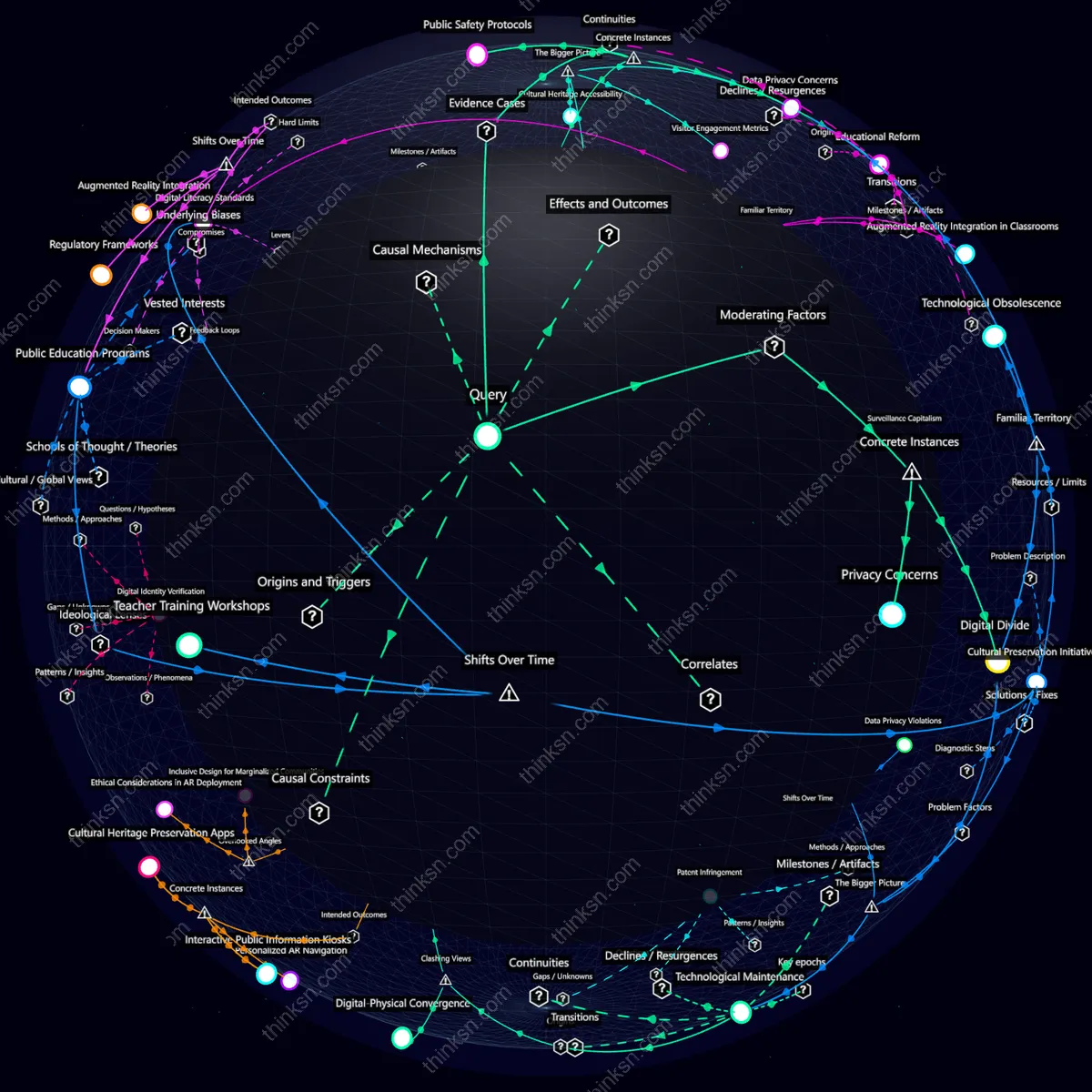
Public Institutions and the Augmented Reality Revolution
Key Findings
Digital Identity In AR
National digital identity systems will not dominate AR because private, interoperable networks now allow authentication outside state control.
Public institutions usually update systems by adding new layers instead of replacing old ones. This pattern shows in how governments adopted digital services. They built new tools on top of existing bureaucracy. Some expect national ID systems to control identity in augmented reality. That idea assumes strong, centralized control like in the early internet era. But new technology is changing the situation. Edge computing and cheap AR platforms let users create content easily. This shift is like the rise of user-generated content after broadband spread. National ID programs still see low use where informal methods dominate. Many people rely on local or private ways to verify identity. State-run digital IDs need exclusive control to grow. But private AR networks now authenticate users without government systems. These systems work on their own. So the old model of top-down identity does not fit the new reality.
AR Digital Maps
Public AR maps will be governed by federal agencies because they depend on federally controlled location data standards.
Digital maps are now treated as public infrastructure. This change is clear in how the US government includes GPS data in its official spatial system. Augmented reality relies on exact alignment with real-world locations. These locations are defined by federal coordinate systems. Because AR needs precise, up-to-date positioning, it must follow the same standards as official digital maps. These standards were set in the 1990s when mapmaking moved from paper to digital. That shift gave federal agencies strong control over map accuracy and access. Future management of AR layers will follow this model. Federal geospatial agencies will therefore take charge of AR data.
Digital ID In AR
Augmented reality will be integrated into centralized digital ID systems because governments prioritize fraud prevention and surveillance, not user-controlled identity.
As augmented reality blurs the line between physical and digital spaces, public institutions will push to standardize digital identity verification. This mirrors actions taken in the 1990s to govern the internet through rules like the OECD privacy guidelines and the U.S. E-Government Act of 2002. Rather than allow augmented spaces to remain unregulated, authorities will apply existing systems for identification and access control. They will do this to prevent fraud and keep surveillance capabilities. We see this pattern in the spread of national digital ID systems like India’s Aadhaar and Estonia’s e-Residency. A decentralized alternative exists, where individuals control their digital identity using cryptographic keys outside state oversight. But this model has little support among powerful governments. Instead, the most likely outcome is that augmented reality will be brought under centralized digital identity systems. These systems will strengthen the control of states and international bodies over personal data.
Digital Truth Decay
When digital layers alter or hide physical facts, official truth breaks down, so trusted records must anchor data to prevent deception.
Public institutions rely on stable and trusted records. Augmented reality blends digital content with the physical world. This mix can let digital edits hide or change real landmarks. When that happens, it becomes hard to know what is true. Officials lose power to confirm facts. A similar problem happened in 2010 during the Flash Crash. Algorithms moved financial data so fast across separate digital systems that markets fell before humans could act. The real danger is not just speed but fragmented records. The fix is to link digital data firmly to official sources. Estonia’s e-government shows one solution. It uses secure digital ledgers to prove what is authentic. These systems mark changes so they cannot be hidden. Without such fixes, false or altered content can spread. This weakens trust in public knowledge. Strong, single records must be restored to keep institutions reliable.
Deeper Analysis
What happens to state-backed digital identity systems when private AR platforms enable users to verify presence and permissions without relying on government-issued credentials?
Digital ID Systems
State digital ID systems remain dominant because only states can link identity to legal responsibility and enforce accountability at scale.
State digital ID systems will keep being the main way legal identity is recognized. This is not due to habit or rules that lock out alternatives. It is because only states can enforce legal responsibilities across borders. Private augmented reality platforms can verify presence in real time. But they cannot assign legal blame or fix harm after the fact. States manage civil registries, taxes, and international identity agreements. They alone can link identity to legal consequences like fines or rights. Private systems lack this power, even when technically advanced. The European Commission has shown this gap in virtual environments. The eIDAS rules also confirm that private digital proofs are not enough. As a result, state IDs will still be required for serious legal and financial acts. So, no matter how popular AR identity tools become, they cannot replace state systems.
Digital Identity In Augmented Reality
State digital IDs lose function in AR settings because private networks make continuous identity verification independent of government systems.
State digital ID systems lose control not when banned but when replaced. This happens as augmented reality verifies identity through private networks. These networks confirm who you are using real-time presence and behavior. They use distributed methods that do not need government approval. As more people use AR platforms daily the systems grow stronger. Switching back to state control becomes too costly and hard to enforce. State-backed IDs remain legal but fall out of daily use. Their role shrinks even if they stay on the books. This shift is not due to better technology but to how systems become locked in. Once private networks become routine they are nearly impossible to reverse. This mirrors how email replaced postal mail without abolishing post offices. Similar shifts occurred in digital payments with stablecoins bypassing banks.
What happens if local governments refuse to recognize federal authority over AR spatial data, asserting municipal control instead?
State Control Of Digital ID
Decentralized identity systems will not dominate because states use their legal authority to link identity to public services and enforce recognition through existing registries.
States maintain control over digital identity through existing legal and administrative systems. They link identity to essential services like healthcare, taxes, and security. This link is clear in national programs such as India's Aadhaar and the EU's eIDAS. These systems require state certification for digital identity to be valid. Digital identity in augmented reality will also need legal recognition. Access to public spaces, legal responsibility, and policing will depend on it. Authorities will demand trusted identity verification. This verification will rely on state-run registries, not decentralized alternatives. Decentralized systems will not succeed without major changes to state institutions. The reason is simple: states hold exclusive power to recognize who counts as a person under their law.
City Control Limits
Cities cannot drive decentralized identity because federal laws and technical systems limit their legal power to act independently.
The idea that cities can lead the push for decentralized digital identity fails in practice. This is because local governments operate within strict legal layers. These layers limit their power over data. Even when cities manage digital systems, federal laws often override local control. In countries like the United States, federal authority is supreme in data matters. This comes from the Constitution and court rulings. Agencies like NIST and DHS set national rules. These rules cover areas such as voting, identity, and public safety. Cities may protest federal control. But they cannot build fully independent data systems. Their legal and technical powers are too weak. National systems require interoperability. This means local data systems must follow federal standards. As a result, cities cannot enforce lasting digital boundaries.
Under what conditions would decentralized cryptographic identity systems gain sufficient political traction to disrupt the centralizing trajectory described in the finding?
Digital Identity Crisis
Decentralized identity gains political traction when centralized systems fail, forcing states to adopt secure alternatives to protect critical functions.
Decentralized identity systems could gain political support when a major government loses control over digital identity and communication networks. This loss creates a urgent need to avoid systems that foreign powers or domestic opponents can undermine. The U.S. response to election interference in 2016 showed how weak state-run identity systems can be. Agencies then began assessing how well identity systems hold up against widespread threats. When centralized systems become security risks instead of tools of control, national security priorities shift. This shift opens the door for cryptographic identity solutions once seen as hostile to state authority. If these solutions fit within existing legal standards, their adoption becomes more likely. Decentralized identity can thus become a realistic option when centralized systems fail to protect key national functions.
Digital Identity Shift
Decentralized identity systems will only become widespread if people stop trusting state-run ID systems due to major government failures.
Decentralized digital identity systems rely on a loss of trust in government-issued IDs. This kind of distrust happens only after major government failures. Examples include the fall of the Soviet Union and the Eurozone crisis. In stable countries, governments control identity systems. They link ID to services, laws, and citizenship rights. These systems have existed since the 1800s. Modern efforts like the World Bank’s ID4D reinforce them. New technologies increase the need for instant, verified identity. Governments respond by strengthening central ID systems. They do not want to give control to individuals. The key barrier is not technology. It is political will. Decentralized systems need widespread rejection of state ID. No large economy has reached that point. Without a major crisis in government trust, decentralized systems will stay on the margins. Decentralized identity cannot succeed without a breakdown in public faith in official ID systems.
Digital Identity Crisis
Decentralized identity systems gain political traction only when major system failures and global pressure undermine trust in centralized control, making them necessary for cross-border function.
Decentralized identity systems will not become politically popular without major crises. These crises must involve both data control issues and public loss of trust in central systems. Past examples show this happened after Snowden's 2013 revelations. Internet governance began to fragment. Cryptographic tools then gained support from groups like the UN and ICANN. They were not chosen because they were better. They were chosen because trust in U.S.-led systems collapsed. The real driver of change is not technology or user choice. It is large-scale system failures and global pressure. When governments fail to protect digital identity, centralized systems lose credibility. Decentralized systems then become necessary. They allow functions like augmented reality to keep working across borders. Stable governments will always prefer central control. But when trust breaks down, only decentralized models can restore function. Political support for them rises only during deep systemic crises. These crises must disrupt normal governance. Only then does decentralization become a practical necessity. That is when it gains real traction. This pattern fits past changes in internet governance. It will shape the future of digital identity. The key moment comes when central control is no longer believable.
Digital ID Control
Decentralized digital identity will remain marginal because most governments depend on centralized systems to manage key services and maintain control.
Decentralized digital identity systems will stay on the political sidelines in most countries. This is because governments rely on centralized identity systems to manage taxes, welfare, and security. These systems are supported by global financial institutions and international development programs. They help states maintain control and monitor populations. Decentralized systems give individuals more control over their identities. This clashes with how most governments run large-scale services. Only where state power is weak or widely distrusted will decentralized models become necessary. In those rare cases, non-state systems may fill the gap. But such conditions are uncommon today. Most governments still have strong control and public legitimacy. So centralized identity systems remain dominant. Decentralized alternatives have little room to grow. Widespread political support for them is unlikely for now.
Explore further:
- Would decentralized cryptographic identity systems still become politically viable if systemic instability arose from climate-driven migration rather than surveillance failures?
- What would happen to state-controlled digital identity systems if a large number of citizens began using augmented reality platforms that authenticate identity independently of state credentials?
What prevents public institutions from adopting cryptographic authentication protocols even when the erosion of authoritative records is clearly observed?
Institutional Truth Monopoly
Public institutions reject cryptographic authentication because their authority depends on a monopoly over truth, and cryptographic protocols would distribute verification power away from the institution, dissolving its exclusive control.
Public institutions avoid cryptographic authentication for a reason beyond technical habits. Their authority depends on controlling the official record. The SEC keeps using its EDGAR system even when blockchain is cheaper and more secure. This happens because cryptographic tools spread verification power outside the institution. Losing sole control over record creation would weaken the institution's power to define truth. Therefore the barrier is not about records being damaged. It is about institutions needing a single, exclusive verification system. Until authority comes from open agreement instead of official designation, cryptographic methods will not fit the institutional structure.
What would happen to state-backed digital identity systems if a decentralized technology enabled enforceable liability and redress without state mediation?
Digital ID Control
State digital ID systems persist because legal accountability requires state authority, not just accurate identity verification, since only states can enforce redress across jurisdictions.
When digital identity is not controlled by governments, enforcing responsibility for harm depends on access to legal power. Decentralized systems can track actions accurately, but cannot force compensation. This is because only states can compel resolution across borders. The EU’s eIDAS system allows private digital signatures, but still relies on state-issued IDs for legal weight. Enforcement depends not on who is identified, but on who has authority to act. States maintain this authority through global agreements on tax and identity. Even if private networks resolve disputes, they cannot replace state systems. This is because no private group can enforce rules consistently across countries. State-backed ID systems remain essential. They define who counts legally and who is accountable, regardless of technological alternatives. As long as cross-border enforcement needs state power, state systems will remain central.
Would decentralized cryptographic identity systems still become politically viable if systemic instability arose from climate-driven migration rather than surveillance failures?
Climate Migrant Identity
Decentralized identity systems gain political support when climate migration breaks state identity systems, because they keep identities usable across borders.
When climate migration overwhelms state systems for verifying identity, centralized registries fail. This happened in Europe during the 2015–2016 refugee crisis. Databases could not handle the number of undocumented people. The breakdown stops governments from linking legal status to physical location. This creates pressure to find new ways to verify identity. Cryptographic digital IDs become useful because they can travel with a person. They do not depend on borders or central control. The need for portable identity grows when people cross many regions. Aid, work, and digital services keep working if identity stays constant. The main reason these systems gain support is practical need, not privacy. System collapse due to climate migration drives adoption. Decentralized identity systems work across fragmented regions. They help people prove who they are, even when borders shift.
Digital Identity Crisis
Decentralized digital identity systems will gain political acceptance when climate migration weakens government control, making cross-border verification impossible without trustless technology.
Public institutions usually keep strict control over digital identity. Sudden global events can disrupt this control. For example, mass surveillance exposed weaknesses in how governments protect personal data. This damage to trust pushed international groups to support new identity systems. These systems rely on cryptography, not on trust in any one government. The shift did not happen because the technology was ready. It happened because faith in government control weakened. When governments lost credibility, global cooperation required new tools. Cryptographic identity systems became necessary for countries to keep working together. This was especially true after 2013, when distrust in U.S. internet leadership grew. Global bodies then accepted decentralized models out of need, not ideology. Today, such systems will only become widely accepted when large climate-driven migrations occur. These migrations will overwhelm current identity systems. They will break the continuity governments need to verify who people are across borders. Only then will decentralized systems be seen as politically realistic. Trust in centralized control must first collapse. Then, cryptographic alternatives will become unavoidable. The need for global function will drive their adoption.
Digital IDs In Crisis
Decentralized identity systems become politically viable during climate-driven migration crises only when the crisis is seen as proof of state overreach in digital surveillance, because that perception breaks trust in centralized control and drives demand for alternatives.
Climate-driven migration can weaken governments' ability to manage population movements and verify identities. When this happens, trust in centralized systems often declines. If the failure is seen as a result of state overreach in surveillance, public and international pressure grows. This distrust makes decentralized digital identity systems more appealing. Major institutions began supporting these systems after Snowden revealed mass surveillance abuses. The key factor is not just displacement or chaos. It is whether people believe the state misused its power over data. When that belief takes hold, decentralized identity solutions gain legitimacy. They are then seen not as radical ideas but as necessary tools. This is especially true for cross-border recognition in digital spaces. Decentralized identity becomes a practical answer to broken trust. The shift happens only when the crisis is understood as misuse of control, not mere logistical stress.
Climate Refugees And Identity
Decentralized identity systems will become necessary when climate migration overwhelms state registration, forcing reliance on cross-border solutions that work because centralized trust has collapsed.
Public institutions usually control identity systems when things are stable. Big climate-driven migrations can break trust in these systems. When people lose faith in governments to manage identity, old systems stop working. This happened after the 2013 surveillance leaks. The U.S.-led internet governance model lost legitimacy because it seemed biased under global pressure. Groups like ICANN then turned to decentralized systems to keep functioning. These were not upgrades but fixes for broken trust. Likewise, climate migration will push governments to adopt decentralized identity systems. It will not be because people want more privacy or better tech. It will be because states fail to keep records during mass displacement. When people cross borders and need proof of identity, only systems outside any one government will work. International agencies will embrace these systems out of necessity. They will see them as the only way to manage large refugee flows reliably.
Explore further:
- What if decentralized identity systems fail in practice not because of technology, but because displaced populations lack the digital literacy to manage cryptographic keys?
- Would decentralized identity systems still gain traction if climate-driven migration crises were widely seen as logistical failures rather than consequences of state surveillance overreach?
- What would happen to decentralized identity systems if climate-induced migration increases but state institutions retain public trust by adapting bureaucratic capacity?
What would happen to state-controlled digital identity systems if a large number of citizens began using augmented reality platforms that authenticate identity independently of state credentials?
Digital Identity Shift
State identity systems grow dependent on private platforms when those platforms verify presence more reliably, especially in low-infrastructure settings, making technical performance the driver of institutional change.
State identity systems lose control when private platforms offer more reliable and widely connected services. This shift happened in middle-income countries after 2015. Systems like India's Aadhaar failed often in rural areas. Meanwhile, private fintech networks worked better and reached more people. Groups like the World Bank and UNDP began accepting non-state verification methods. This acceptance came because technical performance matters more than state control. When private systems verify identity more reliably, they gain trust. States face higher costs maintaining their own systems. As a result, state systems depend on private platforms. These platforms become the most efficient way to confirm who is present and online. This does not remove the state but changes its role. States try to regulate or adopt private standards. The risk is that identity credentials become fragmented.
Digital ID Control
State-run digital ID systems remain dominant because they are essential for real-time tax and welfare management, which decentralized platforms cannot support without state-level enforcement powers.
State governments rely on digital identity systems to manage taxes and welfare programs. These systems are built into how governments collect revenue and deliver services. India’s Aadhaar system handles over ten billion identity checks each month. It is tied to tax records, subsidies, and pension payments. This deep integration makes it hard for private or non-state systems to compete. Governments need real-time verification and audit trails to prevent fraud and ensure compliance. Decentralized systems like those based on augmented reality cannot meet these needs. They lack the authority to enforce compliance or guarantee anonymity at the same time. For a new system to work, it must connect to the state’s existing infrastructure. The dominance of state-run digital IDs is not due to better technology. It is due to the government’s need for control and oversight at scale.
What would happen to state-backed digital identity systems if a non-state actor developed a scalable method for enforcing cross-border liability judgments without relying on state coercion?
Digital Identity Gateways
State-backed digital identities remain essential because only states can enforce compliance through physical power and mutual legal agreements, making private liability systems dependent on state infrastructure.
Private companies can track who did what across borders. They can assign blame for financial crimes or tax violations. But enforcement requires more than blame. It needs power to compel action. Only states hold that power. They control physical enforcement and legal penalties. States also share jurisdiction through treaties and agreements. These networks allow cross-border legal actions to work. The OECD’s financial reporting system uses these state networks. It relies on national taxpayer IDs to trigger consequences. This shows that accurate attribution is not enough. Integration into state systems is key. A private system could never replace this. No private actor can build the same level of mutual legal recognition. State identity systems act as a gate. Accountability only becomes enforcement through them. This dependency will not change unless states lose their monopoly on coercion and cooperation. Private systems remain limited by this structure.
The UN supports state-run identity registries. It sees them as the basis of legal personhood. This reinforces the role of the state. Even a perfect private enforcement tool would still need state cooperation. Without access to state enforcement chains, judgments cannot be scaled. The mechanism is clear: verification is one thing. Compulsion is another. States control compulsion. They do so through layered legal agreements and physical power. Private systems operate outside this chain. Therefore, they cannot fully replace state-backed identity. The key factor is not technical accuracy. It is access to hierarchical legal networks.
What if decentralized identity systems fail in practice not because of technology, but because displaced populations lack the digital literacy to manage cryptographic keys?
Mobile ID Control
Digital ID for displaced people is controlled by tech firms because their platforms manage access and recovery, not users or governments.
Most low-income and displaced people use mobile phones to access digital ID systems. These systems are often supported by global tech companies. The companies design how the systems work. They set rules for biometric backup, SIM card recovery, and central management of access keys. These choices reduce personal control. They favor smooth and reliable service for large groups. This pattern is seen in several African and Asian countries. It is documented in World Bank studies. In practice, identity systems depend on tech companies. They do not rely on user-controlled cryptographic tools. Even in crisis settings, like refugee camps, blockchain-based ID systems have not caught on. Privacy concerns have not driven adoption. Instead, digital identity is shaped by the platforms people use. These private platforms control entry points. They manage recovery tools and build trust. As a result, both governments and decentralized systems take a back seat. The true power lies with big tech firms and their infrastructure.
Would decentralized identity systems still gain traction if climate-driven migration crises were widely seen as logistical failures rather than consequences of state surveillance overreach?
Identity Systems After Crises
Decentralized identity systems will fail in climate migration crises because past breakdowns led to centralized systems that create lasting institutional inertia.
Decentralized identity is unlikely to succeed during climate-driven migration crises. Current thinking blames public perception of surveillance failures. But history shows a deeper pattern. After World War I, mass displacement led to the modern passport system. The League of Nations created standardized identity documents. This was not due to trust in governments. It was due to broken borders and weak states. Refugees moved across many countries. Authorities needed reliable verification. The solution was centralized, not decentralized. Similar forces acted after 1945 and after 2001. The UNHCR expanded identity systems for refugees. The ICAO introduced biometric passports. These systems became embedded in law and infrastructure. Identity standards shaped border controls and banking access. Once in place, these systems create inertia. Legal agreements depend on them. Databases are expensive to replace. Interoperability locks in use across nations. Decentralized systems must work within this framework. They cannot easily replace it. So adoption stalls. The root cause is not how crises are framed. It is the weight of existing systems. Logistical breakdown leads to centralization. It does not create space for radical innovation. The past shows states always choose coordination over self-sovereignty.
What would happen to decentralized identity systems if climate-induced migration increases but state institutions retain public trust by adapting bureaucratic capacity?
Refugee Identity Breakdown
Decentralized identity systems become foundational in international protection when climate migration overwhelms state registries, forcing agencies to prioritize function over sovereignty due to operational necessity.
International organizations rely on national systems to manage personal identity records when governments can handle the task. These systems work only as long as states have the capacity to process documents and keep records linked across borders. When climate-driven migration sharply increases, it can overwhelm national registries. This happened during the 2015–2016 refugee movement into Europe. National databases could not keep up with the surge. UN agencies struggled to share data. Identity records broke down. This failure is not due to rejection of state authority but to concrete operational collapse. When such breakdowns happen, trust in state-run systems falls. Agencies then shift focus. They move from preserving state control to preserving function. They adopt tools like digital biometrics and blockchain credentials. These are used in settings where state capacity is weak. Examples include pilot programs by IOM and WFP. These systems operate outside host-state control. Decentralized identity solutions spread not because they are ideologically preferred. They spread because they are practically needed. The key factor is whether states can still manage records. If they cannot, decentralized systems become essential.
What would happen to state control of digital identity if a decentralized augmented reality platform achieved real-time auditability without compromising user anonymity?
Digital Identity Control
State control of digital identity persists because only state-linked systems can meet the legal need for mass verification and audit.
Some countries use fast and frequent checks to confirm people's identities for taxes and benefits. These checks are built into government systems by law. Examples include India's Aadhaar and Estonia's X-Road. For any new identity system to work, it must allow the government to verify and audit large numbers of transactions quickly. This is not just a technical need. It is a legal and administrative requirement. Decentralized systems, like those for augmented reality, cannot meet this need on their own. They cannot enforce rules or scale audits the way governments require. Their design does not allow for compulsory verification. The only way they can become useful is by connecting to or copying state-run systems. These state systems decide how much privacy is allowed. As long as real-time verification is required, governments will keep control of digital identity. This control continues unless new systems are forced to follow state rules.