Do Social Media Predict Purchases Better Than You Do?
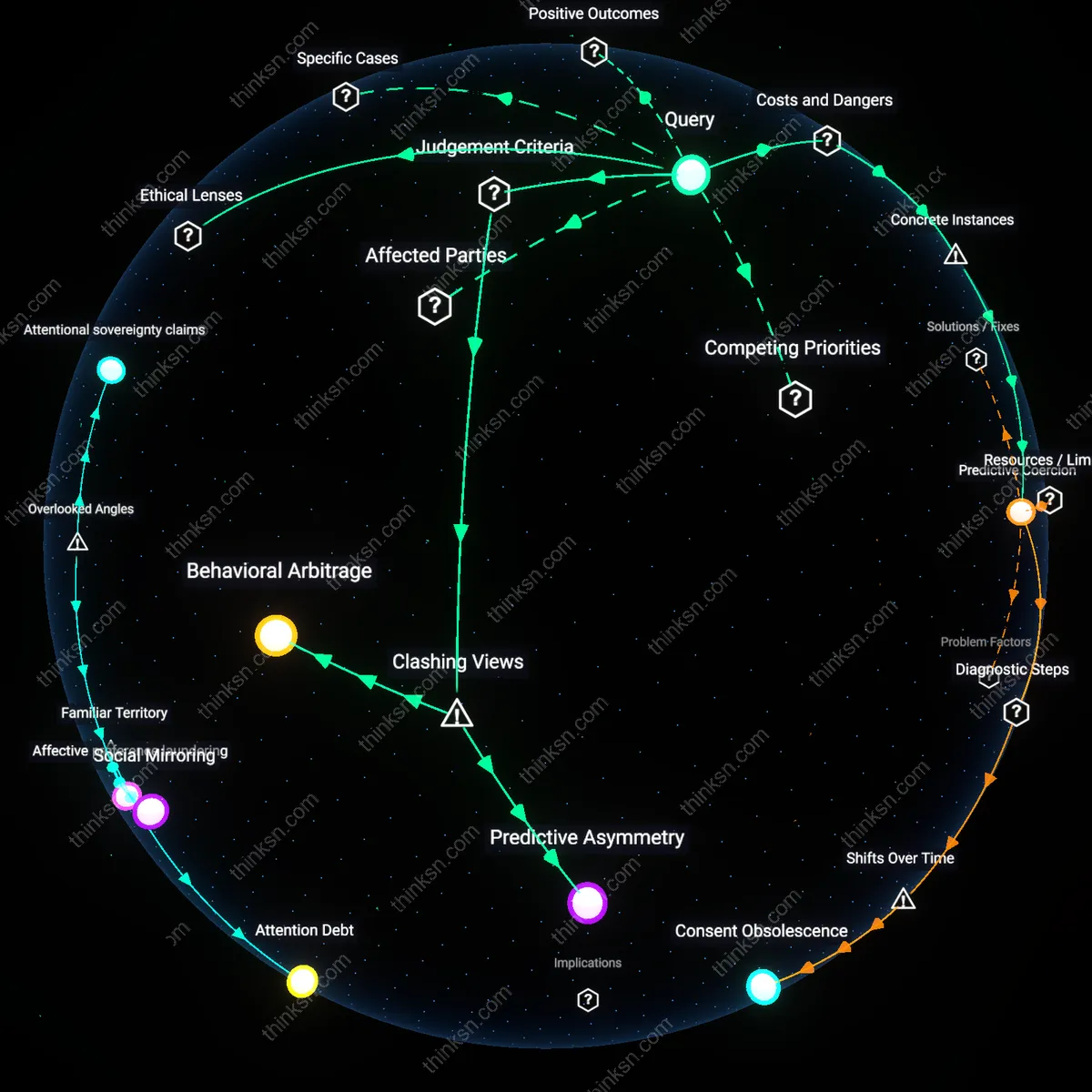
Analysis reveals 5 key thematic connections.
Key Findings
Predictive Asymmetry
Social-media platforms predict user purchasing decisions more accurately than individuals because corporate algorithms aggregate micro-behavioral traces across millions of users, detecting emergent patterns invisible at the individual level through real-time probabilistic modeling — a capability grounded in distributed data infrastructure that transcends personal introspection; this challenges the moral principle of autonomy not through coercion but by redefining agency as statistically inferable, revealing how personalized prediction redistributes epistemic authority from the self to non-transparent systems in ways rarely acknowledged in consumer sovereignty frameworks.
Behavioral Arbitrage
Social-media platforms outperform individual self-prediction not by understanding users better in a cognitive sense but by exploiting systematic divergences between stated intent and revealed preference, using A/B tested interface designs to induce impulsive behaviors that individuals consistently fail to anticipate; this reflects an economic principle of market efficiency extended into behavioral micro-control, where platform-mediated environments create new profit frontiers by turning the gap between self-perception and action into a predictive commodity — a dissonance most evident in the routine underestimation of environmental shaping in digital marketplace psychology.
Autonomy Refraction
The predictive superiority of social media platforms does not directly override personal autonomy but refracts it through layer upon layer of situated feedback loops — notifications, social validation metrics, and algorithmically curated options — that reshape choice architectures in real time, so that user decisions emerge from hybrid cognition rather than internal deliberation alone; judged by the practical principle of effective self-determination, this reveals autonomy not as violation but as continuous redistribution, illuminating how agency in digital environments is co-produced, a phenomenon obscured when autonomy is framed as either intact or compromised.
Predictive Coercion
Meta's deployment of Facebook's algorithm in Myanmar enabled the Burmese military to identify and target Rohingya civilians through behavioral microtargeting, demonstrating that social-media platforms can predict user actions more accurately than individuals can resist them, as the system leveraged emotional engagement patterns to manipulate real-world movement and compliance. This predictive power operated not through explicit purchase data but through granular affective profiling—tracking outrage, fear, and affiliation—which made users legible to both advertisers and state actors. The non-obvious danger is that purchasing-behavior models generalize into behavioral control infrastructures, where autonomy is not merely influenced but systematically preempted by algorithmic foresight masked as content delivery.
Predictive Surveillance
Social-media platforms now predict purchasing decisions more accurately than individuals through infrastructures of real-time behavioral tracking, a shift crystallized after 2010 when targeted advertising evolved from demographic profiling to algorithmic microtargeting grounded in continuous data harvesting. This transition, operationalized through corporate mechanisms like Facebook’s Edge Rank and Amazon’s recommendation engines, embeds predictive models into everyday digital experience, eroding the liberal ideal of individual sovereignty assumed in classical autonomy doctrines. The non-obvious insight is that this autonomy is not overridden by coercion but hollowed out through anticipatory compliance—users learn to act in ways that align with algorithmic expectations, making freedom indistinguishable from optimization.