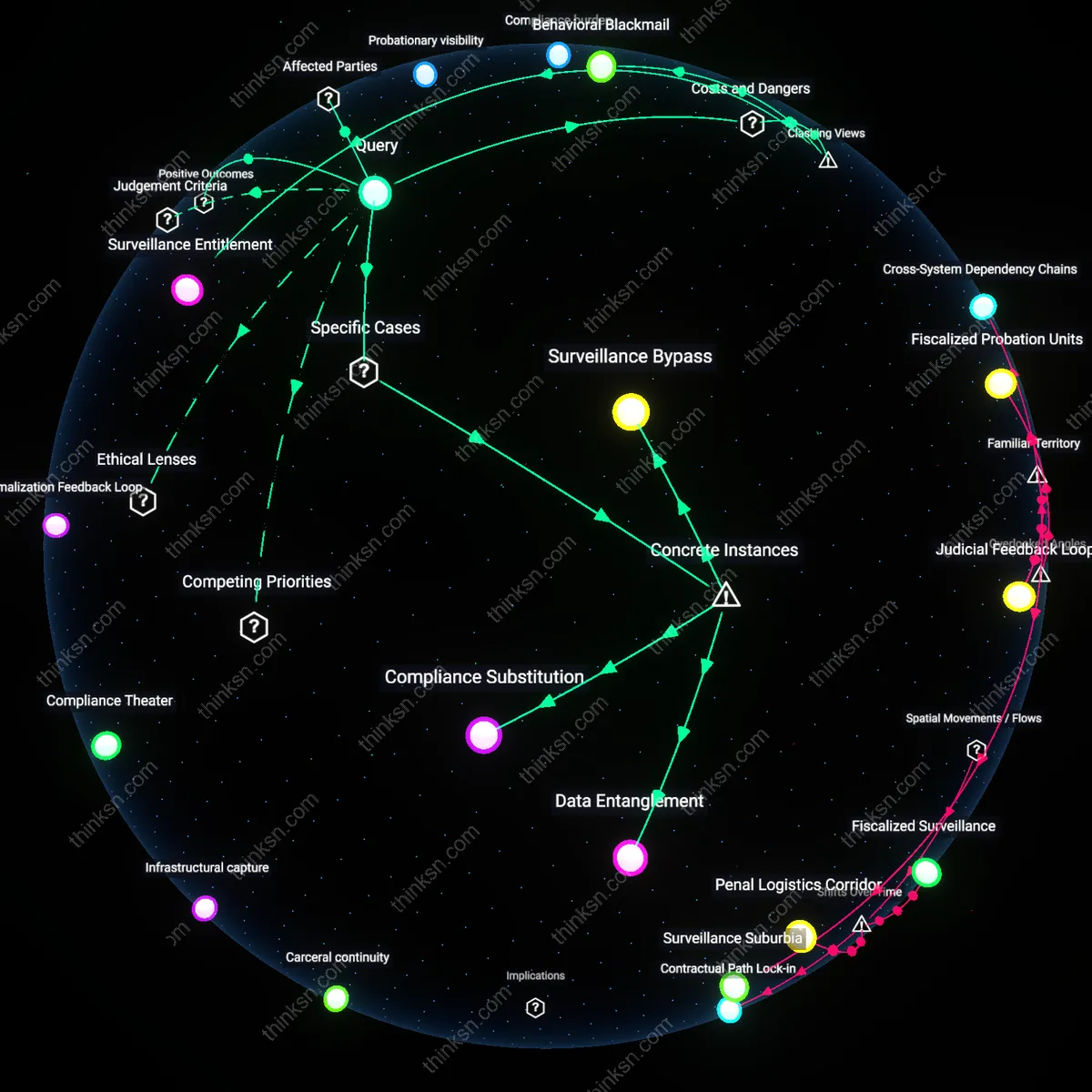
Is Electronic Monitoring Worth the Privacy Price?
Analysis reveals 12 key thematic connections.
Key Findings
Probationary visibility
Expanding electronic monitoring shifted probation from episodic supervision to continuous surveillance, integrating GPS and biometric data into routine oversight after the 2000s expansion of community corrections in the U.S. This transition enrolled local probation departments, private monitoring contractors like Sentinel Offender Services, and formerly incarcerated people into a system where compliance is enforced through perpetual data submission rather than in-person check-ins, making adherence measurable but embedding surveillance into everyday life. The non-obvious consequence of this post-1990s shift is that visibility itself became a condition of liberty, reframing freedom not as absence of control but as continuous legibility to the state.
Racialized infrastructure
The post-1980 War on Drugs redirected criminal legal control into Black and Latino urban communities through policing and sentencing, and the 2010s pivot toward electronic monitoring as an 'alternative' merely rerouted that infrastructure rather than dismantling it. Now, parole boards in cities like Chicago and Brooklyn deploy ankle monitors widely among poor men of color, substituting jail cells with geofenced movement tracked by companies such as SecureAlert, preserving coercion under a veneer of reform. What remains underappreciated is that this evolution did not reduce carceral control but spatially reconfigured it, maintaining racialized surveillance through the guise of technological progress.
Compliance burden
Beginning in the mid-2000s, courts in states like Florida and California began imposing electronic monitoring on low-income defendants pretrial under the banner of risk reduction, transforming the burden of compliance from a punitive measure into a precondition for release. This shift enrolled judicial systems, court-appointed monitors, and device-dependent defendants into a regime where missed check-ins or technical glitches lead to immediate revocation, privileging procedural adherence over structural constraints like unstable housing or work schedules. The overlooked dynamic is that this temporal transition recast poverty itself as non-compliance, rendering systemic vulnerability a technical failure within algorithmic governance.
Fiscal Reallocation Pressure
Expanding electronic monitoring redirects public funds from prison operations to technology infrastructure, enabling corrections departments to reduce per-capita spending while maintaining carceral oversight. This shift is driven by state-level budget constraints and incentivized by federal grant programs that reward incarceration rate reductions without requiring decarceration. The non-obvious outcome is that fiscal efficiency, not rehabilitation or equity, becomes the central metric legitimizing surveillance expansion—transforming corrections into a cost-optimization project within the broader public finance regime.
Compliance Theater
Electronic monitoring boosts measurable compliance rates by generating continuous behavioral data that courts and parole boards use to verify adherence to conditions, thereby reducing technical revocations. This occurs because automated alerts for curfew breaches or zone violations create a procedural shield for officials who can demonstrate 'evidence-based' oversight, even if such surveillance does not reduce recidivism. The underappreciated dynamic is that performance metrics in the justice system now reward the appearance of control over substantive outcomes, making compliance a performative ritual maintained through digital visibility.
Normalization Feedback Loop
The routine use of electronic monitoring in communities with high surveillance penetration desensitizes public and legal expectations around privacy, making successive expansions of monitoring technologies politically feasible. This occurs through a feedback loop where judges, shaped by rising caseloads and risk-averse incentives, increasingly accept monitoring as a default condition, while defense attorneys treat it as a pragmatic concession. The systemic consequence is that diminished privacy becomes institutionalized not through overt policy change but through incremental procedural normalization across county courts and probation departments.
Surveillance Entitlement
Expanding electronic monitoring entrenches a legal and administrative norm that equates compliance with perpetual visibility, conditioning freedom on constant data exposure. Probation departments and sentencing judges increasingly treat monitored submission—such as GPS ankle bracelets or mandatory app check-ins—not as a temporary measure but as a baseline expectation for reintegration, effectively recasting privacy as a privilege forfeited by those convicted, regardless of risk level. This shift entrenches a surveillance entitlement among state actors, who interpret real-time behavioral data as a necessary precondition for trust, thereby undermining due process and disproportionately extending oversight into marginalized communities. The non-obvious consequence is not reduced incarceration, but a redefinition of liberty as contingent on algorithmic legibility.
Behavioral Blackmail
Electronic monitoring systems generate dense behavioral records that prosecutors and parole boards can weaponize to enforce compliance beyond original sentencing terms, transforming technical violations into de facto control mechanisms. By capturing granular data—location history, movement speed, proximity to restricted zones—agencies can retroactively punish ambiguous behaviors without proving intent, enabling discretionary sanctions based on pattern interpretations rather than criminal acts. This creates a system of behavioral blackmail, where monitored individuals must conform not only to legal boundaries but also to the anticipated interpretations of their data by officials, chilling movement and social engagement. The danger lies not in malfunction, but in the perfect functioning of a system designed to extract conformity through fear of secondary punishment.
Infrastructure Capture
The expansion of electronic monitoring diverts public safety funding into private technology infrastructure, consolidating long-term dependence on proprietary platforms that resist oversight and erode democratic accountability. Companies like GEO Group and AT&T SecureAll have structured contracts with municipal courts that tie monitoring services to recurring data fees, device rentals, and mandatory software updates, locking jurisdictions into costly ecosystems that disincentivize decarceration or policy reversal. As these systems become embedded in routine supervision, the financial and bureaucratic inertia they generate makes abolition politically unfeasible, even when outcomes show no improvement in recidivism. The overlooked trade-off is not privacy versus safety, but fiscal entrapment versus systemic reform.
Surveillance Bypass
In Cook County, Illinois, judges began expanding electronic monitoring for pretrial defendants to reduce jail overcrowding, but many low-income participants disconnected GPS ankle monitors during work hours to avoid stigma or job loss, leading to increased technical violations without actual flight risk—revealing how compliance is gamed through strategic disconnection when monitoring conflicts with socioeconomic survival. This dynamic exposes the false equivalence between signal continuity and public safety, as the system penalizes poverty-linked behavior more than dangerousness.
Data Entanglement
In Harris County, Texas, data from court-mandated GPS monitors was shared with local police for 'operational efficiency,' resulting in monitored individuals being stopped or searched based on movement patterns flagged as suspicious, even without criminal charges—demonstrating how monitoring infrastructure becomes a backdoor for predictive policing. The integration of probation databases with law enforcement surveillance networks blurs civil and criminal oversight, turning compliance tools into preemptive investigation platforms.
Compliance Substitution
Philadelphia’s electronic monitoring program for parolees saw a 40% reduction in rearrests over five years, but internal audits revealed that officers prioritized checking device functionality over assessing rehabilitation, substituting technical compliance for behavioral progress—indicating that success metrics were redefined to match what the technology could measure, not what reduced recidivism. The system optimized for signal fidelity rather than social reintegration, mistaking connectivity for public safety.