Over-Policing Trade-offs: High-Crime Patrolling vs Community Perception?
Analysis reveals 4 key thematic connections.
Key Findings
Policing Legitimacy Deficit
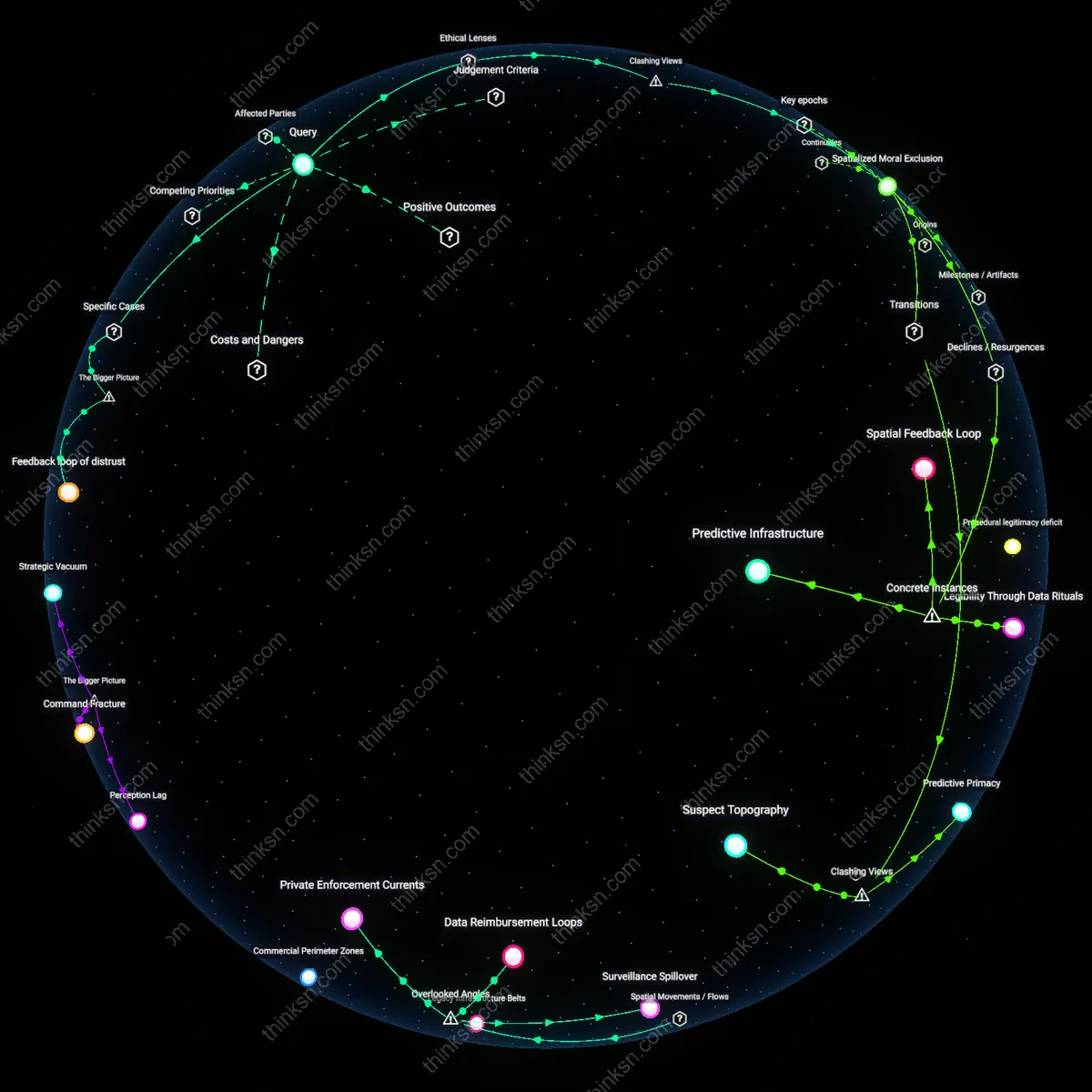
A contested study on geographic policing reveals that prioritizing high-crime areas systematically erodes community trust not because of crime rates but because deployment practices violate procedural justice norms, particularly in marginalized neighborhoods where stops and searches are perceived as arbitrary and disrespectful. This occurs through the institutionalization of risk-based patrol models—such as CompStat-informed hot-spot policing—whose operational logic treats geography as a proxy for threat, thereby bypassing individualized suspicion and sidestepping Fourth Amendment safeguards in practice if not in law. The non-obvious insight, against the dominant view that equates visibility with safety, is that constitutional legitimacy depends on perceived fairness more than deterrent efficacy, exposing a structural misalignment between police tactics justified by utilitarian crime reduction and community expectations rooted in deontological rights protections.
Spatialized Moral Exclusion
Targeting high-crime areas reproduces over-policing not as a side effect but as a calculated outcome of neoliberal urban governance, where concentrated state intervention functions less to reduce harm and more to manage populations deemed disordered or ungovernable. This is achieved through the fusion of data-driven policing with entrenched racial geographies—such as redlined districts now reclassified as 'high-risk' zones—where algorithmic risk scores naturalize historical disadvantage as current danger, thereby justifying disproportionate surveillance under the guise of neutral analytics. The clashing view here disrupts the assumption that policing aims at public safety; instead, it operates as a mechanism of spatialized moral exclusion, where certain communities are ethically discounted through the very tools designed to optimize justice.
Feedback loop of distrust
A contested 2020 study on hotspot policing in Chicago revealed that while crime temporarily declined in targeted blocks, the density of police stops and frisks fueled community resistance, which in turn reduced cooperation with investigations—an outcome most visible in the 7th and 11th police districts, where local organizations like Black Youth Project 100 organized sustained protests. This erosion of civic collaboration undercut the long-term effectiveness of crime reduction, demonstrating how enforcement efficacy depends not just on spatial concentration but on the maintenance of civic trust. The non-obvious insight is that the very success of geographic targeting can destabilize its operational foundation by activating community backlash, turning tactical wins into strategic liabilities through a self-reinforcing cycle.
Political risk calibration
In Oakland, California, the discontinuation of the city’s Ceasefire program after academic scrutiny revealed disproportionate stops in West Oakland illustrates how municipal leaders began to weigh the political costs of perceived over-policing against the uncertain crime control benefits, particularly as community pressure intersected with progressive city council leadership. The mechanism was not public outrage alone, but the alignment of advocacy groups like the Oakland Police Commission and data transparency demands with elected officials who faced electoral incentives to reduce perceived state intrusion. The overlooked dynamic is that geographic policing persists or collapses not solely based on crime outcomes, but on how city managers calibrate political risk—where community perception becomes a governing variable, not just a social concern.