Is Your Financial Privacy Worth Sacrificing for Convenience?
Analysis reveals 4 key thematic connections.
Key Findings
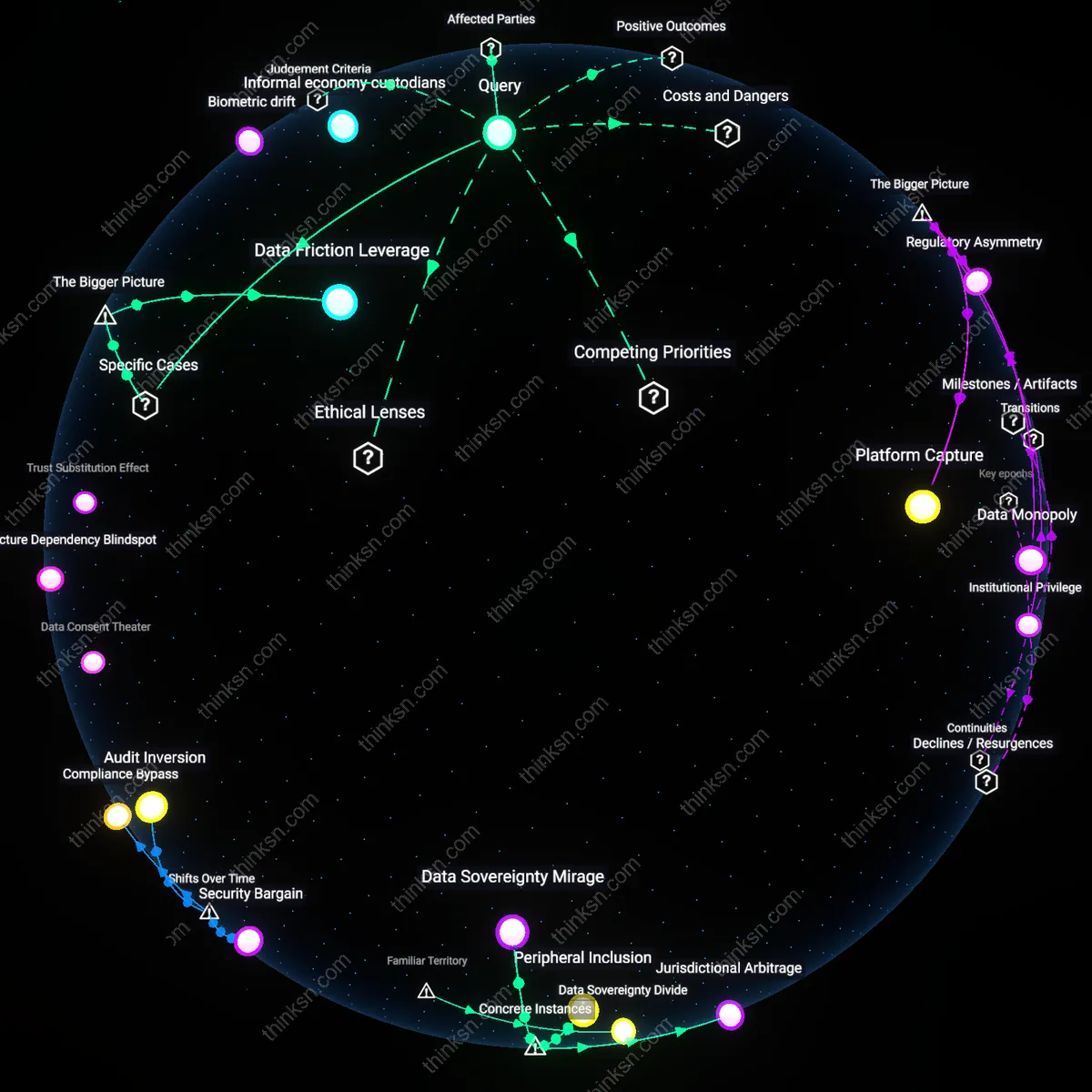
Informal economy custodians
Citizens should defer full adoption of national digital IDs for banking if they rely on informal economic networks that depend on anonymity to function. In regions like rural India or peri-urban Nigeria, small-scale traders, rotating credit associations (like *esusu* or *hawala*), and unofficial labor markets operate outside state visibility; integrating these actors into a digital ID regime risks eroding their operational autonomy by exposing transaction patterns to surveillance, freezing them out of systems they helped sustain. Most privacy-convenience debates assume formal financial inclusion as an uncontested good, overlooking how state-linked identification can destabilize existing, resilient financial ecosystems that thrive precisely because they are untraceable—this dynamic reframes exclusion not as failure but as adaptive resistance.
Biometric drift
Citizens must recognize that biometric data used in national digital IDs degrades over time and across physiological conditions, introducing systemic reliability risks that undermine both convenience and privacy. In countries like Estonia or India, where fingerprint and iris scans are foundational to digital ID authentication, aging, manual labor, diabetes, or environmental exposure can alter biometric signatures, leading to exclusion from banking services despite prior enrollment—yet the assumption persists that biometrics are static. This overlooked physical instability means that revocation or re-enrollment becomes a recurring privacy intrusion, shifting the trade-off from a one-time surrender to a cyclical exposure, fundamentally altering the cost-benefit timeline most analyses treat as fixed.
Credential asymmetry
Citizens should account for how national digital IDs create asymmetric control over identity verification, where banks gain irreversible access to state-verified data while individuals lose the ability to selectively disclose personal information. Unlike self-sovereign identity models, state-issued digital IDs often mandate full data release during authentication, enabling banks to accumulate detailed behavioral profiles under the guise of compliance—this power imbalance is rarely acknowledged in privacy debates, which focus on government overreach rather than institutional accumulation. The overlooked consequence is a quiet transfer of identity agency from the individual to regulated financial entities, transforming banking convenience into a mechanism of corporate surveillance camouflaged as public service.
Data Friction Leverage
Citizens gain negotiating power over surveillance creep when national digital ID systems like India's Aadhaar create mandatory data collection points for banking, because the scale of enrollment—over 1.3 billion users—forces institutions to standardize identity verification and simultaneously generates public backlash over unauthorized data sharing, revealing a systemic pressure point where user withdrawal becomes a credible threat. The intensity of friction between convenience-driven adoption and privacy erosion activates political accountability mechanisms only visible at mass scale, making incremental privacy safeguards a survival tactic for the system rather than a voluntary concession. This demonstrates that opacity in digital ID intermediaries can backfire when centralized data enables both efficiency and contestability. What is non-obvious is that friction itself becomes a strategic asset rather than a design flaw.