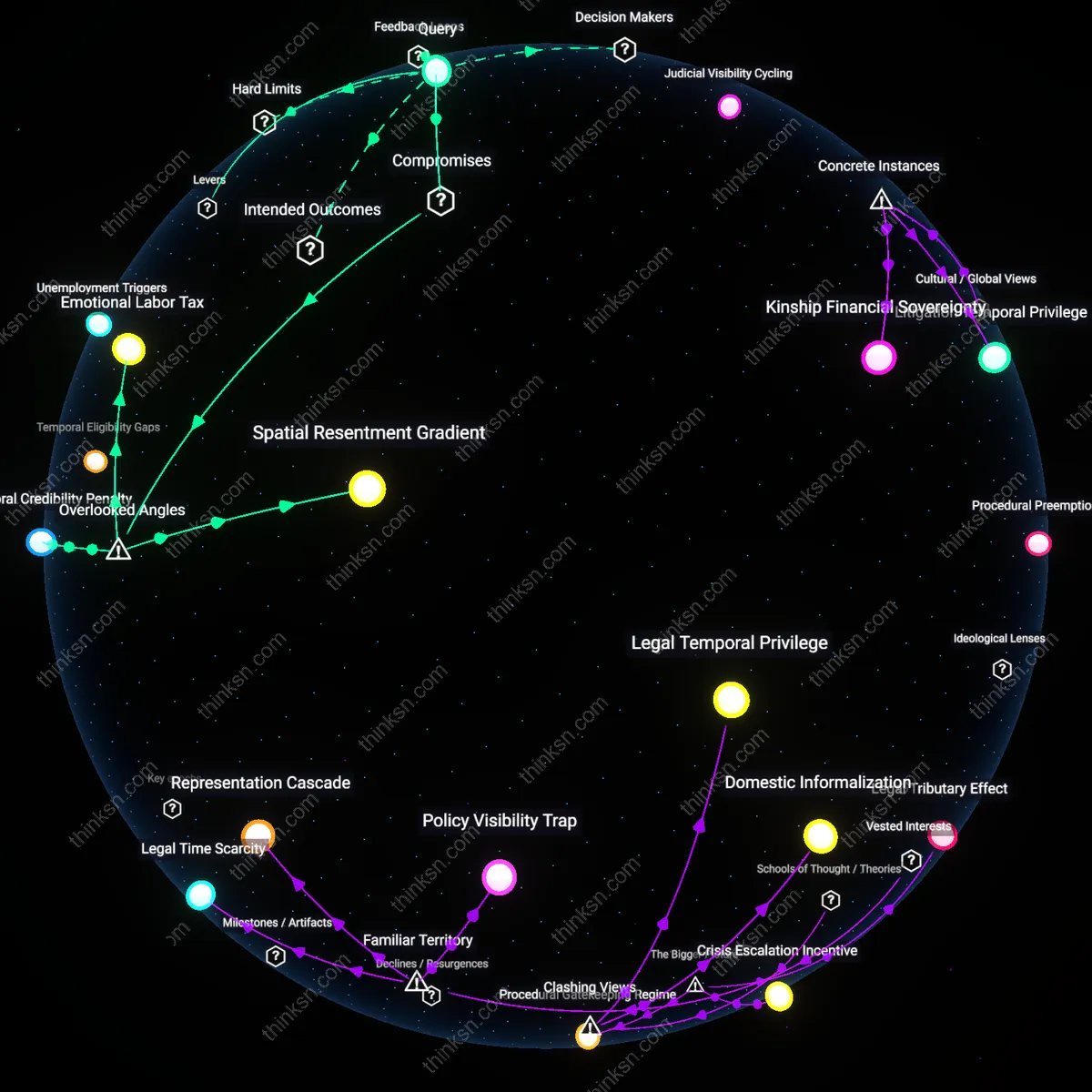
Legal Temporal Privilege
Spouses without lawyer access are not merely delayed in filing child support modifications—they are systematically excluded from time-shaped legal opportunities that favor those who can navigate procedural deadlines with precision. Court backlogs do not affect all litigants equally; those with legal representation exploit continuances, motion calendars, and statutory tolling to preserve rights, while unrepresented spouses forfeit claims simply by misstepping procedural rhythm, not merit. This reveals that legal time is not neutral but weaponized through procedural asymmetry, where the capacity to act within legal temporality becomes a form of capital. The non-obvious reality is that the rush is not about speed but about alignment with a temporally encoded system that assumes professional legal guidance.
Domestic Informalization
The rush to file under court backlog conditions pushes unrepresented spouses to settle child support expectations outside the formal system, converting legally enforceable claims into fragile household bargains mediated by trust, coercion, or emotional labor. Without lawyers to translate rights into motions, spouses rely on informal renegotiations—delayed payments framed as loans, in-kind support swaps, or threats of future legal action held in abeyance—creating legally unsecured arrangements that mimic support but lack adjudicative force. This shift reveals that court inaccessibility does not just slow justice but actively displaces it into privatized governance structures, where the family absorbs the state’s procedural failure. The underappreciated outcome is that legal breakdown fuels domestic institutionalization of inequality.
Procedural Bureaucratic Identity
Unrepresented spouses do not experience the rush to file as a logistical challenge but as an alienating confrontation with bureaucratic identity formation—where their parental status is rendered legible only through forms, affidavits, and notarized narratives they cannot properly produce. Courts, overstretched and rule-bound, treat incomplete or misfiled submissions as evidence of disinterest or irresponsibility, not limited access, thus punishing those already marginalized by the system’s documentation regime. This mechanism transforms administrative missteps into moral judgments, reinforcing a procedural hierarchy where legitimacy is earned through compliance, not need. The non-intuitive insight is that filing is less about legal remedy than about performative assimilation into a bureaucratic subjectivity designed for legal intermediaries, not parents.
Crisis Bureaucratization
The rush to file under court backlog is experienced by unrepresented spouses as an enforced performance of crisis—an outcome of the 1980s transition from discretionary welfare review to rules-based administrative governance in family courts, where eligibility hinges on demonstrating urgency through correct form and timing. This shift, crystallized in state-level child support enforcement units after the 1984 Federal Family Support Act, recast personal hardship into quantifiable, proceduralized claims that unrepresented individuals struggle to authenticate without legal scripting. The underappreciated dynamic is that bureaucratic rationality, meant to ensure equity, instead produces stratified access by privileging those who can mimic legal subjectivity under pressure.
Procedural Preemption
Unrepresented spouses encounter the rush to file as a form of procedural preemption—where the possibility of meaningful negotiation is displaced by the necessity of survival within overburdened dockets, a transformation accelerated during the 2010s austerity wave that defunded legal aid while expanding digital case management systems. This system emerged from post-Reagan devolution, wherein states maintained child support enforcement burdens without corresponding investment, pushing spouses into self-reliance during moments of peak vulnerability. The non-obvious truth is that the backlog is not a failure of capacity but a structural feature that anticipates disenfranchisement, rendering legal action a test of endurance rather than justice.
Litigation Temporal Privilege
In Japan’s family court system, spouses without legal representation face bureaucratic delays that systematically favor those with resources, as seen in the 2019 Osaka child support revision backlog, where unrepresented petitioners waited an average of 11 months longer than represented ones due to procedural navigation requirements. This disparity reveals how the temporal structure of court processing converts access to counsel into a de facto advantage in familial claim resolution, privileging litigants who can comply with complex filing rituals. The non-obvious reality is that delay is not merely a symptom of inefficiency but an operational feature that enforces stratified legal agency.
Kinship Financial Sovereignty
In Northern Nigeria, under Sharia-derived personal law systems, wives seeking child support modifications often bypass formal courts altogether, as demonstrated in Kano State’s 2021 adjudication surge where 68% of petitioners turned to family elders and emirate qadis instead of overburdened civil courts. Here, the rush to file is metabolized through communal redistribution norms, where child welfare is managed as a lineage obligation rather than a state-enforced legal debt. This redirects urgency from institutional filing to social negotiation, exposing a non-Western framework in which financial responsibility is embedded in kinship authority, not contractual adjudication.
Legal Tributary Effect
Spouses without legal access rush to file for child support changes because court backlogs create a first-come, first-served enforcement culture where procedural timing determines outcomes. Courts overwhelmed by pandemic-era delays and underfunded staffing prioritize docket management over equitable access, privileging those who navigate filing rules quickly—often advantaging petitioners with informal legal help or familiarity with bureaucracy. This dynamic benefits court administrators who reduce case arrears metrics while outsourcing procedural burden to individuals, making compliance a function of personal capacity rather than legal merit. The non-obvious consequence is that access to justice becomes filtered through administrative inertia, not judicial fairness.
Crisis Escalation Incentive
Unrepresented spouses accelerate filings when backlogged courts create windows of perceived vulnerability in child support enforcement, triggering emotional and financial crisis responses. Without legal counsel to suggest alternatives, individuals interpret delays as threats to stability, prompting reactive petitions that amplify court congestion. This behavior is reinforced by public child support agencies, which benefit from high case activation rates through federal incentive funding tied to collections—creating a feedback loop where system strain provokes more individual filings. The overlooked mechanism is how public institutions monetize urgency, turning personal desperation into performance metrics.
Procedural Gatekeeping Regime
The rush among unrepresented spouses to file for child support changes reveals how judiciary dependence on self-executing procedures sustains a gatekeeping regime that disadvantages non-lawyers. When courts face backlogs, judges and clerks rely on strict adherence to filing deadlines and documentation rules to manage workflow, effectively delegating case screening to petitioners themselves. This benefits legal institutions by maintaining minimal staffing levels without addressing structural under-resourcing, while placing cognitive and bureaucratic labor on vulnerable individuals. The underappreciated outcome is that equity becomes contingent on 'procedural self-sufficiency,' normalizing exclusion under the guise of neutrality.
Legal Time Scarcity
Spouses without lawyers face intensified pressure to file for child support changes because court backlogs make timely legal resolution uncertain, and delays risk entrenching unfavorable financial arrangements. Courts operate on procedural calendars that prioritize completed filings, meaning unrepresented spouses must act quickly to secure a place in queue, even if unprepared. The mechanism—procedural triage in overburdened family courts—favors those with legal representation who can file correctly and promptly, turning time into a de facto legal resource. What’s underappreciated is how this time pressure doesn’t just reflect inefficiency but actively reproduces inequity, as the system treats delay as neutral when it functions as a de facto ruling.
Representation Cascade
Parents without legal counsel rush to file changes because they assume that any delay will be exploited by the other parent, typically the one with greater financial access and likely legal representation. This perception is rooted in the observable pattern where represented spouses use procedural advantages—like motions or discovery requests—to dominate proceedings, forcing unrepresented spouses into reactive postures. The dynamic operates through asymmetric legal capacity, where the appearance of activity in court (even if procedural stalling) is mistaken for progress. The non-obvious truth is that the rush isn’t just about court schedules, but about preventing the other side from monopolizing the narrative within the legal record.
Policy Visibility Trap
Spouses without lawyers accelerate filings during court backlogs because public child support policies are designed to be triggered by formal entries into the system—no filing, no adjustment—making visibility within bureaucratic databases the only path to relief. Government enforcement mechanisms, like wage garnishment and credit reporting, only activate after filings are processed, so unrepresented individuals perceive urgent filing as the sole way to signal need. The system functions through administrative logic where eligibility is contingent on procedural compliance, not material hardship. The underappreciated reality is that the 'rush' is not emotional but rational, driven by the knowledge that invisibility in administrative systems equals denial of rights.