Jurisdictional timing arbitrage
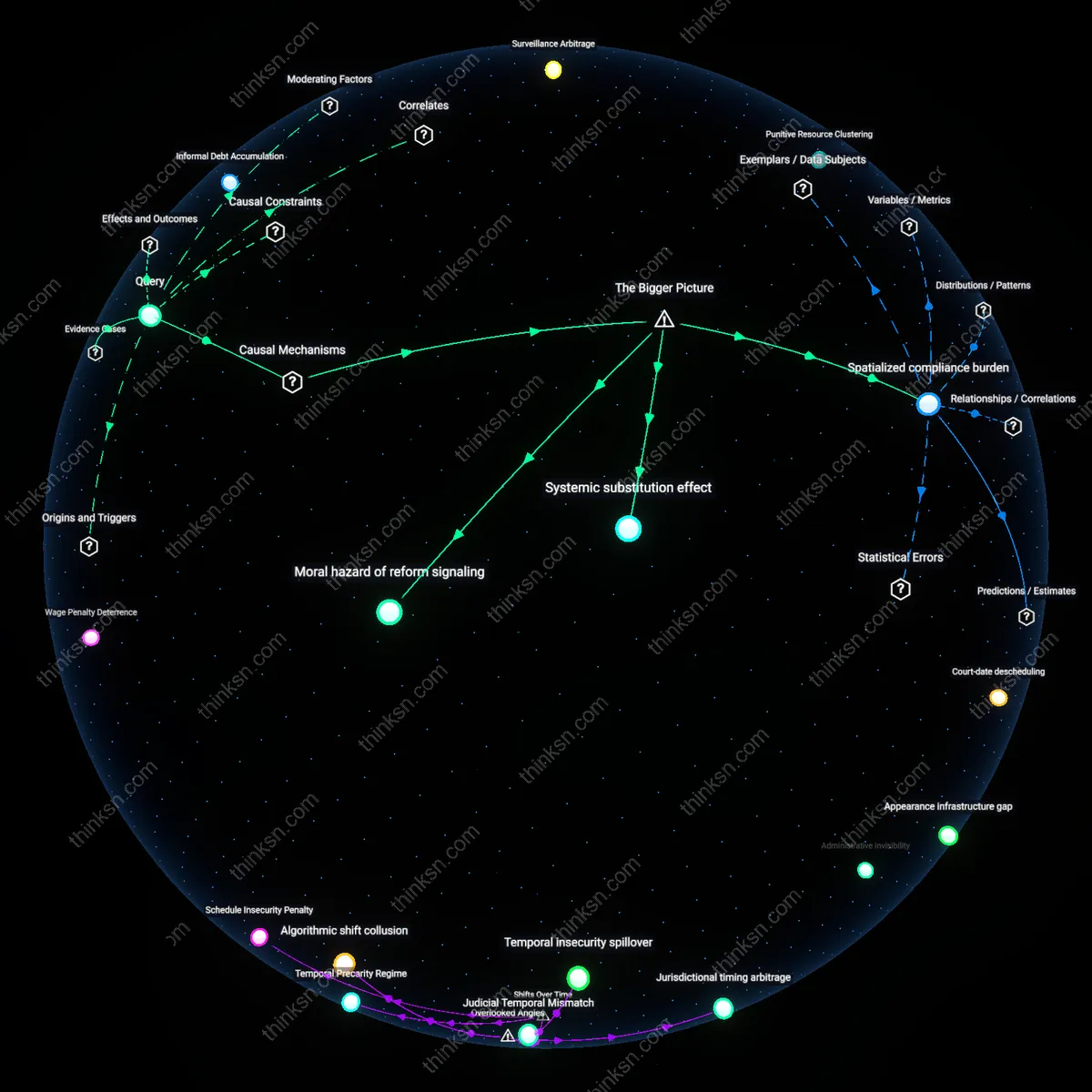
The rise of unpredictable work schedules reduced court attendance by enabling employers in high-turnover sectors like retail and gig platforms to indirectly influence employee availability, as shift-based scheduling algorithms in cities like Los Angeles and Chicago systematically clustered work hours around court dates, creating de facto penalties for time off. Managers exploited jurisdictional variation in court timing—such as morning docket assignments in municipal courts—by assigning last-minute shifts on hearing days, a pattern most visible in misdemeanor cases where workers faced retaliation for requesting leave; this dynamic reframes nonappearance as strategic labor coercion rather than personal neglect, exposing how employment systems silently administer legal disenfranchisement.
Temporal insecurity spillover
Court nonattendance increased when unpredictable scheduling eroded workers' ability to forecast their own time weeks in advance, particularly among home healthcare aides in states like Texas and Ohio, who relied on patchwork shifts to maintain Medicaid eligibility but could not confirm availability for court summons issued 30 days ahead. Because Medicaid enrollment required documentation delivery during working hours and court dates were fixed, workers faced impossible tradeoffs between retaining health benefits and fulfilling legal obligations, a mechanism hidden in plain sight because courts assume temporal stability; this reveals that legal compliance infrastructure presupposes scheduling predictability, making temporal insecurity a silent procedural barrier to justice access.
Algorithmic shift collusion
Unpredictable work schedules suppressed court appearance rates by aligning with automated workforce management systems—such as Kronos and HotSchedules—that coordinate shift distribution across regional labor markets, effectively synchronizing employee unavailability with municipal court calendars in industrial corridors like the I-95 Northeast. These systems, optimized for labor cost suppression, avoid assigning predictable blocks of free time, thereby increasing the statistical likelihood that any given worker will face a shift conflict on a court date—an outcome not due to individual employer malice but systemic coordination through shared software logic, which means nonappearance becomes a networked byproduct of invisible scheduling convergence rather than isolated scheduling conflicts.
Scheduling friction
Unpredictable shift work at Amazon fulfillment centers in Baltimore after 2010 directly reduced court appearance rates by conflicting with fixed judicial calendars, as hourly workers lacked control over time off requests and faced disciplinary action for unapproved absences, revealing how private labor discipline systems can silently override civic obligations without legal exemption mechanisms.
Temporal precarity
In New York City between 1995 and 2005, taxi drivers on call-based dispatch schedules—particularly those leasing vehicles hourly—missed traffic violation hearings due to inability to predict idle windows, demonstrating that income instability tied to time-based asset access can incapacitate compliance even when motivation is high.
Institutional asynchrony
The rise of just-in-time manufacturing at auto suppliers in the Detroit metropolitan area from the 1980s onward created chronic absenteeism in misdemeanor courts, as employers like Meritor Automotive shifted workers weekly without notice, exposing a systemic mismatch between industrial labor coordination and state-operated time-bound legal rituals.
Scheduling Invisibility
The rise of unpredictable work schedules reduced court appearance rates not because people disregarded legal obligations, but because hourly workers in logistics and service sectors—especially at companies using just-in-time scheduling algorithms—could not secure predictable time off without risking job loss, rendering court dates invisible within opaque, last-minute shift assignments; this mechanism reframes nonappearance as a structural conflict between labor control systems and civic participation, challenging the dominant narrative of personal irresponsibility with evidence of employer-driven temporal displacement.
Temporal Precarity
Court nonappearance increased primarily when municipal courts began aligning case scheduling with standardized morning dockets while low-wage labor became concentrated in irregular evening and overnight shifts, meaning that workers in gig platforms and retail—particularly in cities like Phoenix and Nashville where 24-hour operations expanded after 1995—were time-locked out of compliance due to circadian and logistical disjuncture; this reveals that the real barrier was not motivation but bodily exhaustion and transportation gaps, undercutting the assumption that legal warnings alone ensure attendance.
Institutional Temporal Mismatch
Unpredictable work hours undermined court attendance not by directly preventing people from showing up, but by eroding trust in institutional time itself—tenant court summons in cities like New York and Oakland, often rescheduled multiple times, collided with workers’ experiences of unstable shifts, making compliance feel arbitrary rather than obligatory; this shift reveals a crisis of temporal coherence, where legal legitimacy fades not from defiance but from perceptual dissonance between chaotic work life and rigid, yet inconsistently applied, court timetables.
Administrative invisibility
Unpredictable work schedules reduced court appearance rates by rendering workers’ time invisible to legal institutions that assume fixed availability. Employers in retail, gig, and service sectors impose just-in-time scheduling through algorithmic management systems, which displace workers’ autonomy over time commitments—yet court systems still operate on rigid, advance-notice dockets incompatible with 12-hour schedule shifts or last-minute shifts. This mismatch reflects a systemic failure by public institutions to adapt to labor precarity, where the legal burden falls disproportionately on marginalized workers who cannot negotiate time off, revealing how institutional time norms perpetuate exclusion through assumed temporal stability.
Sanctioned presentism
The rise of unpredictable work schedules entrenched a temporal hierarchy in which economic productivity supersedes legal accountability, making non-appearance a rational response to competing demands. Low-wage workers in cities like Chicago and Los Angeles face downward pressure to accept volatile shifts due to fear of replacement, while traffic courts and small claims dockets offer no accommodation for hourly workers’ scheduling conflicts; this creates a tacit norm where employers’ schedule demands are socially and economically prioritized over civic obligations. The structural power of firms to compress individual agency in time-use decisions reframes absenteeism not as irresponsibility but as coerced trade-offs under economic duress, exposing how labor precarity recalibrates civic participation through employer-mediated time control.
Procedural inflexibility
Court systems’ persistent reliance on one-time, in-person hearings without adaptive scheduling mechanisms amplified no-show rates among workers subject to unstable labor rhythms. As shift variability increased post-1990s in sectors like logistics and food services, due to inventory optimization models and demand-responsive staffing, municipal courts maintained fixed procedural timelines that do not integrate with digital labor platforms or employer calendar APIs—leaving workers without legitimate excuse mechanisms for rescheduling. This institutional rigidity functions as a silent filter, where access to justice becomes contingent on schedule predictability, privileging salaried or union-protected workers whose time is institutionally recognized, thus embedding labor market stratification into legal compliance requirements.
Schedule Insecurity Penalty
The rise of just-in-time scheduling in service and gig economies after the 1990s directly reduced court appearance rates among low-wage workers by eroding temporal autonomy, where algorithmic shift assignments in retail and food service made it difficult to secure time off or predict availability—this mechanism operated through employers’ adoption of labor-minimizing software that prioritized operational flexibility over worker stability, which in turn made compliance with fixed legal obligations functionally precarious; this shift is analytically significant because it reveals how labor market engineering, not individual indifference, redefined legal accountability for a class of workers whose time became externally ungovernable, exposing a hidden penalty embedded in workplace regimes rather than judicial ones.
Temporal Precarity Regime
Beginning in the mid-2000s, the integration of automated scheduling systems in municipal courts—such as digital docketing and automated warrant issuance for non-appearance—intersected with rising job schedule instability, creating a feedback loop where unpredictable work hours triggered missed court dates that then escalated into arrest warrants; this dynamic emerged most acutely in urban jurisdictions like New York and Chicago, where court automation assumed a level of temporal predictability in defendants’ lives that low-wage employment no longer provided, revealing a systemic misalignment between institutional time structures and labor realities—an underappreciated shift where bureaucratic modernization, intended to increase efficiency, instead amplified penalties for those already marginalized by labor market transformations.
Judicial Temporal Mismatch
From the 1990s to the 2010s, the decoupling of work time from standard civic scheduling norms eroded the implicit assumption in court systems that individuals could reasonably plan around fixed appointments, as rotating, last-minute, and on-call shifts in sectors like healthcare, logistics, and ride-sharing made advance coordination nearly impossible; this shift was institutionalized through the absence of legal accommodations for irregular employment in summons design or rescheduling policies, making non-appearance a structural inevitability rather than moral failing—what emerged was a hidden inflection point where the temporal architecture of justice, long calibrated to industrial-era routines, failed to adapt to post-industrial labor fragmentation, exposing a foundational mismatch between civic institutions and the lived rhythms of contemporary work.
Scheduling Collision Effect
Unpredictable work schedules caused more people to miss court dates because shift gaps were too narrow to travel, especially in transportation-constrained areas. Hourly service workers in cities like Chicago and Los Angeles faced scheduling gaps shorter than courthouse wait times, making compliance physically impossible even when willing. The mechanism operated through just-in-time staffing algorithms in retail and food service, which gained dominance after the Fair Labor Standards Act exemptions of the 1990s enabled erratic shift assignments. This reveals that the problem isn’t apathy or disorganization, but a structural clash between automated labor management and civic obligation timing—an underappreciated friction in public participation.
Wage Penalty Deterrence
People began avoiding court appearances when unpaid time off from unpredictable jobs created immediate income loss, especially after the 1996 welfare reforms tied earnings to program eligibility. Workers in sectors like gig delivery and temporary labor faced docked pay or deactivation for missing shifts, making court attendance feel financially hazardous. This mechanism functioned through employer policies amplified by platforms like FedEx Ground and McDonald’s franchise operators who standardized no-show penalties from the 2000s onward. The non-obvious insight is that wage insecurity, not legal fear, became the primary behavioral governor—transforming court summons into economic threat assessments.
Temporal Precarity Trap
Court no-shows increased when workers lost advance notice of their own availability, a shift cemented by the rise of ‘clopening’ shifts in big-box retailers like Walmart post-2005. Without knowing their schedule a week ahead, people couldn’t confidently book courthouse visits, transport, or child care. This operated through centralized workforce management systems like Kronos, adopted widely after 2008 to optimize labor costs, which prioritized operational flexibility over employee predictability. What’s underappreciated is that it wasn’t merely long hours but the collapse of temporal autonomy—the inability to plan one’s own life—that corroded civic reliability, reframing absence as a symptom of institutionalized time alienation.