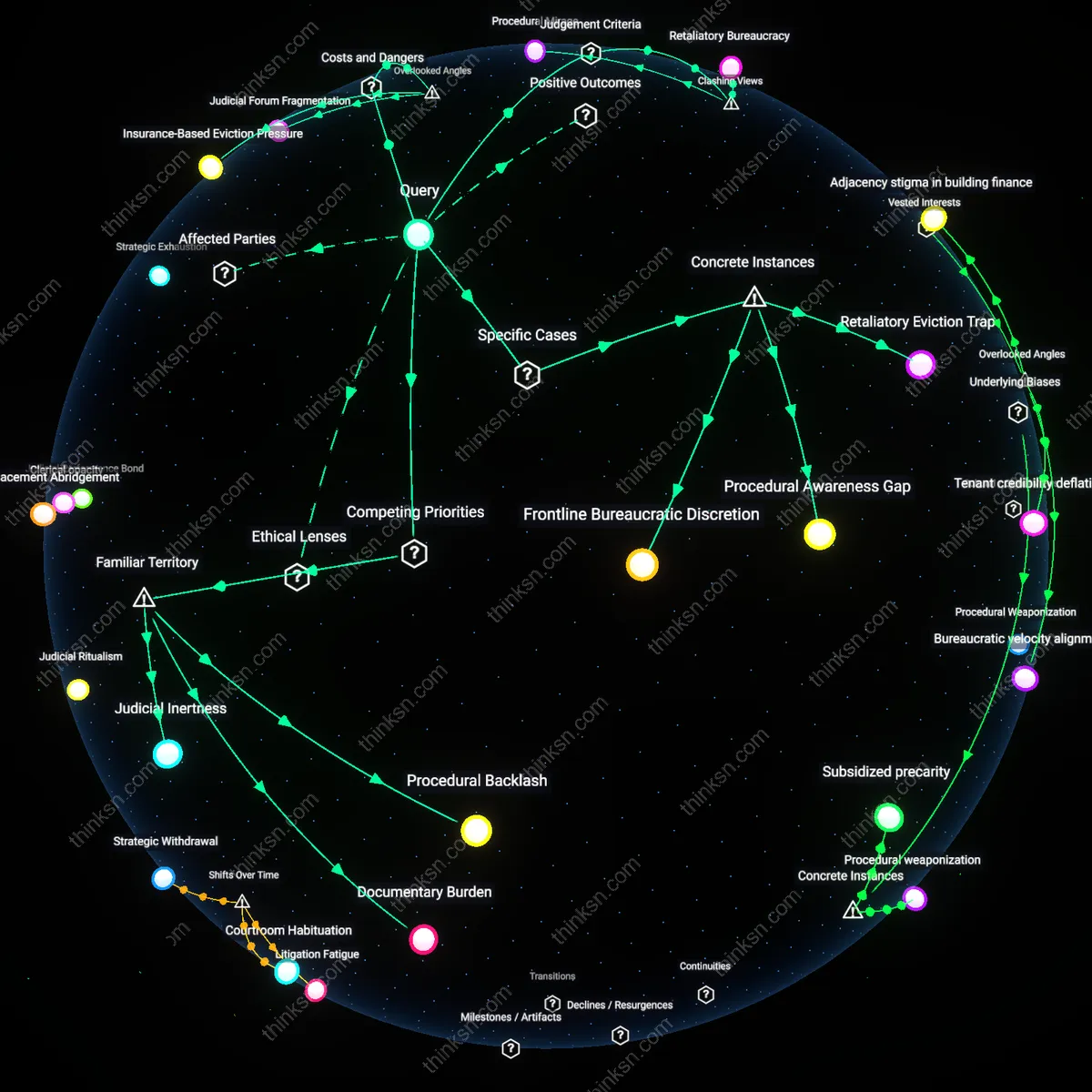
Do Discrimination Claims Leave Tenants Vulnerable to Lease Termination?
Analysis reveals 12 key thematic connections.
Key Findings
Procedural Mirage
No, the legal system does not adequately protect tenants' due process rights because the availability of formal hearings and appeals creates an illusion of fairness while the actual burden of proof, timing pressures, and lack of legal representation neutralize meaningful participation—tenants must navigate eviction proceedings in housing courts that operate on accelerated timelines, often within days of notice, while simultaneously litigating discrimination claims in parallel federal or state agencies with much longer dockets—this procedural bifurcation allows landlords to terminate leases under color of law before the discrimination claim is substantively reviewed, rendering due process hollow in practice—what appears to be procedural justice becomes a synchronized mechanism of displacement.
Retaliatory Bureaucracy
No, the legal system fails to protect tenants because anti-retaliation provisions are structurally undermined by the very agencies tasked with enforcement—the Department of Housing and Urban Development (HUD) and local commissions investigate discrimination claims, but their findings are retrospective and non-binding in eviction cases, allowing housing courts to proceed independently on lease violations even when those violations were triggered by complaints—this institutional fragmentation enables landlords to weaponize lease enforcement as a legitimate-seeming cover for retaliation, with judges deferring to 'objective' lease terms while ignoring contextual causality—this reveals that bureaucratic neutrality can function as complicity when systems refuse to integrate motive into procedural legitimacy.
Threshold Coercion
No, due process is compromised not through overt denial but through the strategic manipulation of filing and response deadlines that force tenants into procedural default—the moment a tenant files a discrimination claim, landlords may initiate eviction for minor lease infractions such as late rent or unauthorized occupants, triggering mandatory court dates within 72 hours in jurisdictions like New York City’s Housing Court, where failure to appear results in automatic default judgment—this temporal coercion exploits the tenant’s limited access to counsel and mobility, effectively penalizing the assertion of civil rights as though it were a breach of contractual good faith—this reframes lease termination not as a response to violation but as a performative sanction calibrated to deter rights-assertion.
Procedural Chilling Effect
The legal system fails to protect tenants’ due process rights because the timing and procedural complexity of eviction defenses after a discrimination complaint create a coercive environment that deters legitimate claims, even when those claims are later validated. Landlords can exploit automatic lease termination clauses triggered post-complaint, forcing tenants into immediate housing instability while their discrimination cases crawl through civil court—a process that often takes months or years. This asymmetry in temporal consequences (instant displacement risk vs. delayed justice) operates through local housing court norms that treat lease violations as administratively urgent and discrimination retaliation as a separate, secondary claim, rendering due process functionally inaccessible at the moment it matters most. What is overlooked is how procedural sequencing, not just legal standards, enforces silence—tenants understand intuitively that winning a legal principle months later does not prevent a locked-out night today, making the system’s structure itself a deterrent to rights assertion.
Insurance-Based Eviction Pressure
Tenant due process is undermined because property insurers’ risk algorithms classify properties with pending fair housing complaints as higher liability, triggering premium hikes or nonrenewal that push landlords to terminate tenancies swiftly, regardless of the claim’s merit. This creates a financial incentive for property managers—particularly in corporate-owned rental portfolios in states like Florida and Texas, where insurance markets are volatile—to preemptively remove tenants not because of lease violations, but to maintain insurability. The mechanism operates through private risk assessment systems that are opaque and unregulated in their treatment of discrimination filings as proxy signals for management instability, effectively outsourcing evictions to financial risk models that bypass judicial scrutiny. Most analyses miss that eviction pressure can originate not from landlords’ intentional retaliation but from backstage insurance protocols that transform civil rights claims into actuarial red flags, making due process a casualty of capital logistics rather than malice.
Judicial Forum Fragmentation
Tenants lose due process protection because discrimination claims are heard in federal or state civil rights tribunals while lease terminations are decided in local housing courts, creating irreconcilable procedural tracks that allow eviction judgments to finalize before any retaliation can be adjudicated. This fragmentation enables landlords in cities like Cleveland and Sacramento to pursue eviction on lease grounds—even if pretextual—while the discrimination claim remains pending in a separate system with different evidentiary rules and timelines. The critical overlooked dynamic is that due process protections in one forum cannot operate retroactively to undo a termination validated in another, even when the two are causally linked; the system’s structural incoherence across jurisdictions permits legal compliance on paper while nullifying practical defense. This jurisdictional siloing transforms forum rules from neutral procedures into tools of dispossession.
Procedural Backlash
The legal system often fails to protect tenants' due process rights because landlords can exploit procedural delays and technical violations to retaliate after a discrimination claim, using the formal neutrality of lease enforcement to mask punitive action. Courts treat lease violations as objective breaches, ignoring how timing and selective enforcement reveal retaliatory intent, especially in jurisdictions with weak anti-retaliation enforcement. This dynamic is hidden in plain sight because the public assumes due process is guaranteed by courtroom access, not realizing that procedural weapons are available to those who control lease terms and eviction timelines.
Documentary Burden
Tenants lose due process protections when fighting lease termination because the system demands formal documentation of housing conditions or discriminatory behavior—something most low-income renters cannot produce on short notice. Landlords, by contrast, hold institutional advantages in recordkeeping and legal access, allowing them to meet evidentiary thresholds more easily. This disparity is rarely acknowledged in public discourse, which assumes equal footing in court, but in reality, the requirement to 'prove' discrimination or retaliation favors those already positioned within bureaucratic systems.
Judicial Inertness
Courts routinely defer to landlords’ stated reasons for lease termination, accepting pretextual justifications without probing into temporal proximity or circumstantial evidence of retaliation, thereby permitting discrimination claims to be punished under color of law. This passivity is structurally reinforced by crowded dockets and summary eviction procedures that prioritize speed over scrutiny, especially in housing courts accustomed to treating lease terms as sacrosanct. Although people commonly believe judges act as neutral arbiters, their habitual non-intervention in landlord-tenant dynamics effectively transfers due process power to property managers and attorneys fluent in procedural minimalism.
Retaliatory Eviction Trap
In Baltimore, public housing tenants who filed disability discrimination complaints with the U.S. Department of Housing and Urban Development (HUD) were systematically issued lease violation notices within weeks, often for minor infractions such as unapproved home modifications, transforming reasonable accommodation requests into grounds for termination. The city’s housing authority used ostensibly neutral enforcement mechanisms to target complainants, exploiting the lack of a direct burden-of-proof standard in retaliation cases. This reveals how compliance with due process procedures—service of notices, hearings, documentation—can coexist with the effective nullification of rights through temporally proximate, discretionary enforcement actions that are legally colorable but functionally retaliatory.
Procedural Awareness Gap
In New York City Housing Court, tenants in Mitchell-Lama buildings who challenged race-based maintenance neglect and then faced sudden non-renewal leases were routinely denied injunctive relief despite temporal clustering of complaints and actions, because judges required evidence of direct communication linking the claim to termination—ignoring organizational patterns. The court’s adherence to narrow factual causation standards, even as administrative records showed complainants were nine times more likely to face proceedings, demonstrates how due process formalism fails to protect against indirect retaliation when systemic inference is excluded from judicial reasoning, rendering temporal coincidence legally irrelevant. This exposes a structural blindness in common law adjudication to organizational learning and bureaucratic retaliation that operates without explicit directives.
Frontline Bureaucratic Discretion
In Dallas, an internal audit of the Housing Authority revealed property managers had developed informal scoring systems to track 'high-maintenance' tenants—including those filing fair housing complaints—which were later used to justify selective lease non-renewals during annual reviews, even when no violations occurred. Supervisors tolerated this practice because standardized performance metrics emphasized occupancy turnover and 'problem tenant' reduction, creating incentives to disguise retaliatory outcomes within routine administrative processes. This exposes how tenant protections are undermined not by formal rules but by the tacit realignment of frontline discretion under institutional performance pressures, where due process rights are circumvented through unrecorded, qualitative assessments that evade legal scrutiny.