Is Credible Fear Enough for U.S. Asylum Fairness?
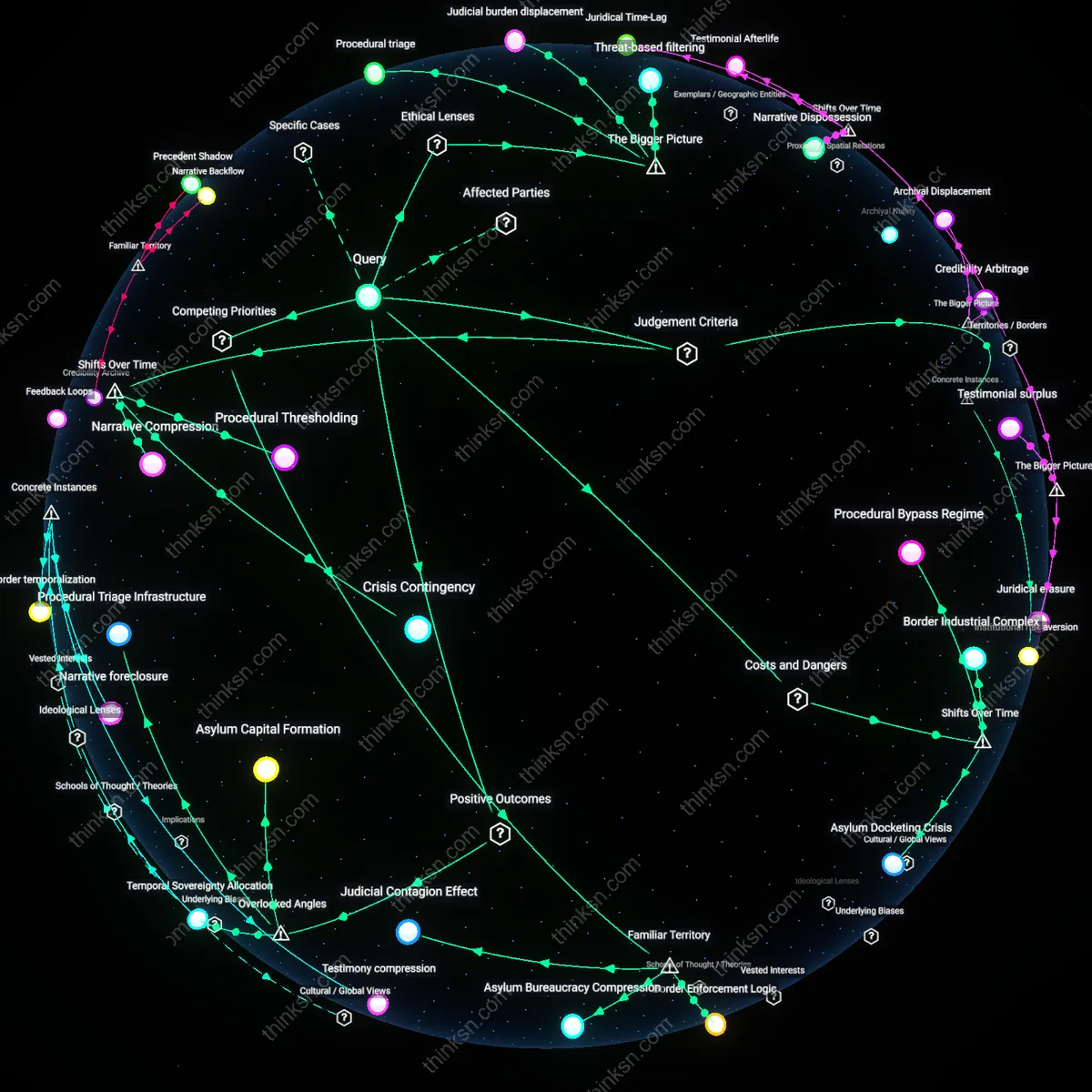
Analysis reveals 18 key thematic connections.
Key Findings
Procedural triage logic
The U.S. asylum system prioritizes credible fear assessments because it operates under a procedural triage logic shaped by the Illegal Immigration Reform and Immigrant Responsibility Act of 1996, which mandated rapid screening of asylum seekers at ports of entry to filter 'manifestly unfounded' claims efficiently. This mechanism, administered by asylum officers within U.S. Citizenship and Immigration Services rather than immigration judges, reduces complex narratives to checkbox evaluations of plausibility, privileging speed over depth—most evident in the surge of Central American asylum cases after 2014, where over 80% of initial screenings were found to present credible fear, yet fewer than 20% ultimately resulted in granted asylum, revealing systemic reliance on thresholds of procedural manageability rather than narrative truth. This exposes how fairness is structurally deferred in favor of volume control, a non-obvious outcome because public discourse often conflates high referral rates with protective inclusivity when they in fact reflect procedural leniency, not access to justice.
Asymmetric burden of proof
The emphasis on credible fear over detailed narratives reflects an asymmetric burden of proof embedded in the asylum process, exemplified by the 2018 Matter of A-B- decision under Attorney General Jeff Sessions, which restricted eligibility for domestic violence survivors by redefining 'particular social group' to require broader social recognition. In this instance, victims like Ms. A-B—whose testimony detailed years of abuse and police inaction in Guatemala—were denied on grounds that their narratives, though coherent and traumatic, failed to meet newly narrow legal thresholds, shifting the burden onto applicants to anticipate evolving jurisprudence rather than enabling full articulation of harm. This reveals that fairness is compromised not by overt denial but by retroactive recalibration of evidentiary standards, a non-obvious dynamic because the system appears to honor narratives while systematically devaluing them through doctrinal narrowing.
Institutional risk aversion
The U.S. asylum system's preference for credible fear assessments stems from institutional risk aversion within the Executive Office for Immigration Review (EOIR), particularly after the 2021 collapse in case processing during the Title 42 expulsions, when overwhelmed immigration courts defaulted to expedited procedures that minimized narrative development. In Del Rio, Texas, during the same period, thousands of Haitian asylum seekers were processed under conditions that prioritized rapid CBP screening over USCIS-led interviews, leading to drastically lower credible fear pass rates—dropping from 75% to under 10%—not due to weaker claims but because officers applied fear thresholds more stringently under operational pressure. This illustrates how fairness erodes not through explicit policy but through frontline administrative adaptation to capacity constraints, a non-obvious mechanism because the system's failures appear as individual determinations rather than systemic byproducts.
Procedural Thresholding
The U.S. asylum system prioritizes credible fear assessments over full narratives because post-1996 immigration reforms, especially the Illegal Immigration Reform and Immigrant Responsibility Act (IIRIRA), institutionalized screening mechanisms to filter applicants before full hearings, thereby converting asylum into a two-tier process where efficiency—measured by case throughput and border control—became the operative yardstick. This shift transformed asylum officers and immigration judges into gatekeepers rather than fact-finders, embedding a procedural logic that limits deep narrative engagement unless a minimal threshold of plausibility is met. The non-obvious consequence is that fairness is no longer assessed on the completeness of a refugee’s story but on its immediate structural coherence under duress, revealing how expedience has redefined due process in immigration bureaucracy.
Crisis Contingency
The emphasis on credible fear emerged prominently after the 1994 Haitian and 1995 Cuban interdiction crises, when the U.S. Coast Guard began intercepting migrants at sea and deflecting asylum claims offshore, forcing the state to develop rapid evaluation protocols that could justify non-admission without full adjudication—here, the moral principle of non-refoulement was balanced against national security and deterrence objectives. By compressing asylum into a binary fear assessment during expedited removal, the system evolved to treat migration spikes as emergencies requiring triage, not individual legal reckonings. This normalization of emergency logic reveals how temporary crisis responses became codified into permanent administrative infrastructure, making contingency itself a governing mechanism.
Narrative Compression
Since the 2001 USA PATRIOT Act and subsequent securitization of border policies, asylum narratives have been structurally truncated to fit intelligence-compatible formats, privileging discrete threat indicators over contextual life histories—here, the yardstick shifts from restorative justice to risk mitigation. This transformation institutionalized a forensic mode of listening in asylum interviews, where adjudicators extract data points (persecution, identity, state failure) rather than sustain empathetic engagement, a shift accelerated by post-9/11 vetting regimes and DHS data protocols. The underappreciated effect is that the refugee subject is no longer reconstructed through testimony but reduced to a threat profile, revealing how counterterrorism logics have reshaped humanitarian procedure into algorithmic screening.
Procedural Triage Infrastructure
The U.S. asylum system prioritizes credible fear assessments because they activate a procedural triage infrastructure that routes applicants into differentiated legal processing lanes based on standardized risk thresholds, not narrative completeness—this mechanism, managed by U.S. Citizenship and Immigration Services asylum officers at ports of entry and inland facilities, enables the Department of Homeland Security to sort approximately 80% of cases into accelerated or deferred processing without triggering full immigration court dockets, a function that is rarely analyzed as an administrative backbone rather than a screening flaw. This triage infrastructure depends on minimally sufficient evidence rather than holistic storytelling to preserve operational bandwidth across overburdened EOIR courts, revealing that the system’s fidelity is to procedural scalability, not narrative equity—an overlooked pivot because most fairness critiques assume the system is designed to assess truth when it is actually designed to manage flow.
Asylum Capital Formation
Credible fear assessments generate asylum capital formation by converting subjective persecution claims into transferable legal eligibility units that can be leveraged across jurisdictions, legal aid networks, and humanitarian funding streams, a process centered in nonprofit legal clinics like those in the Immigration Justice Campaign that rely on standardized credible fear determinations to unlock pro bono attorney assignments, bond hearings, and access to shelters. This capital—non-monetary but structurally fungible—is built not on narrative depth but on the recognition of threshold risk markers (e.g., gang threats, sexual orientation), which allows resource-constrained NGOs to allocate services predictably; this dynamic is overlooked because analysis typically treats credible fear as a binary legal hurdle rather than an economic-like asset that scaffolds downstream support, reshaping the understanding of fairness as distributed access to ecosystemic resources rather than individualized adjudicative weight.
Temporal Sovereignty Allocation
The credible fear regime allocates temporal sovereignty by legally recognizing only certain moments of threat as administratively valid—specifically those that occur just before entry, as defined by the 2005 REAL ID Act’s implementation guidance—thereby compressing an applicant’s lived history into a narrow window of assessable time that immigration officers at locations like the Rio Grande Valley processing centers can adjudicate within 72-hour deadlines. This compression privileges recency over continuity, enabling the system to treat asylum as a time-bound event rather than a cumulative experience, a mechanism overlooked in equity debates that assume narrative exclusion is a flaw rather than a deliberate temporal gating strategy which redistributes the authority to define ‘persecution’ across time, ultimately favoring institutional pacing over biographical complexity.
Procedural Bypass Regime
The credible fear assessment became dominant after the Illegal Immigration Reform and Immigrant Responsibility Act of 1996 reframed asylum as a threat management tool rather than a humanitarian pathway, instituting expedited removal and requiring only minimal screening to prevent immediate deportation. This shift transferred decision-making power from immigration judges to asylum officers operating under DHS, prioritizing speed over depth and embedding a procedural logic that treats narrative detail as functionally disposable. The non-obvious consequence was not merely faster processing but the normalization of a two-tier system—one for those who trigger credible fear and thus avoid summary removal, and another, invisible tier where even plausible claims are administratively erased without narrative engagement.
Border Industrial Complex
The post-9/11 expansion of border enforcement, culminating in the creation of DHS and the integration of immigration control into national security frameworks, transformed credible fear into a risk-filtering mechanism calibrated to institutional capacity rather than evidentiary value. As CBP and ICE absorbed asylum processing into broader interdiction operations, the burden shifted toward identifying minimally threatening individuals for deferral, not truth-seeking. The underappreciated dynamic is that personal narratives were not simply devalued—they became logistical liabilities, exposing how the system’s evolution fused immigration control with carceral logistics, where throughput and containment outweigh due process.
Asylum Docketing Crisis
Beginning in the mid-2010s, unprecedented caseload surges at southern border ports of entry overwhelmed EOIR’s already backlogged immigration courts, inducing USCIS and CBP to tighten credible fear interpretation as a pressure-release valve, thereby reducing the number of cases referred to full hearings. This reactive recalibration treated narrative development as a downstream luxury, reserving full adjudication only for the narrowest claims that survived initial screening. The overlooked transformation is that the system ceased aiming for equitable resolution altogether, instead evolving into a triage mechanism whose historical drift reveals asylum not as a legal right but as a rationed administrative outcome.
Border Enforcement Logic
The U.S. asylum system prioritizes credible fear assessments because they enable rapid screening at ports of entry, where immigration officers must make time-sensitive determinations under operational pressure from Customs and Border Protection protocols. This mechanism relies on standardized yes/no indicators—such as whether an asylum seeker names a recognized persecutor—rather than narrative coherence, allowing frontline agents to process high volumes without deep engagement. While most associate the border with security, the underappreciated reality is that the system treats the border not as a legal threshold but as a logistical chokepoint, where procedural speed becomes the organizing principle.
Asylum Bureaucracy Compression
Credible fear assessments dominate over personal narratives because the Executive Office for Immigration Review is structured to manage case throughput, not therapeutic witnessing, forcing asylum officers to reduce complex life stories into checkbox validations of threat plausibility. This dynamic emerges from a system overwhelmed by backlog—over 2 million pending cases—where efficiency demands filtering out nonviable claims early, even if that means disregarding context that might humanize or substantiate claims later. Though people commonly think of asylum as a moral refuge, the routine administrative reality is that the system cannot afford the time it takes to believe someone fully.
Judicial Contagion Effect
The emphasis on credible fear stems from federal court precedents that define minimal constitutional protections for noncitizens, requiring only a 'probable cause' standard before removal, which has bled into agency practice as a norm of skepticism toward detailed narratives. This legal mechanism, rooted in case law like *Scheidecker v. ICE*, conditions adjudicators to treat elaboration as potential fabrication unless corroborated, privileging brevity and consistency over depth. While the public often frames courts as neutral arbiters, the unexamined consequence is that legal minimalism becomes operational dogma, shaping how fear itself is recognized in practice.
Procedural triage
The U.S. asylum system prioritizes credible fear assessments over personal narratives because immigration enforcement agencies operate under structural time and resource constraints that necessitate rapid screening mechanisms at ports of entry, particularly after the Illegal Immigration Reform and Immigrant Responsibility Act of 1996 institutionalized expedited removal. This mechanism, administered by U.S. Citizenship and Immigration Services (USCIS) asylum officers rather than immigration judges, functions as a gatekeeping tool to filter out manifestly non-meritorious claims without triggering full judicial review, reflecting a utilitarian ethical calculus where systemic throughput outweighs individualized deliberation. The non-obvious consequence is that credibility becomes a proxy for legal worthiness, reducing complex experiences of persecution to binary risk indicators, which entrenches procedural triage as the de facto standard in border governance.
Judicial burden displacement
The emphasis on credible fear assessments reflects a deliberate legal strategy to shift the burden of asylum adjudication from Article I immigration judges to executive-branch asylum officers, minimizing the strain on overburdened immigration courts and aligning with a legal positivist ideology that privileges statutorily defined procedures over empathetic interpretation of testimony. This design emerged from the expansion of expedited removal under the Homeland Security Act of 2002, which fragmented adjudicative authority across agencies, thereby enabling the Department of Justice and DHS to control case flow without constitutional obligations to provide counsel or public hearings. The underappreciated systemic effect is that the narrowing of narrative space insulates policymakers from accountability for deportation outcomes by externalizing discretion to low-visibility administrative officers, revealing judicial burden displacement as a structural solution to political risk accumulation.
Threat-based filtering
Credible fear assessments dominate asylum processing because homeland security institutions treat border management as a risk-mitigation function, privileging indicators of threat compatibility—such as gang violence or state persecution—that align with national security criteria established post-9/11, particularly through the Patriot Act’s expansion of surveillance and exclusion protocols. This operational logic, embedded in the Asylum Division’s training manuals and risk-scoring matrices, reflects a deontological ethics in which adherence to standardized criteria trumps narrative nuance, ensuring uniformity but often misrecognizing diffuse or culturally specific forms of harm like gender-based violence. The overlooked dynamic is that this system rewards claims legible to security bureaucracies while marginalizing those that do not conform to threat templates, institutionalizing threat-based filtering as a quiet mechanism of selective inclusion.