How Many Sources Are Too Many for Clear Thinking?
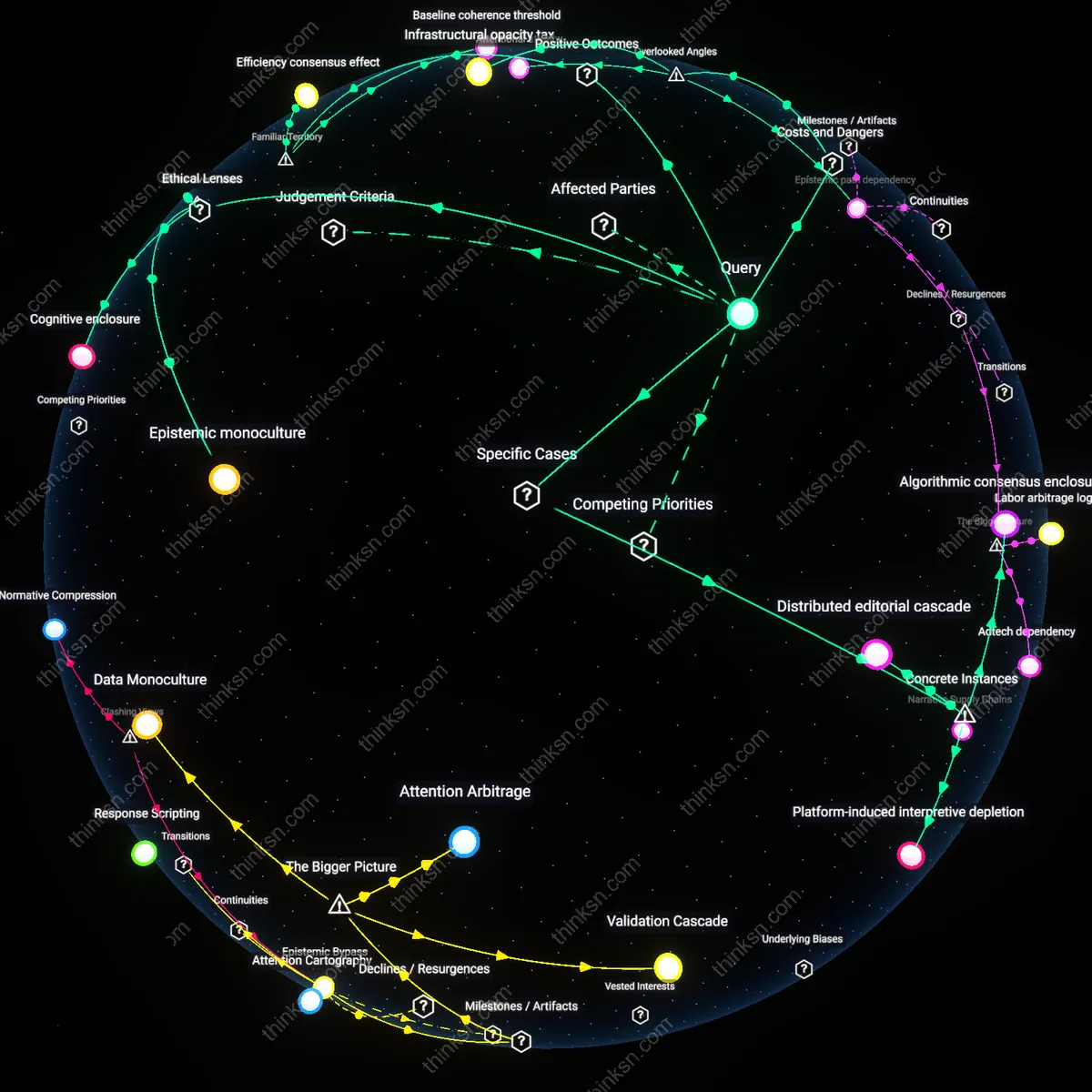
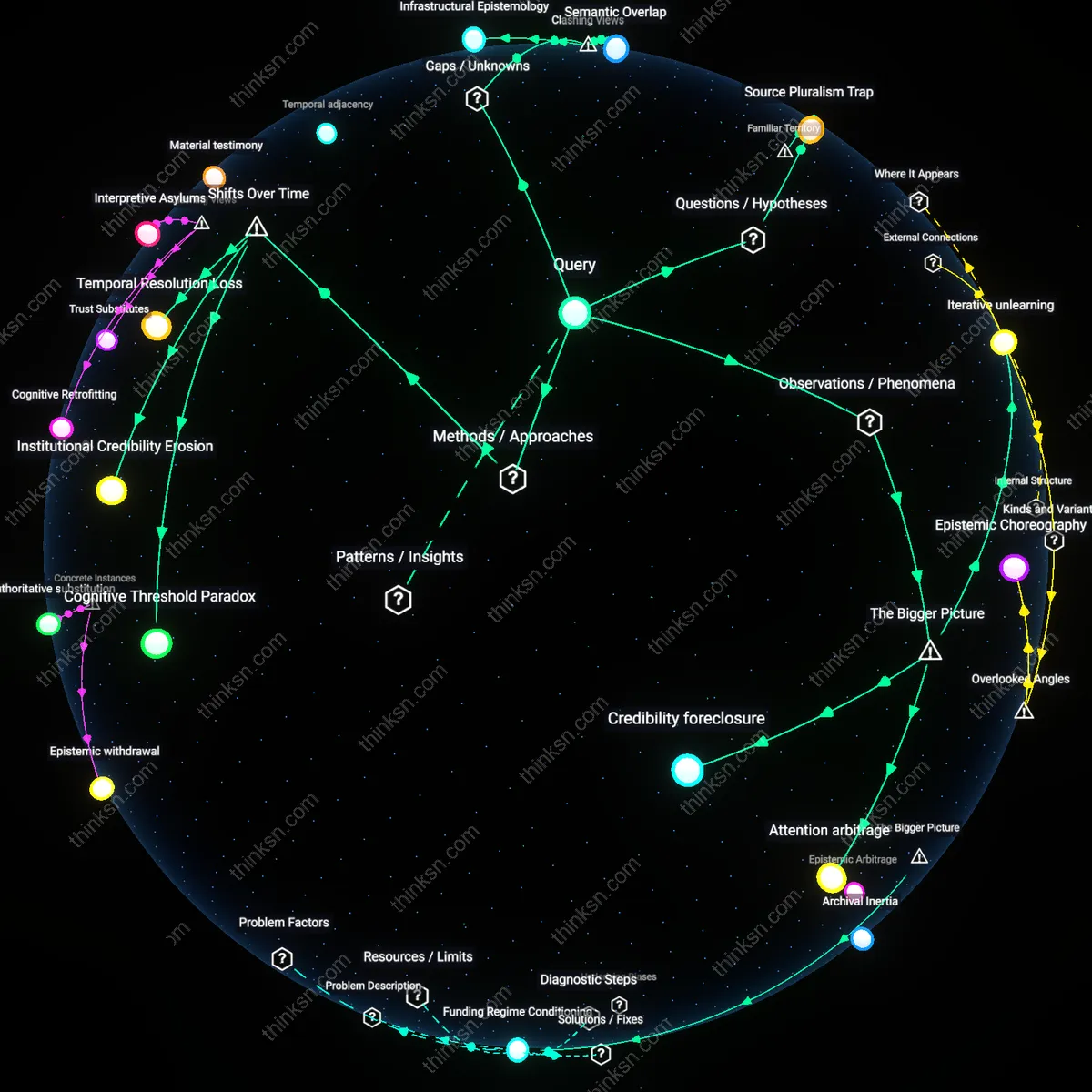
Analysis reveals 10 key thematic connections.
Key Findings
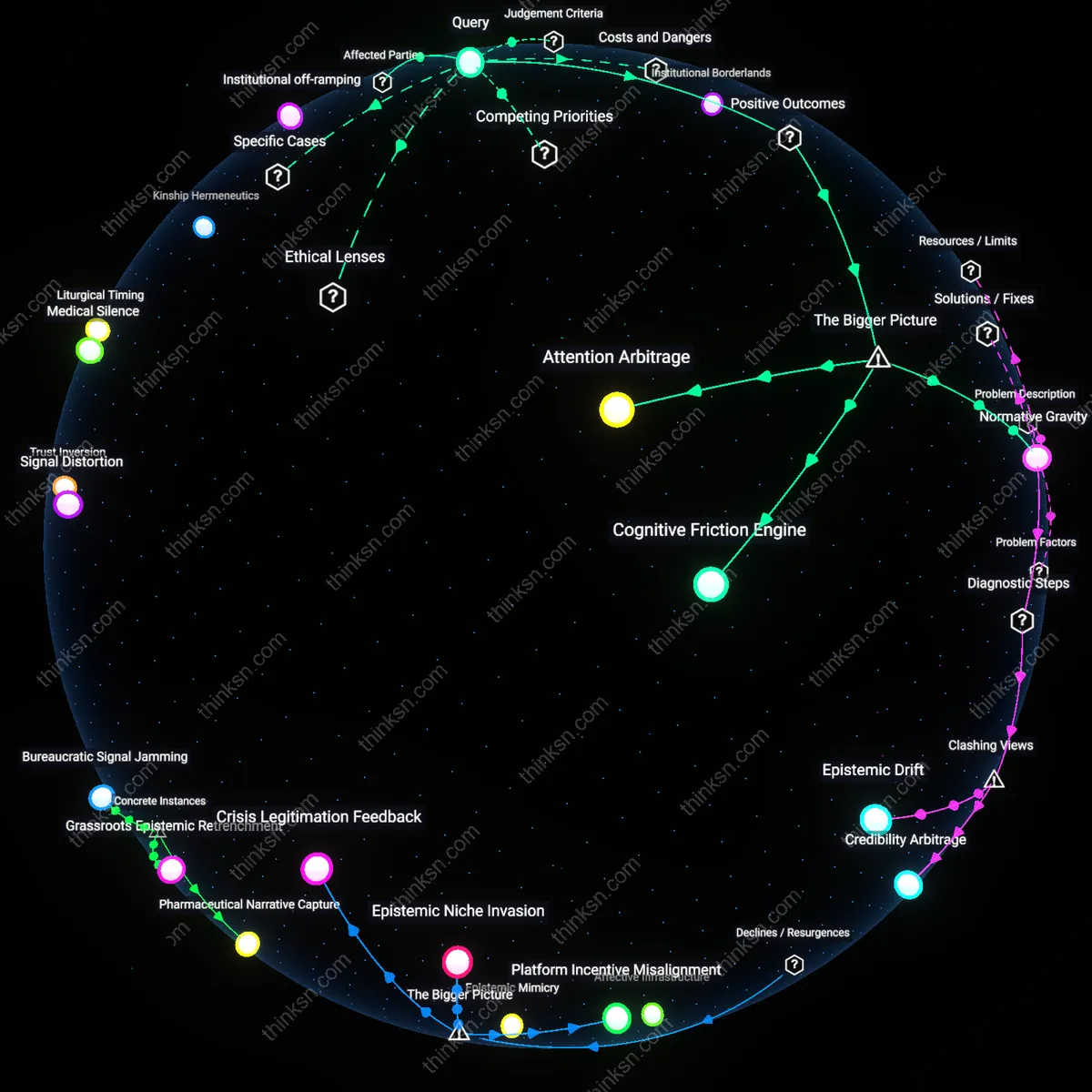
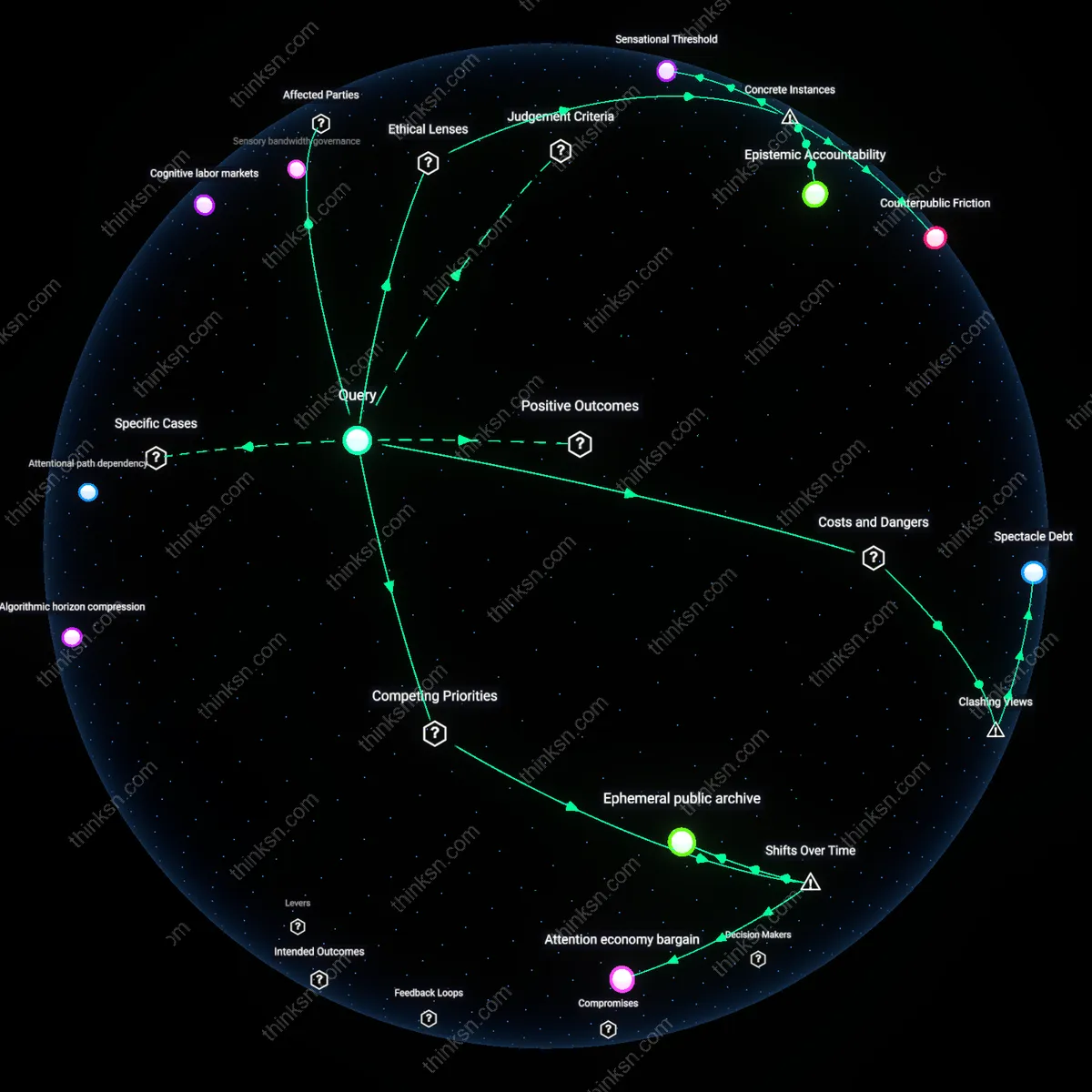
Attention arbitrage
When information environments are engineered to maximize platform engagement, seeking diverse sources amplifies epistemic overload because attention becomes a currency exploited by algorithms that prioritize virality over epistemic coherence. Content distributors on platforms like YouTube or X (formerly Twitter) deploy recommendation systems that reward emotional salience and novelty, systematically introducing contradictory narratives under the guise of diversity, which fractures users’ ability to assess credibility. This mechanism is non-obvious because users perceive their efforts as epistemically vigilant, while the system covertly substitutes breadth of exposure for quality of integration, making coherent belief formation increasingly incoherent not due to individual failure but structural manipulation. The residual concept named here is the systemic conversion of user attention into platform value at the expense of cognitive resolution.
Credibility foreclosure
Epistemic overload occurs not when information is excessive per se, but when diverse sources are equally positioned as credible despite asymmetrical epistemic foundations, thereby disabling metacognitive discrimination in lay evaluators. In public debates over climate change or vaccines, scientifically narrow consensus is presented alongside marginal dissent in the name of 'balance' by media institutions seeking neutrality, which inadvertently trains audiences to interpret peer-reviewed findings and ideologically motivated claims as equally contestable. This dynamic is significant because it shifts the burden of epistemic sorting onto individuals unequipped for domain-specific evaluation, rendering diversity a source of paralysis rather than refinement — a systemic consequence of institutional norms mistaking procedural fairness for epistemic equivalence. The phenomenon reveals how institutional credibility practices can collapse under pluralistic pressure, producing not pluralism but epistemic gridlock.
Iterative unlearning
Seeking diverse sources impairs belief accuracy when contradictory inputs trigger repeated belief revision without anchoring feedback, causing individuals to abandon correct beliefs under perceived uncertainty. In domains like financial investing or geopolitical forecasting, retail participants who consult heterogeneous sources — from Reddit forums to premium newsletters — often encounter mutually incompatible explanations that lack clear performance accountability, leading them to adopt a default skepticism toward all models, including accurate ones. This is non-obvious because cognitive resilience is typically framed as resistance to misinformation, yet here the mechanism of overload operates through the erosion of correct knowledge via constant unlearning under noise, revealing a dynamic where cognitive humility, when decoupled from reliable verification, becomes indistinguishable from epistemic drift. The concept that emerges is not mere confusion, but an active degradation of accurate understanding through repetition of inconclusive synthesis.
Source Pluralism Trap
Epistemic overload arises when exposure to multiple perspectives is mistaken for epistemic rigor, particularly in politically charged contexts like election monitoring or public health policy debates. Citizens, journalists, and officials encounter ideologically heterogeneous outlets—ranging from peer-reviewed journals to partisan blogs—and assume that sampling across this spectrum guarantees balanced understanding. However, without domain-specific expertise to evaluate evidentiary weight, people end up granting equal cognitive footing to disproportional claims, mistaking volume for validity. The underappreciated dynamic is that pluralism without epistemic calibration tools leads not to truth-tracking but to interpretive drift, where more input produces greater uncertainty and susceptibility to narrative framing.
Infrastructure Mismatch
Diverse information sources impair belief formation when personal cognitive architecture fails to align with the scale and speed of modern data ecosystems, such as during real-time disinformation campaigns on platforms like X (Twitter) or Telegram. Users attempt to synthesize inputs from official channels, crowd-sourced updates, and leaked documents, yet lack the computational support—version control, provenance tracking, conflict resolution—that institutions like intelligence agencies deploy for similar tasks. The critical but overlooked point is that what experts manage through structured analytic protocols becomes destabilizing for individuals, not because they are irrational, but because the cognitive infrastructure expected to handle diversity simply isn't available outside specialized organizations.
Cognitive Threshold Paradox
Seeking diverse information sources leads to epistemic overload when individuals encounter more contradicting expert interpretations than their cognitive schema can reconcile, a condition intensified after the democratization of digital publishing post-2008. As institutional gatekeeping eroded online, non-specialists gained access to peer-reviewed science, alternative medicine blogs, and algorithmically amplified contrarian claims simultaneously, forcing evaluative labor without proportional training. The mechanism—unstructured epistemic triangulation—requires users to arbitrate between equally vocal yet incompatible claims, producing paralysis rather than clarity. The non-obvious insight is that the historical shift from scarcity to oversupply of authority figures, not just volume, destabilizes belief formation.
Institutional Credibility Erosion
Epistemic overload emerges when the collapse of centralized knowledge institutions removes shared calibration benchmarks, a transition crystallized during the 1980s neoliberal restructuring of public media and higher education. As state-funded broadcasters and universities were defunded or commercialized, diverse sources persisted not as pluralism but as fragmented legitimacy regimes, each with distinct evidentiary standards. The mechanism—decentralized epistemic authority—means individuals must assess source reliability independently, despite lacking access to institutional memory or peer review contexts. The underappreciated consequence is that earlier pluralism assumed background consensus among experts, whereas post-institutional diversity presumes fundamental disagreement, making coherent belief formation structurally harder.
Temporal Resolution Loss
Diverse information sources impair belief accuracy when real-time data streams dissolve the distinction between provisional and settled knowledge, a shift accelerated by Twitter-driven news cycles beginning in the early 2010s. As journalists, scientists, and citizens broadcast evolving events before consensus forms, individuals absorb preliminary hypotheses as facts, overwhelming their capacity to track epistemic revision. The mechanism—compressed temporal epistemology—forces continuous reevaluation of beliefs under conditions where source diversity outpaces cognitive integration, particularly in fast-moving crises like pandemics or elections. What is rarely acknowledged is that earlier eras relied on delayed, edited reporting to filter noise, whereas current diversity includes unvetted real-time claims, transforming information richness into destabilizing flux.
Infrastructural Epistemology
Seeking diverse information sources impairs belief formation when access disparities across digital infrastructures make verification contingent on invisible technical constraints, not user intent. In countries like India, where mobile data throttling disproportionately affects lower-income users accessing fact-checking sites, the diversity of available sources creates an illusion of epistemic control while algorithmic throttling silently degrades cross-referencing capacity—rendering belief accuracy dependent on network logistics rather than critical engagement. This reveals that epistemic overload is not a cognitive failure but a systemic artifact of uneven digital plumbing, challenging the dominant view that equates source diversity with empowerment.
Semantic Overlap
Epistemic overload occurs when diverse sources use similar terminology to encode conflicting models, such as when public health agencies, naturopathic communities, and fitness influencers all reference 'immunity' with incompatible physiological assumptions during vaccine debates. The impairment arises not from volume but from lexical convergence masking conceptual divergence, causing individuals to falsely assume commensurability and blend epistemically incommensurate claims into single belief structures. This inverts the standard account of overload as information abundance, revealing instead that linguistic mimicry across domains induces synthetic ignorance through apparent coherence.