Do Consumer Arbitration Clauses Serve Lobbyists or Efficiency?
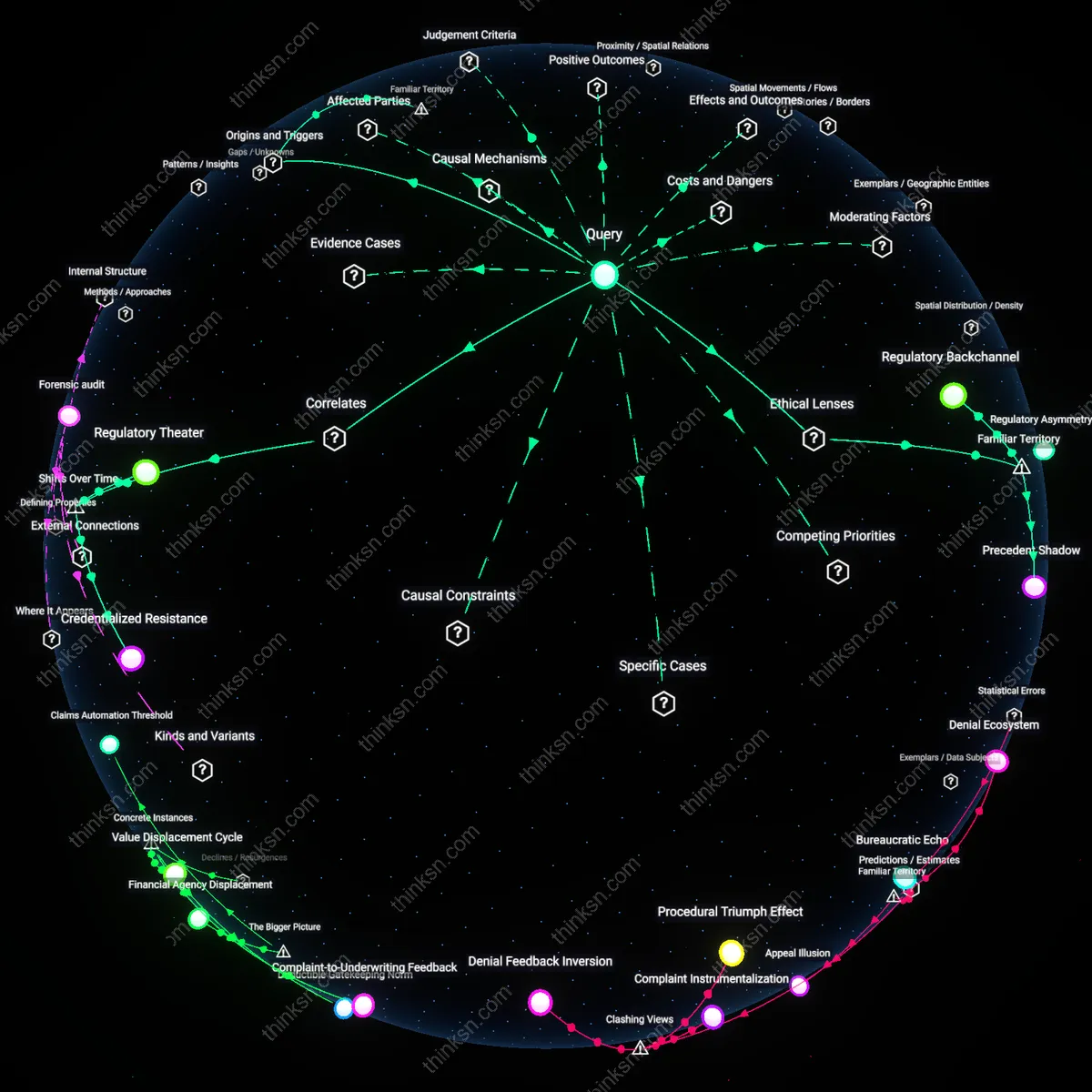
Analysis reveals 11 key thematic connections.
Key Findings
Regulatory Freeze Dynamics
Corporate lobbying has less influenced the content of consumer arbitration clauses than it has the procedural paralysis of federal regulatory agencies, preventing updates that could improve dispute resolution efficiency. The Consumer Financial Protection Bureau, for example, drafted a 2017 rule to limit forced arbitration in financial products but was systematically undermined by Congressional riders and staffing restrictions—acts lobbied for by trade groups like the U.S. Chamber of Commerce. This stagnation entrenches outdated mechanisms not because they are efficient, but because reform is institutionally blocked, shifting the battleground from legal design to administrative delay. What is overlooked is not the direct shaping of laws, but the strategic disablement of the bodies meant to adapt them, preserving arbitration regimes through inaction rather than overt legal engineering.
Judicial Feedback Loop
Federal judges appointed with support from corporate-aligned bar associations disproportionately uphold arbitration clauses, not due to explicit lobbying of courts, but because their legal socialization emphasizes contractual sanctity over consumer access to justice. This creates a feedback loop where corporate legal strategies are validated by jurists whose interpretive frameworks were shaped during careers in institutions funded by business interests, such as the Federalist Society or American Enterprise Institute. The overlooked mechanism is not lobbying the judiciary directly, but populating it with jurists whose cognitive defaults align with arbitration enforcement—making the legal framework appear neutral while being ideologically pre-filtered. This transforms lobbying into a long-term judicial conditioning process, where case law evolves not from statutory mandates but from embedded judicial dispositions.
Insurance Underwriting Incentives
The expansion of mandatory arbitration clauses is tacitly underwritten by liability insurance providers who price lower premiums for firms that adopt them, creating a hidden financial incentive disconnected from actual dispute resolution efficiency. Companies like AIG and Travelers include arbitration adoption in risk assessment algorithms, treating it as a proxy for litigation exposure regardless of whether arbitration produces fairer or faster outcomes. This shifts the driver of clause proliferation from legal or consumer considerations to actuarial calculations made in corporate back offices, where legal form follows insurance economics. The overlooked dynamic is that arbitration’s spread is sustained not by its merits or lobbying alone, but by a parallel risk-financing system that treats legal procedures as calculable exposure controls, privileging predictability over justice.
Regulatory Asymmetry
Corporate lobbying has systematically tilted the legal framework for consumer arbitration clauses toward corporate interests by exploiting disparities in regulatory access and expertise, not consumer protection outcomes. Industry groups such as the U.S. Chamber of Commerce and financial trade associations have funded model legislation and judicial outreach that weaken judicial scrutiny of mandatory arbitration, embedding procedural fairness deficits under the guise of efficiency. This asymmetry—where organized corporate actors dominate rulemaking forums while dispersed consumers lack effective representation—reveals how the durability of arbitration clauses rests less on dispute resolution performance than on institutionalized influence channels. The non-obvious insight is that the framework persists not because it resolves disputes better, but because it is shielded from accountability by unequal participation in administrative and judicial standard-setting.
Judicial Load Shifting
The legal acceptance of consumer arbitration clauses functions primarily as a mechanism to offload judicial burden onto private systems, with lobbying serving as the catalyst for legitimizing this transfer under the banner of efficiency. Courts, particularly at the state and federal trial levels, face overwhelming dockets, creating systemic pressure to endorse arbitration as a 'relief valve'—a role amplified by ABA-endorsed policies and pro-arbitration rulings like those stemming from the Federal Arbitration Act’s expansive interpretation in AT&T Mobility v. Concepcion. Corporate lobbying succeeded not by proving arbitration’s superiority in resolving disputes, but by aligning the clauses with bench-level incentives to reduce caseloads, thereby embedding a structural dependency on privatized adjudication. The overlooked reality is that efficiency here serves the judiciary’s capacity concerns, not consumer access to justice, making lobbying effective by latching onto an institutional vulnerability rather than a dispute resolution ideal.
Enforced Submission
Corporate lobbying has embedded arbitration clauses into standard consumer contracts so pervasively that opting out is functionally impossible, making consent a legal fiction. This mechanism operates through standardized form contracts in industries like telecom, banking, and gig work platforms where companies such as AT&T, PayPal, and Uber deploy mandatory arbitration as a default condition of service. The non-obvious reality beneath this familiar setup is that it is not dispute efficiency driving adoption but the preemptive elimination of class actions and public court scrutiny—leveraging the appearance of contractual fairness to mask one-sided power.
Privatized Adjudication
The legal framework treats arbitration as a neutral venue for resolving disputes, but in practice it functions as a closed system where repeat corporate players influence arbitrator selection and outcomes, while individual consumers rarely participate. This dynamic thrives in states like California and Texas where companies fund private arbitration firms such as JAMS or AAA, creating structural incentives for favorable rulings. What the public overlooks in their intuitive association of arbitration with 'faster resolution' is that speed serves corporate dockets, not fairness—turning adjudication into a routine compliance cost rather than accountability.
Opacity Shield
Arbitration clauses conceal systemic patterns of harm by prohibiting public disclosure of rulings, allowing companies to repeat harmful practices without reputational or legal consequence. This condition exists in sectors like student loans and online retail, where firms like Navient or Amazon use confidentiality to block aggregative scrutiny of predatory terms. The underappreciated danger—despite widespread familiarity with 'fine print'—is that the real issue isn't inefficiency but the deliberate erasure of legal visibility, transforming arbitration into a tool for institutional invisibility rather than conflict resolution.
Lobbying Institutionalization
Corporate capture of arbitration rulemaking intensified after the 1991 Gilmer v. Interstate/Johnson Lane decision, when financial and franchising sectors systematically embedded arbitration clauses into consumer contracts by aligning with the American Arbitration Association to standardize rules favoring enforcement over equity. This shift transformed arbitration from an industry-specific dispute tool into a legally entrenched, pre-dispute mechanism, achieved not through demonstrated efficiency gains but through coordinated lobbying to reshape judicial interpretation and procedural norms. The non-obvious outcome is that the legal framework’s expansion relied more on institutionalizing corporate access to rule-setting bodies than on measurable improvements in resolution speed or fairness.
Judicial Path Dependency
The 2010 AT&T Mobility v. Concepcion Supreme Court ruling marked a turning point where pro-arbitration precedent, initially justified on grounds of efficiency in commercial contexts, became detached from performance metrics and instead reinforced by a self-sustaining judicial trajectory favoring federal preemption of state consumer protections. Telecommunications and payday lending firms exploited this shift by designing arbitration clauses that nullified class actions, not because arbitration proved superior in dispute resolution, but because prior pro-business rulings created a path-dependent legal environment resistant to scrutiny of actual outcomes. The underappreciated dynamic is that lobbying succeeded not by proving arbitration’s efficacy, but by locking courts into a doctrinal arc that treated enforceability as an end in itself.
Asymmetric Standardization
Following the 2009 recession, fintech companies and private student loan providers adopted uniform arbitration clauses across consumer agreements—modeled on those vetted by the U.S. Chamber of Commerce’s litigation arm—thereby replacing ad hoc dispute mechanisms with a homogenized system that prioritized corporate risk containment over procedural reciprocity. This standardization wave, unlike earlier arbitration models used in labor or securities, was not accompanied by independent assessments of fairness or cost, reflecting a shift from arbitration as a bilateral tool to a unilateral shield, enabled by lobbying that preempted regulatory oversight. What remains hidden is that the framework’s scalability stems not from efficiency improvements but from the strategic replication of legally optimized, lobbying-derived templates across disparate consumer markets.