Scheduling Threshold
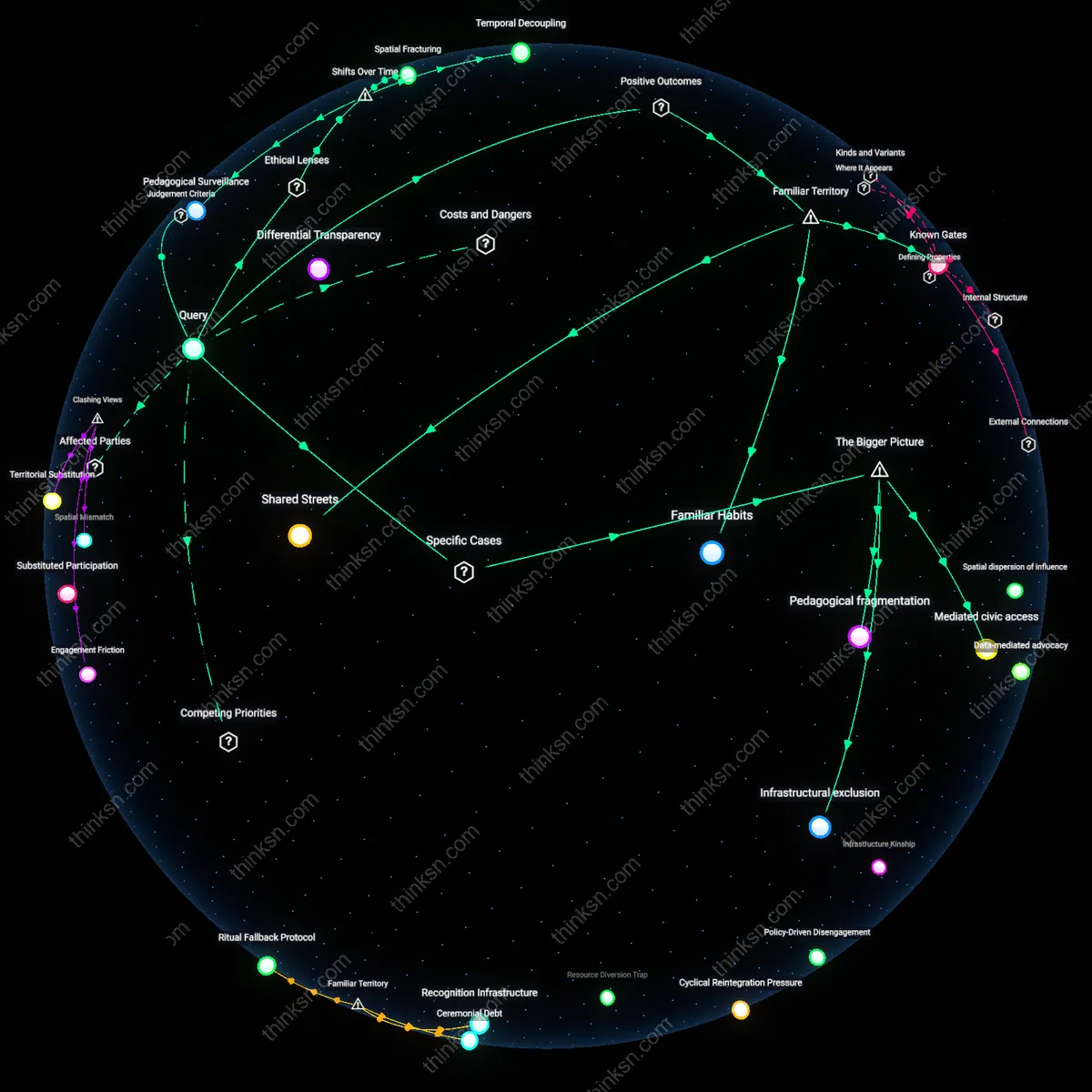
Parents who prioritize free play establish a schedule-based boundary by permitting only those structured activities that do not overlap with or displace more than 30% of weekday after-school hours. This threshold is actively policed by parental time audits conducted through shared digital calendars used by two-income families in suburban school districts with competitive extracurricular cultures. The mechanism hinges on visible time scarcity as a proxy for developmental pressure, revealing how middle-class families weaponize temporal data to resist institutional encroachment on autonomy.
Peer Density Line
These parents draw their limit at activities requiring regular participation in groups larger than eight children per adult supervisor, a ratio observed in studies of Danish ‘friskoler’ (free schools) and replicated in U.S. forest kindergartens. This criterion emerges from parental alignment with ecological developmental psychology, where bodily risk and unmediated peer negotiation are treated as cognitive catalysts only possible below critical group mass. The non-obvious insight is that the boundary isn't about time but spatial-social density—a systemic response to institutional risk-aversion in mainstream schooling that suppresses sensory feedback loops.
Initiative Ownership
The line is drawn at whether the child independently renews a weekly commitment to an activity without parental prompting, measured over a trimester period in parental logs across progressive homeschooling networks in Oregon and Vermont. This hinges on decentralized decision-making circuits in child-led pedagogy systems, where scheduling is treated as a test of agency retention rather than balance. The significant dynamic is that structured activities are conditionally accepted only when they survive market-like attrition based on demonstrated child interest, exposing a micro-economy of attention operating beneath family routines.
Play Infrastructures
Parents who prioritize free play do not draw a line between unstructured time and scheduled activities based on time allocation but through the design of domestic spatial arrangements. They configure homes and yards with loose parts, accessible outdoor zones, and minimized adult-directed zones—such as removing branded play equipment in favor of mobile, open-ended materials—so that spontaneous play becomes the default mode even during designated 'free' hours. This architectural embedding of randomness challenges the common assumption that scheduling dictates developmental balance; instead, it reveals that unstructured play persists not when 'allowed' but when physically presupposed, exposing a hidden dependence on environmental grammar over parental calendars.
Pedagogical Invisibility
The line between free play and structured time dissolves when parents redefine learning itself as undetectable during play, erasing the need to compartmentalize. Waldorf-influenced families in Northern California, for instance, reject visible curricula entirely, treating baking, walking, and storytelling as math, ecology, and rhetoric—thus eliminating the need to 'schedule learning' because cognition is assumed to be omnipresent in unstructured time. This undercuts the standard trade-off model of activity versus leisure by asserting that all time is pedagogical if perception is refracted correctly, revealing how parental ideology can collapse categories thought to be inherently in tension.
Play Infrastructure
Parents who value free play limit scheduled activities only where institutional alternatives like school or urban design fail to embed spontaneous play into daily environments. This occurs through municipal park systems, neighborhood layouts, and recess policies that determine when, where, and how children access unstructured time without parental scheduling. Most assume free play competes with structured enrichment, but the real constraint is often the absence of physical and social infrastructures that make self-directed play a default—not a choice—revealing how dependency on built environments shapes seemingly personal parenting decisions.
Temporal Ownership
These parents draw the line when scheduled activities usurp a child’s control over their own time, particularly during after-school hours when logistical demands like carpool or extracurricular logistics might otherwise dominate. The mechanism is the household’s negotiation of agency, where parents treat unscheduled time as a domain belonging to the child, not to be colonized without consent. Though people commonly frame scheduling as developmental support, what’s underappreciated is how resisting over-scheduling becomes an act of recognizing children as time-autonomous agents, not just passive recipients of enrichment.
Risk Entitlement
The boundary emerges where scheduled activities eliminate exposure to manageable risks—such as unmonitored outdoor exploration—that parents believe are essential for emotional resilience. This line is enforced through deliberate withdrawal from safety-optimized programs like indoor play centers or supervised camps, favoring environments where children encounter unpredictability without adult intervention. While public discourse ties free play to creativity or joy, the less-discussed driver is a belief that risk itself is a developmental right, not a hazard to be engineered out of childhood.
Temporal Ownership Threshold
Parents who value free play draw the line when a child’s routine allocates uninterrupted blocks of time exceeding two hours, because this duration triggers a psychological shift in the child’s perception of agency over their own time. The mechanism operates through household micro-scheduling norms, where parents unconsciously treat shorter blocks as 'available' for insertion of adult-led activities, while longer stretches are tacitly protected as belonging to the child. This overlooked threshold—distinct from activity content or frequency—reconfigures the power dynamic in time allocation, making duration itself the hidden regulator of autonomy rather than the type of activity.
Sibling Negotiation Load
The boundary between unstructured play and scheduled activities is primarily determined by the cognitive burden of mediating sibling conflict during free play, not parental philosophy or available time. In multi-child households, parents calibrate unstructured periods based on the exhausting, unacknowledged labor of arbitrating disputes that emerge when children co-regulate play, leading them to schedule activities precisely when relational friction exceeds a household-specific tolerance. This dynamic transforms free play from a developmental ideal into a social coordination problem, revealing that sibling dynamics—not time or resources—are the stealth variable shaping scheduling decisions.
Urban Zoning Threshold
In Copenhagen’s Ørestad district, parents who prioritize free play allow unstructured time only within walking distance of their residences, relying on municipal 'play-tube' networks—physically connected, car-free green corridors—that cap scheduled activity penetration at 30% of weekday afternoon hours. This geographic constraint reframes freedom as proximity-bound mobility, revealing that zoning infrastructure, not parental philosophy alone, enforces the boundary between structure and spontaneity. The non-obvious insight is that the city’s spatial design codifies play autonomy through literal path access, making urban form the silent regulator of temporal freedom.
Forest School Calibration
At the Schullandheim Feldafing residential forest school in Bavaria, parents permit only one scheduled activity per week—mandatory instrument lessons—while all other time is unscheduled, monitored not by clocks but by natural transitions like meal smoke signals and dusk drum calls. The school’s institutional rhythm replaces calendar logic with environmental cues, demonstrating that withdrawal from scheduling requires external systemic substitution. What is underappreciated is that parents rely on third-party ecosystems to absorb decision fatigue, using the forest’s tempo as a socially sanctioned boundary mechanism.
Digital Immunity Contract
In rural Vermont, the Putney Student Travel Program enrolls parents in a signed 'no-screens, no-schedules' compact that only lifts during inter-family shuttle rotations, when children are transported between homes and may access coordinated extracurriculars. The contract conditions structured time on physical transit, making vehicle movement the threshold for scheduled engagement. This reveals that certain communities treat mobility through networked private spaces as the legitimate trigger for temporally bounded activities, converting logistical necessity into a ritualized exception gate.