Research Role vs. Stable Income for College-Bound Kids?
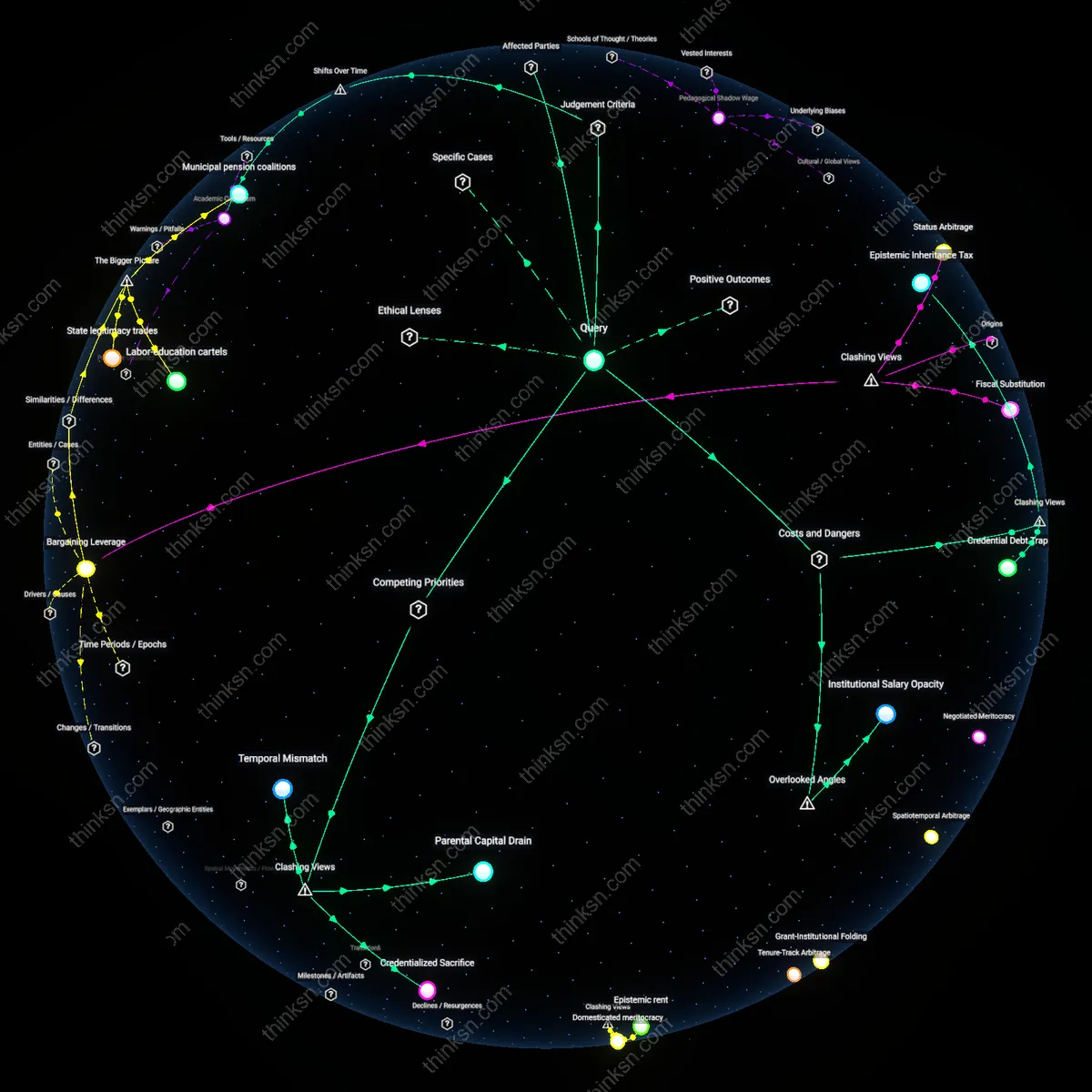
Analysis reveals 10 key thematic connections.
Key Findings
Academic Spousal Capital
Prioritize dual-career academic partnerships where one partner’s institutional position carries dependent educational benefits that offset future college costs. Universities like the University of California or Big Ten schools often provide full tuition waivers for faculty dependents, effectively converting spousal employment in academia into a form of prepaid college funding—this transforms the valuation of a partner’s academic career from a mere income stream into a hidden educational endowment. Most analyses of dual-career households focus on income pooling or geographic constraint, ignoring how one partner’s employment benefits can systematically de-risk the other’s intellectually driven but lower-earning research path. This reframes 'spousal support' not as emotional or financial compromise but as strategic asset deployment within knowledge institutions.
Pedagogical Shadow Wage
Treat undergraduate research mentorship at teaching-intensive institutions as a covert financial instrument that amortizes future education costs through reputational accumulation. Professors who consistently mentor high-achieving students generate durable referrals to elite graduate and professional programs, which in turn increase the likelihood that their own children—when applying to college—will benefit from internal advocacy networks, legacy-adjacent recognition, or developmental opportunities like early research placements. This indirect payoff is rarely accounted for in career utility models, which treat teaching as a time cost rather than a long-term social capital investment. The overlooked mechanism is that consistent mentorship builds a 'shadow curriculum vitae' for the professor’s family, altering intergenerational access dynamics in ways that parallel informal legacy admissions.
Academic Capitalism
Pursue tenure-track research positions in public research universities to leverage state-subsidized job stability against private education costs, because the post-1980 shift from civic academic missions to market-aligned knowledge production has embedded individual researchers within hybrid systems of public funding and tuition-dependent revenue streams. Public research institutions now operate as semi-privatized entities where faculty generate external grants that subsidize both their salaries and institutional overhead, effectively monetizing intellectual labor in ways that offset personal financial risk. This reconfiguration—accelerated by state disinvestment and the rise of performance-based funding—transforms the researcher into a revenue node, making intellectual fulfillment contingent on entrepreneurial acumen rather than pure inquiry, a tension rarely acknowledged in career planning for parenthood.
Academic Austerity
Pursue tenure-track research careers only in public institutions with binding tuition-free education promises to employees' children, because the systemic underfunding of academic labor makes personal intellectual fulfillment a subsidy to elite knowledge production at direct cost to household financial resilience. State colleges like City University of New York have long tied employee benefits to family education access, exposing how the romanticized independence of research labor depends on institutionalized wage suppression—where the professor’s sacrificed market value funds both knowledge and kin, revealing that intellectual autonomy is structurally contingent on institutional austerity regimes.
Credential Debt Trap
Reject the assumption that children must attend college to validate parental sacrifice, because middle-class research professionals reproduce intergenerational risk by internalizing education as a moral obligation rather than a financial decision—leading to dual ruin when academic salaries underwrite debt-laden degrees that fail to generate economic mobility. At institutions like University of California or University of Michigan, dual-career PhD households routinely commit to elite undergraduate programs for children, not through wealth, but through deferred consumption and mortgage refinancing, thereby embedding intellectual vocation within a debt-driven parenting ideology that dissolves both scholarly purpose and fiscal stability.
Epistemic Inheritance Tax
Treat children’s college education not as an investment but as an extraction mechanism, because the research university system tacitly demands that scholars pay for their own reproduction through opportunity costs that are transferred to the next generation—where faculty forego industry wages to pursue knowledge, then demand equivalent prestige for their children’s education, locking families into high-cost, low-liquidity pathways. This occurs explicitly in Ivy League satellite networks, where faculty children are informally steered toward legacy admissions not for social mobility, but to preserve epistemic status, demonstrating how research careers treat education as a status inheritance rather than economic provisioning.
Institutional Salary Opacity
Remain in a research position while underestimating college costs because university payroll structures obscure long-term earning potential, particularly through non-linear compensation models that include soft money, summer salary uncertainty, and indirect cost dependencies. Researchers on grant-funded lines often cannot accurately project five-year income, making it impossible to use standard college savings calculators or tuition payment plans that assume wage stability. This opacity acts as a silent risk multiplier, where parents miscalibrate risk not due to personal miscalculation but because the financial architecture of research employment conceals volatility behind the façade of institutional affiliation—a hidden dependency that undermines household financial modeling in ways specific to academia.
Parental Capital Drain
Prioritize financial stability over research because academic careers systematically extract uncompensated time and emotional labor from parents, disproportionately affecting those in tenure-track roles at public research universities where service demands and teaching loads undermine dual-career viability; this dynamic reveals that the romanticized ideal of knowledge pursuit actively erodes household sustainability, exposing how institutional prestige relies on invisible familial subsidization.
Credentialized Sacrifice
Choose the research path only if children are framed not as dependents but as future credential-holders within the same system, because elite research environments covertly reward intergenerational replication of academic privilege through tuition access, networking, and cultural capital—this reframes college funding as an investment in dynastic knowledge production, challenging the notion that financial trade-offs are zero-sum when long-term academic belonging is the metric.
Temporal Mismatch
Reject the binary by recognizing that the peak financial burden of child-rearing aligns with the most precarious phase of a research career—pre-tenure—while meaningful intellectual returns are delayed into mid-career, creating a temporal misalignment that destabilizes family planning; this exposes tenure-track timelines as implicitly structured around single-earner or childless models, making dual-commitment viability a function of institutional rigidity rather than personal failure.