Family Unity or Financial Risk: Should You Manage Parents Investments?
Analysis reveals 9 key thematic connections.
Key Findings
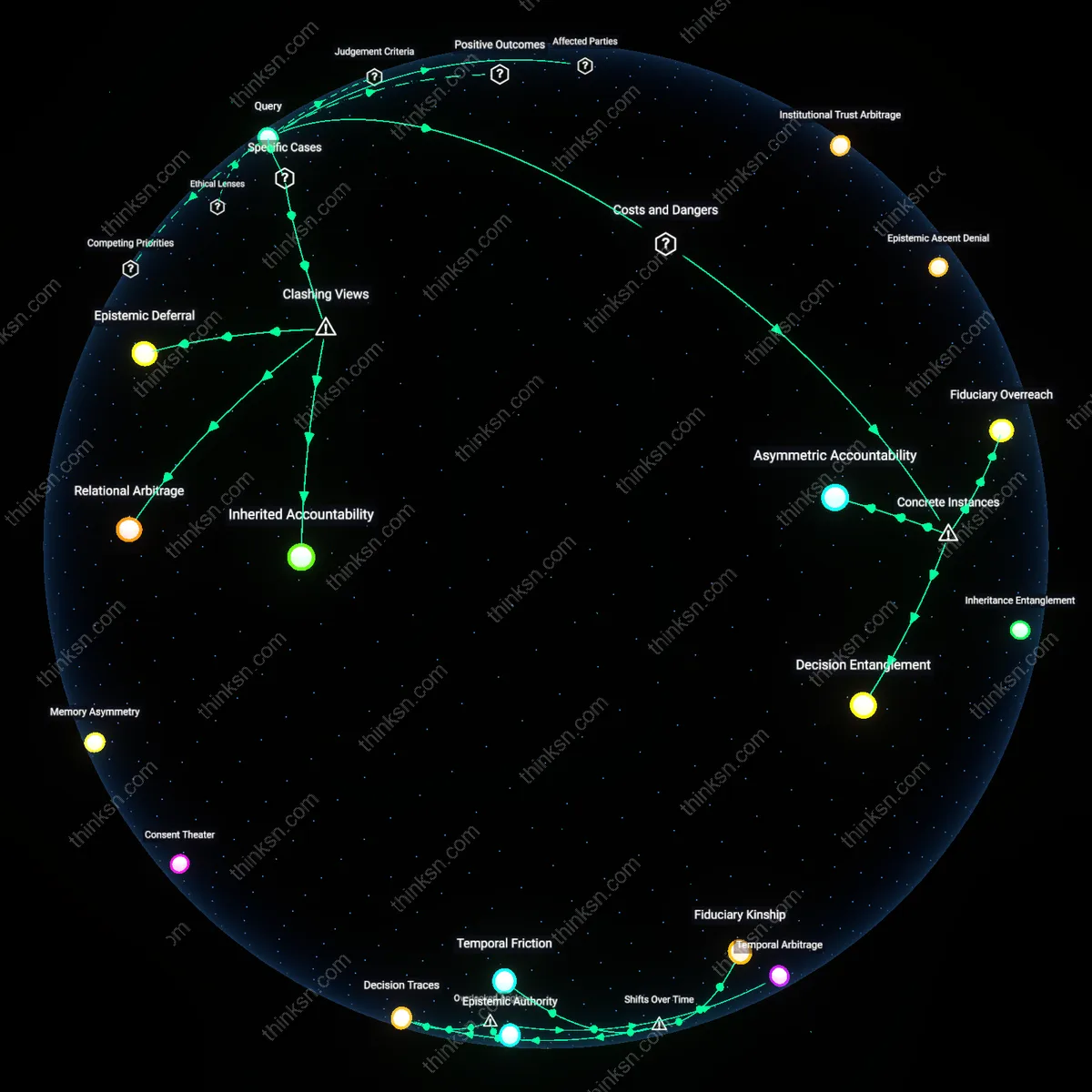
Institutional Trust Arbitrage
Agreeing to co-manage a parent's investments without expertise erodes family harmony by positioning the amateur manager as a de facto fiduciary while bypassing regulated financial institutions, thereby transferring systemic accountability risks onto kinship networks. Family members become unintentional intermediaries of institutional trust typically held by licensed advisors, distorting expectations of reliability and recourse when performance falters—especially when parents perceive their child as fulfilling a professional role despite absence of credentials. This misalignment is typically overlooked because families focus on emotional intent rather than the latent substitution of regulated financial governance, altering the risk calculus by embedding fiduciary-like expectations within relationships unequipped to handle regulatory or liability frameworks.
Epistemic Ascent Denial
Co-managing a parent’s portfolio without expertise risks long-term relational fracture by suppressing the child’s visible epistemic dependence on external research or advice, creating covert power struggles over decision validation within the family hierarchy. The parent, often accustomed to authority in familial domains, may unconsciously resist deferring to sources the child cites (e.g. financial literature or algorithms), interpreting them as challenges to lived experience rather than compensatory tools. This dynamic is rarely acknowledged because most analyses assume knowledge gaps are neutral, failing to see that the refusal to institutionalize learning—by bringing in a third-party expert—forces familial roles to mediate technical uncertainty, transforming financial underperformance into personal betrayal.
Temporal Legibility Debt
Families who co-manage investments without expertise accumulate temporal legibility debt by deferring transparent performance benchmarks and decision logs, assuming emotional continuity will preserve coherence across years of market shifts and cognitive decline. As the parent ages, the informal, memory-dependent rationale behind trades becomes inaccessible, leaving successors unable to audit or justify positions during estate transitions—often revealing conflicts between stated values and actual allocations. This hidden cost is absent from standard discussions, which treat family investment roles as static, when in reality the absence of documented reasoning processes converts financial ambiguity into intergenerational suspicion during moments of heightened vulnerability.
Fiduciary Overreach
Co-managing a parent's investments without expertise risks breaching fiduciary duty, as when a daughter in Palo Alto liquidated her mother’s dividend stocks to invest in speculative tech ETFs, triggering a taxable event and permanent portfolio loss—revealing that familial trust can override financial prudence, enabling well-intentioned but structurally unsound decisions under the guise of shared responsibility.
Decision Entanglement
In a 2019 case from Broward County, Florida, a son co-managing his father’s retirement account introduced complex options trading despite no formal training, causing a 38% drawdown; the father, reluctant to confront his son, delayed terminating the arrangement, exposing how emotional dependency entangles financial decision-making, where relational inertia sustains harmful strategies longer than arm’s-length partnerships would tolerate.
Asymmetric Accountability
A Minneapolis family trust eroded after a grandson assumed co-management of his grandmother’s portfolio using robo-advisor platforms marketed as 'foolproof,' but failed to rebalance during the 2020 market crash, leading to outsized losses—demonstrating that informal family mandates lack the corrective mechanisms of professional oversight, where unmonitored amateur custodians face no enforcement, turning benign neglect into systemic risk.
Inherited Accountability
Inherited Accountability
Relational Arbitrage
Relational Arbitrage
Epistemic Deferral
Epistemic Deferral