Institutional scaffolding
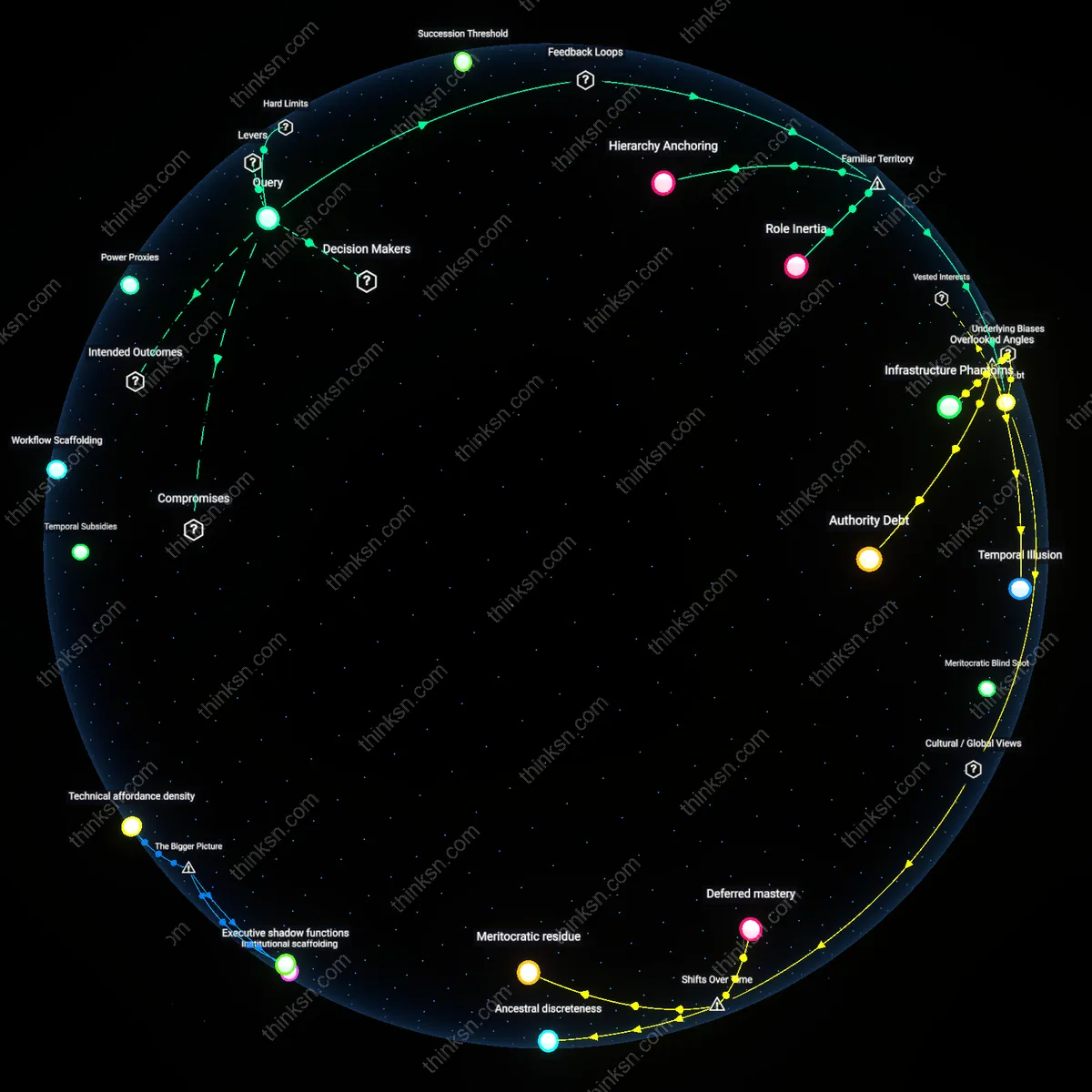
This manager depends on institutional scaffolding from prior roles—stable reporting structures, established cross-departmental protocols, and embedded compliance mechanisms—that silently absorb coordination costs. These systems, built over years within a mature organization, allow managers to appear effective without demonstrating systems-thinking, because workflows self-stabilize through redundancy and cultural inertia. When transplanted into a leaner or younger organization where such scaffolding is thin or absent, the manager cannot replicate performance because they lack the procedural substitutes to manage ambiguity or resolve interdependence. The non-obvious insight is that individual leadership efficacy is often a joint product of personal skill and invisible organizational mass, not skill alone.
Executive shadow functions
The manager’s past effectiveness was systemically enabled by unacknowledged executive shadow functions—such as an experienced COO quietly reconciling operational misalignments or HR pre-negotiating team tensions before they escalated. These behind-the-scenes interventions, rarely visible to mid-level leaders, functioned as a latent error-correction layer that compensated for gaps in communication, planning, or judgment. In a new role lacking such protective overhead, minor managerial missteps accumulate into systemic failures because no parallel mechanism absorbs fallout. The critical oversight is how organizational hierarchy often contains hidden buffering roles that preserve leadership credibility without improving it.
Technical affordance density
The manager’s decision-making was historically supported by high technical affordance density—an ecosystem of integrated software, automated reporting pipelines, and real-time dashboards that reduced cognitive load and masked delays in human judgment. In prior roles, tools anticipated needs (e.g., CRM flags, inventory predictors), enabling the illusion of proactive leadership. In a new environment with lower digital infrastructure maturity, the same manager struggles with situational awareness, revealing dependence on technology-mediated responsiveness rather than intrinsic strategic capacity. The overlooked reality is that digital ecosystems can function as cognitive prosthetics, and their absence exposes gaps in autonomous decision-making.
Shadow Infrastructure Dependence
At NASA’s Jet Propulsion Laboratory during the 2009 Mars rover deployments, engineering managers relied on informal coordination channels with retired specialists who informally reviewed mission-critical code—a support system never documented or acknowledged in organizational charts. This reliance only became visible when delays in later missions were traced to the unavailability of these individuals, revealing that tacit validation rituals had substituted for formal verification protocols. The mechanism—an invisible network of legacy trust and voluntary mentorship—was analytically significant because it exposed how high-reliability organizations can silently outsource risk mitigation to personal goodwill. What is non-obvious is that the manager’s apparent success in one context was less a function of process rigor than of ambient access to a vanishing cohort of system-aware elders.
Cultural Debt Anchoring
When Nokia’s smartphone division faltered in 2010–2011, executives transplanted team leaders from its legacy hardware divisions into software strategy roles, assuming competence would transfer—yet those leaders unknowingly depended on a culture of top-down consensus that had been sustained by decades of shared Finnish engineering norms within stable teams. This support system, which enabled rapid alignment without explicit communication, collapsed in global cross-functional software teams where ambiguity required negotiation rather than assumption. The mechanism—culturally encoded decision inertia—was significant because it showed how managerial efficacy can be parasitic on homogenous organizational microclimates. The non-obvious insight is that leadership behaviors interpreted as personal competence were, in fact, emergent properties of a specific sociotechnical ecosystem now absent.
Surrogate Accountability Networks
During the 2008 restructuring at General Motors, plant managers relocated from Detroit to oversee new operations in Korea struggled despite identical performance metrics because they had unknowingly depended on union stewards as proxy feedback sensors who surfaced operational risks before crises emerged. In the Korean context, where labor relations followed hierarchical reporting, that lateral early-warning system vanished—yet neither the managers nor headquarters recognized its role in pre-failure detection. The mechanism—a distributed surveillance network mediated by adversarial collaboration—was significant because it demonstrated how managerial control can be outsourced to structurally opposed actors under stable industrial relations. The non-obvious point is that some oversight functions are sustained not by design, but by the productive friction of contested authority.
Trust Infrastructure
Institute regular peer feedback loops across teams to expose and reinforce reliance on informal credibility networks. Most managers depend on accumulated goodwill and recognized competence from past environments—often invisible until they’re absent in a new context where their reputation hasn’t transferred. This trust infrastructure operates through daily coordination cues, delegation acceptance, and conflict resolution efficiency, yet it's rarely acknowledged as a functional system. What’s underappreciated is that organizational trust isn’t just cultural—it’s operational infrastructure that enables decisions to stick without constant oversight.
Workflow Scaffolding
Mandate standardized handoff templates and cross-role process maps during onboarding to reveal hidden dependencies on familiar execution rhythms. Managers often assume teams share an implicit understanding of timing, communication channels, and escalation paths, but these workflow scaffolds are usually role- or company-specific and vanish when contexts change. This system operates through predictable human and technical response patterns that reduce coordination overhead. The non-obvious insight is that familiarity with micro-processes—like when to email versus call—functions as cognitive load reduction, and its absence causes silent breakdowns in execution speed and quality.
Power Proxies
Implement transparent decision-rights charts and escalation protocols to surface unexamined reliance on historical positional influence. Managers frequently depend on secondary sources of authority—like access to senior leaders, control over project visibility, or informal advisory roles—that aren't codified but heavily shape outcomes. These power proxies operate through social capital accrued in prior positions and quietly enable agenda-setting without formal mandates. The overlooked reality is that in new roles, especially across organizations, these proxies evaporate first, crippling influence before performance issues become visible.
Shadow Infrastructure
This manager depends on informal peer coalitions that quietly absorb workflow overflows, where mid-level staff in their prior division routinely adjusted timelines and reallocated tasks without formal approval to maintain output. These ad-hoc coordination circuits, sustained by years of reciprocal trust and shared performance pressure, are invisible in org charts but critical to operational continuity. Their absence in a new role—where departmental silos and compliance rigidity prevent such improvisation—exposes the manager to cascading delays previously masked by collective buffering. Contrary to the assumption that individual leadership drives execution, the real engine was a clandestine pact among implementers, revealing how much 'individual' performance relies on unseen collective tolerance.
Latent Escalation Pathways
The manager's effectiveness was artificially sustained by unacknowledged access to senior executives who informally intervened in bottlenecks when projects neared failure, a privilege earned through proximity and past loyalty in a tightly-networked headquarters office. This backchannel escalation, never documented or available to all, allowed critical roadblocks to dissolve without public escalation or process reform. In a decentralized or rules-bound new role, such access vanishes, turning minor obstacles into fatal delays. This contradicts the dominant belief that process mastery ensures resilience, exposing instead a hidden dependency on political capital disguised as operational skill.
Temporal Subsidies
The manager succeeded by leveraging time arbitrage from teams in earlier time zones who routinely completed preliminary work outside standard hours, effectively extending the operational day without formal overtime or resourcing. This unmeasured contribution—based on cultural norms in offshore offices—created the illusion of efficient planning while masking chronic under-resourcing. In a new role without global teams or with strict labor boundaries, this temporal cushion disappears, collapsing the planning horizon and overloading local staff. Against the conventional focus on budget or tools as constraints, this reveals time itself as a covert, inequitably distributed resource that props up managerial mythologies.