What Does a Parents Estate Plan Say About Generational Trust?
Analysis reveals 8 key thematic connections.
Key Findings
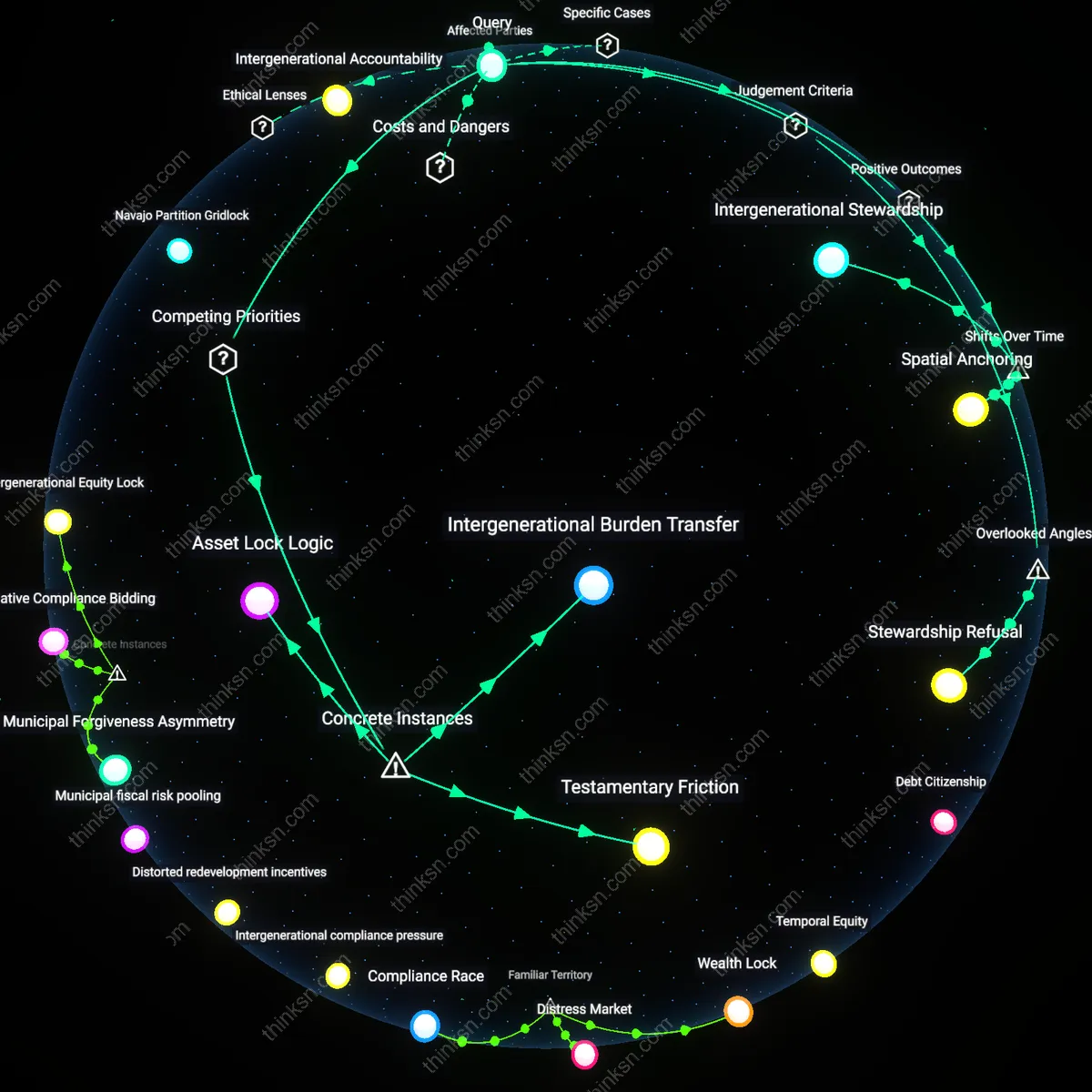
Intergenerational Accountability
A parent’s decision to transfer illiquid real estate without liquid assets establishes a binding expectation that heirs must collectively steward inherited property, revealing that intergenerational expectations are structured around ongoing responsibility rather than immediate consumption. This claim holds because adult children become de facto co-trustees of a shared estate, subject to municipal tax regimes, inheritance laws, and kinship norms that require cooperation—often under penalty of forced sale or family dispute. The non-obvious force here is not wealth preservation alone, but the activation of legal and social mechanisms that compel heirs to maintain familial presence in specific geographies, such as rural landholding communities in France or agricultural zones in Japan, where land fragmentation threatens intergenerational continuity. This dynamic embeds heirs in a web of inherited duty, making accountability the true inheritance.
Estate Entanglement
By requiring heirs to manage real estate without liquid reserves, parents embed their descendants in long-term financial and managerial dependencies that reveal intergenerational expectations as tools of control rather than liberation. This occurs because real estate maintenance—especially in high-tax or regulated jurisdictions like California or the UK—forces heirs into shared financial commitments, exposing them to market volatility, insurance mandates, and maintenance costs they may not be equipped to handle. What is underappreciated is that this setup often reflects a parental belief that overcoming such friction builds character or reinforces familial cohesion, yet it simultaneously traps heirs in a jointly liable asset structure that can deter individual economic mobility, particularly for younger generations facing housing affordability crises. Thus, the estate becomes a mechanism of silent coercion, perpetuating class-specific burdens under the guise of legacy.
Stewardship Refusal
A parent’s decision to leave real estate but no liquid assets reflects a deliberate rejection of intergenerational wealth transfer as entitlement, signaling that heirs must earn inclusion in stewardship through demonstrated management commitment. This mechanism embeds economic responsibility within familial duty, using property not as passive inheritance but as an active trial of competence—where access to equity is contingent on performance. Unlike standard analyses that frame asset distribution as generosity or favoritism, this angle reveals how the absence of liquidity functions as a disciplinary device, conditioning belonging on effort; what is overlooked is that real estate here operates less as wealth than as a proving ground. The non-obvious insight is that disinheritance in liquid form may be a form of moral investment, not deprivation.
Intergenerational Stewardship
A parent’s decision to transfer real estate without liquid assets cultivates long-term responsibility by requiring heirs to maintain and manage property, a shift from mid-20th-century norms where estates were often liquidated for immediate consumption. This reflects a post-1980s transition in wealth transfer toward active engagement with productive assets, particularly among agrarian and rural landholding families in regions like the U.S. Midwest or Southern Europe, where intergenerational continuity depends on land use rather than cash distribution. The mechanism—deliberate under-liquidity—forces coordination, dispute resolution, and investment planning among heirs, revealing an expectation that family cohesion is sustained through shared labor, not passive inheritance. What is underappreciated is how this practice counters the postwar trend of financialization, re-embedding economic obligation in physical and social place.
Spatial Anchoring
Requiring heirs to manage inherited real estate rather than dispersing liquid wealth reflects a late-modern response to increasing geographic mobility and familial fragmentation, particularly visible since the 2000s in suburban and exurban American communities. Unlike the mid-century pattern of dispersing cash to support individual upward mobility, this approach intentionally ties family identity to specific parcels—houses, farms, or rental complexes—creating structural incentives for multi-generational co-residence or proximity. The mechanism operates through deed restrictions, shared equity models, or family LLCs that legally bind ownership to ongoing participation, thereby producing geographic continuity even as economic lives diversify. The underappreciated shift is that real estate here functions not as an asset class but as a kinship technology—one that stabilizes lineage in an era of digital detachment and nomadic careerism.
Intergenerational Burden Transfer
A parent’s decision to transmit illiquid real estate while withholding liquid assets shifts the burden of liquidity management to heirs, as seen in the post-WWII division of Japanese family-owned urban land parcels in Tokyo, where fragmenting ownership among siblings required consensus-driven management under Japan’s Civil Code Article 250, revealing that forced collaboration on non-liquid assets prioritizes familial continuity over individual autonomy, a non-obvious trade-off where collective stewardship undermines generational exit options.
Testamentary Friction
The 1980s breakup of the Astor family real estate trust, which held vast Manhattan properties, exposed how withholding liquid assets compels heirs to navigate prolonged co-ownership under fiduciary constraints, revealing that testamentary design favoring asset preservation over liquidity generates prolonged decisional interdependence, a mechanism in which estate planning becomes a tool of behavioral control disguised as legacy, a dynamic rarely acknowledged in inheritance ethics discussions focused on equity rather than enduring influence.
Asset Lock Logic
In West Germany’s postwar Erbbaurecht (building lease) system, parents retained ground ownership while passing leasehold structures to children, conditioning inheritance on non-sale clauses and state-mandated reinvestment, which reveals that tethering heirs to immovable assets institutionalizes intergenerational accountability, where security of tenure substitutes for liquid wealth, a calculated exchange in which the state and family jointly constrain exit to preserve socio-spatial order, an underappreciated fusion of public policy and private obligation.