Are Social Media Giants the New Utilities of Our Digital Age?
Analysis reveals 7 key thematic connections.
Key Findings
Jurisdictional Arbitrage
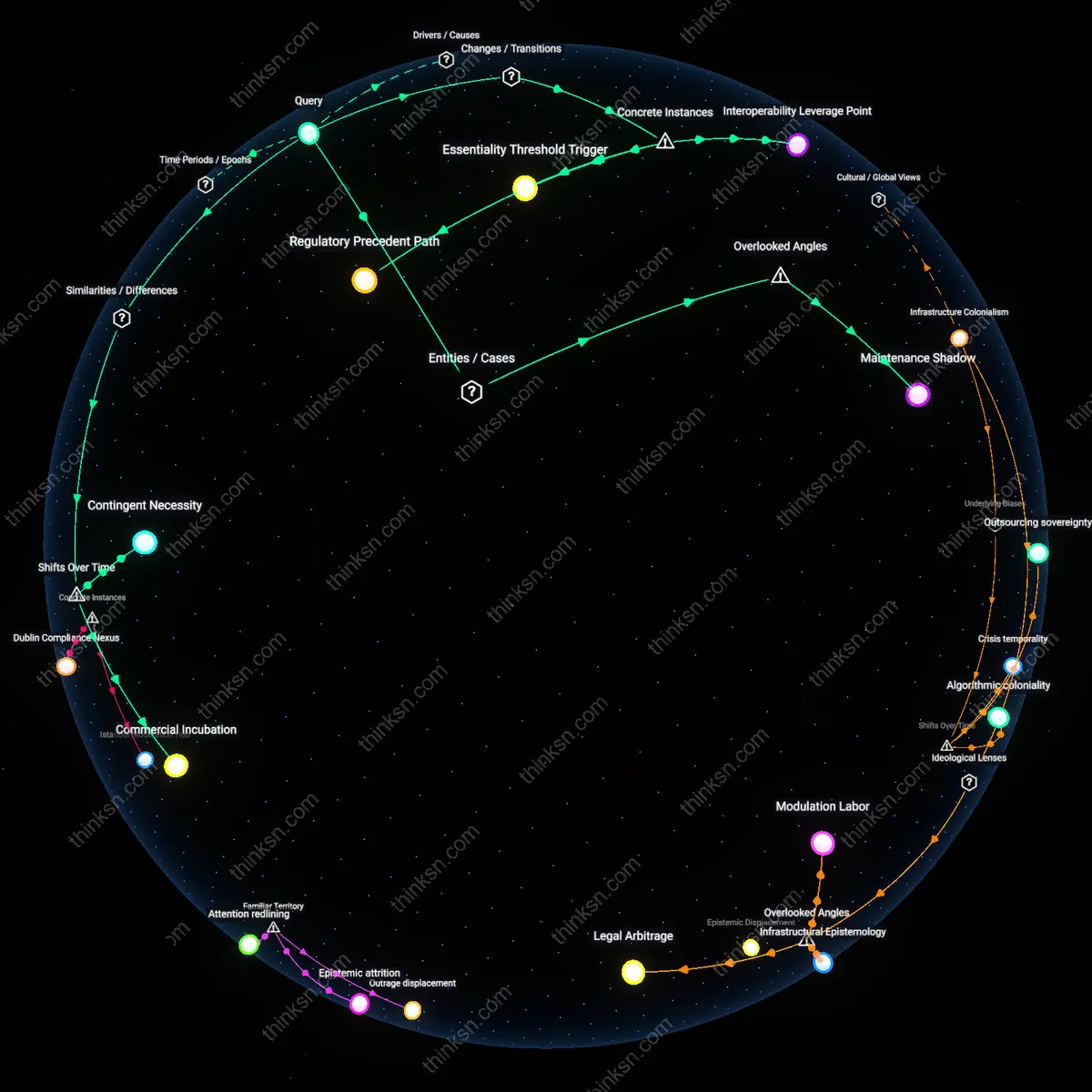
When regional telephone companies emerged from the divestiture of AT&T, they remained subject to state-level public utility commissions with enforceable service obligations, a constraint absent in the governance of global social media platforms. The overlooked dynamic is that digital platforms exploit jurisdictional fragmentation by centralizing decision-making in locations with weak regulatory precedent—like Ireland for Meta’s EU operations—while fragmenting user bases across nations to block the formation of unified regulatory pressure, unlike the geographically bound, interoperable obligations utilities faced. This territorial disjuncture enables platforms to treat speech governance as a compliance cost rather than a service mandate, evading corresponding duties to ensure equitable access or redress. The residual concept is the strategic displacement of sovereign accountability through asymmetrical regulatory embedding.
Maintenance Shadow
The sustained operation of utility monopolies depended on legions of unionized technicians whose labor in maintaining physical infrastructure was rendered invisible but institutionally indispensable, a reality mirrored today in the outsourced content moderation and data-labeling work that upholds platform 'neutrality' while remaining epistemically segregated from public accountability. Unlike utility breakups, which redistributed physical maintenance under state oversight, social media platforms externalize the cognitive labor required to stabilize their systems—especially in geopolitically marginalized regions—creating a blind spot in regulatory imaginations that focus on ownership rather than epistemic upkeep. This hidden dependency on distributed, racialized labor to define what counts as acceptable discourse reshapes the concept of public service to privilege visibility of capital over visibility of labor. The residual concept is the delegation of systemic reliability to unrecognized cognitive scaffolding.
Regulatory Precedent Path
The divestiture of AT&T in 1984 demonstrates that breaking up a telecommunications monopoly enabled competitive infrastructure development while preserving universal service obligations, as the Modified Final Judgment forced the Bell System to release control over local exchange carriers while maintaining interoperability standards through FCC oversight, revealing that structural separation can coexist with functional continuity when essential connectivity is at stake—what is underappreciated is that the breakup did not dismantle service universality but instead institutionalized it through mandated access rules, which suggests that fragmenting dominant platforms could preserve public access without sacrificing competition.
Essentiality Threshold Trigger
The classification of electricity distribution as a public utility in Tennessee during the New Deal era—epitomized by the creation of the Tennessee Valley Authority (TVA) in 1933—shows that when a service becomes indispensable to economic participation and civic life, the state intervenes to redefine its governance beyond market logic, as Congress authorized direct federal provision and rate regulation in regions where private utilities refused to extend service, highlighting that the threshold for public utility designation is not technological but socio-political—what is often overlooked is that the TVA emerged not from consumer demand for competition but from the state’s judgment that electricity was a prerequisite for democratic modernity, implying that platform essentiality may require similar sovereign assertion rather than antitrust incrementalism.
Interoperability Leverage Point
The breakup of British Telecom’s monopoly in the UK during the 1980s–90s ultimately led to the establishment of Ofcom as a regulator capable of mandating line-sharing and network unbundling, which allowed competitors to lease infrastructure at regulated rates, proving that decommissioning monopoly control required enforcing technical interconnection standards rather than mere ownership division—what remains underemphasized is that competition was not achieved by splitting the company alone but by weaponizing interoperability as a regulatory tool, suggesting that treating social media as public utilities may be less about ownership models and more about legally binding access and portability requirements to sustain pluralistic participation.
Commercial Incubation
Social media platforms evolved not as regulated utilities from inception, but as commercial ventures operating under venture capital logic, which fundamentally reshaped their structural incentives compared to state-supervised utilities of the past. Unlike mid-20th century electrical or telephone networks—shaped by rate-of-return regulation and public service mandates—platforms like Facebook and Twitter scaled through user growth, data extraction, and algorithmic engagement, priorities arising directly from their equity-driven formation in the 1990s and 2000s. The key shift occurred during the 1996 Telecommunications Act, which deregulated digital infrastructure while preserving utility oversight for older forms, creating a policy divergence that allowed digital platforms to escape common carrier treatment despite fulfilling similar societal roles. This divergence reveals that the current ambiguity over whether social media should be regulated as public services stems not from technological novelty but from a deliberate historical exemption granted during a critical moment of digital liberalization.
Contingent Necessity
The essential status of utility monopolies in the 20th century was codified after electrification and telephony became prerequisites for modern civic and economic life, but social media’s essentiality emerged hastily during moments like the 2020 U.S. election and pandemic lockdowns, bypassing the slow institutionalization seen in earlier utilities. Unlike the phased development of utility governance—from local monopolies to rate commissions to public utility commissions—platforms like YouTube and X (formerly Twitter) became de facto public squares almost overnight due to network effects and state reliance, creating a condition where governments depend on private infrastructure without regulatory reciprocity. The critical transition occurred in the 2010s, when platforms shifted from communication tools to coordination infrastructures for protest, governance, and emergency response—yet retained unfettered control over access and visibility. This abrupt elevation to systemic importance, unaccompanied by ownership or accountability reforms, reveals that today’s social media necessity is not administratively conferred but situationally imposed, a status forged in crisis rather than by design.