Ultrasound Overdiagnosis or Missed Aggressive Thyroid Cancer?
Analysis reveals 5 key thematic connections.
Key Findings
Diagnostic Velocity
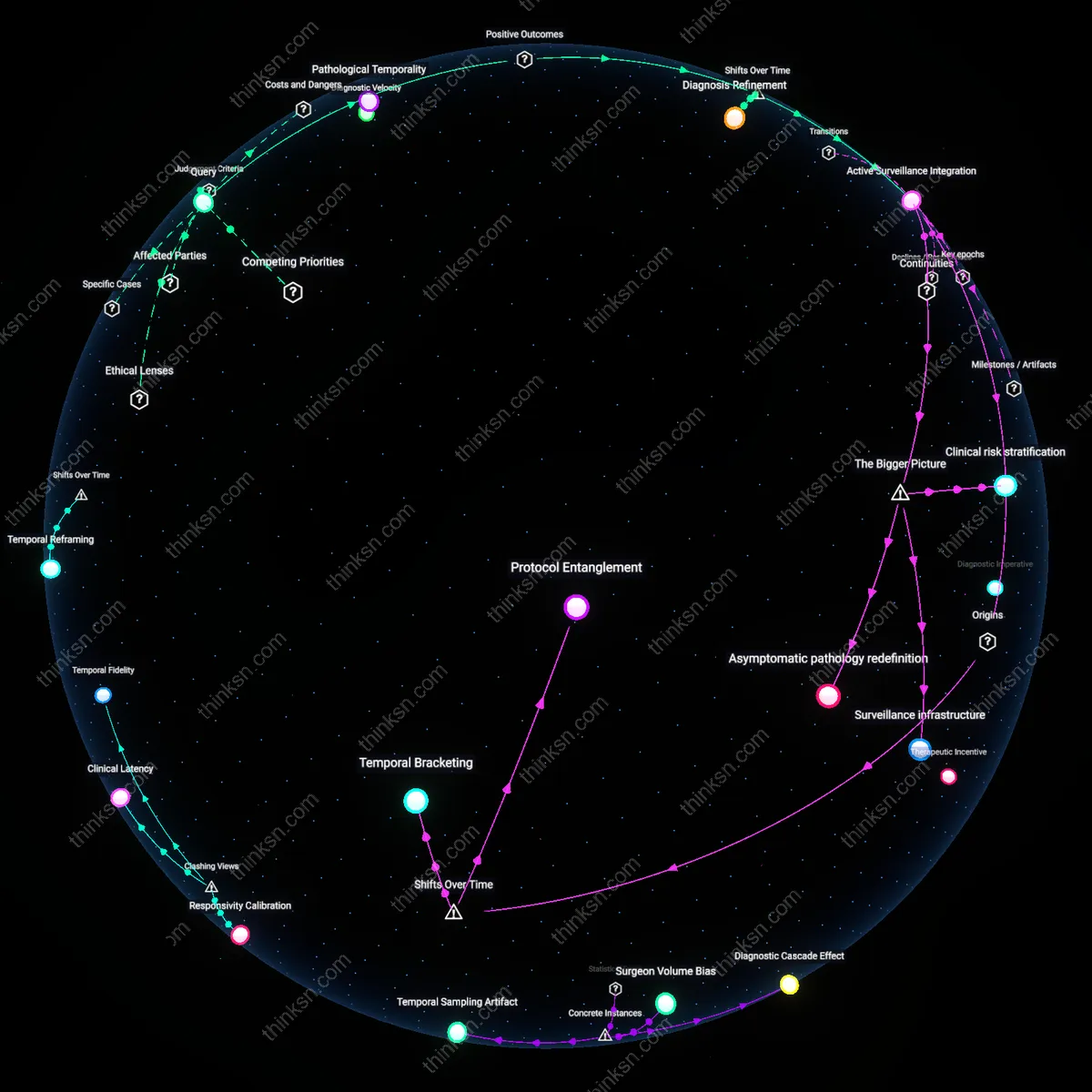
One can balance overdiagnosis of thyroid nodules by implementing tiered ultrasound referral protocols that restrict initial screening to patients with regionally validated risk markers, such as radiation exposure history in post-Chernobyl zones or familial syndromes, because the mechanism of diagnostic escalation is tied not just to test sensitivity but to the speed at which low-risk presentations are pulled into specialized imaging cascades. Evidence indicates that rapid access to ultrasound without clinical filtering multiplies detection of subclinical nodules by an order of magnitude, yet most guidelines conflate test availability with clinical urgency. What’s overlooked is that the rate of diagnostic entry—how quickly and broadly patients move from primary care into imaging—acts as a hidden throttle on overdiagnosis, independent of radiologist accuracy or nodule classification systems. This reframes the problem not as one of interpretation, but of temporal exposure to diagnostic machinery.
Pathological Temporality
One can reduce overdiagnosis by deferring ultrasound follow-up for small nodules beyond the standard 12-month interval, using risk-stratified timelines that align surveillance with the biological tempo of thyroid cancer progression, because indolent papillary microcarcinomas grow at less than 1mm per year, while aggressive variants exhibit exponential volume doubling within 24 months. Despite this, most monitoring schedules enforce uniform time intervals, decoupling surveillance from tissue biology. The overlooked dynamic is that time is not a neutral container in thyroid monitoring—it’s a morphogenetic variable, where the interval between scans functionally selects for detection of certain growth patterns and suppresses clinical attention to others, thereby shaping what counts as a ‘missed cancer’ versus a ‘false alarm.’
Geographic Risk Gradients
One can align thyroid nodule screening intensity with geographically variable background cancer virulence by calibrating ultrasound thresholds to regional cancer registries that reflect post-iodine-sufficiency shifts, because parts of central China and the eastern Mediterranean exhibit higher prevalence of aggressive histologies in nodules smaller than 1 cm due to residual iodine deficiency and environmental co-factors. Standard guidelines assume pathologic uniformity across populations, but spatial heterogeneity in tumor behavior means that a 9mm nodule in Qidong carries different implications than the same finding in Oslo. The overlooked factor is that geography serves as a proxy for unmeasured biosocial risk layers—soil composition, dietary patterns, and historical public health interventions—that modulate cancer behavior more than nodule size alone, making location a hidden determinant of diagnostic appropriateness.
Diagnosis Refinement
Integrating risk-stratified follow-up protocols into routine thyroid ultrasound practice minimizes unnecessary interventions while preserving early detection of high-risk cancers. This shift became widespread in the 2010s as radiology societies adopted standardized ultrasound pattern classifications—like the American College of Radiology's Thyroid Imaging, Reporting and Data System (ACR TI-RADS)—which replaced indiscriminate biopsy recommendations with evidence-based imaging criteria. The system leverages accumulated clinical outcomes data to differentiate benign-appearing nodules from those warranting action, thus calibrating diagnostic intensity to morphological risk. The underappreciated transformation is that diagnosis is no longer a binary event but a tiered, longitudinal process shaped by post-2010 consensus frameworks that align surveillance with cancer aggressiveness rather than nodule presence alone.
Active Surveillance Integration
Adopting active surveillance as a standard option for low-risk thyroid cancers, rather than immediate surgery, emerged prominently after 2015 following long-term Japanese cohort data demonstrating minimal progression in microcarcinomas. This model redefined patient management by treating observation as an intentional, protocolized alternative rather than inaction, enabling early detection without committing to immediate treatment. The shift empowered patients and clinicians to decouple diagnosis from intervention, reducing overtreatment while maintaining safety through scheduled monitoring. The underrecognized outcome is that surveillance itself became a structured intervention—a managed pathway with defined triggers for escalation—transforming how clinicians balance detection sensitivity with therapeutic prudence in the post-overdiagnosis era.