Panic Attacks: Diagnosis or Self-Help in College?
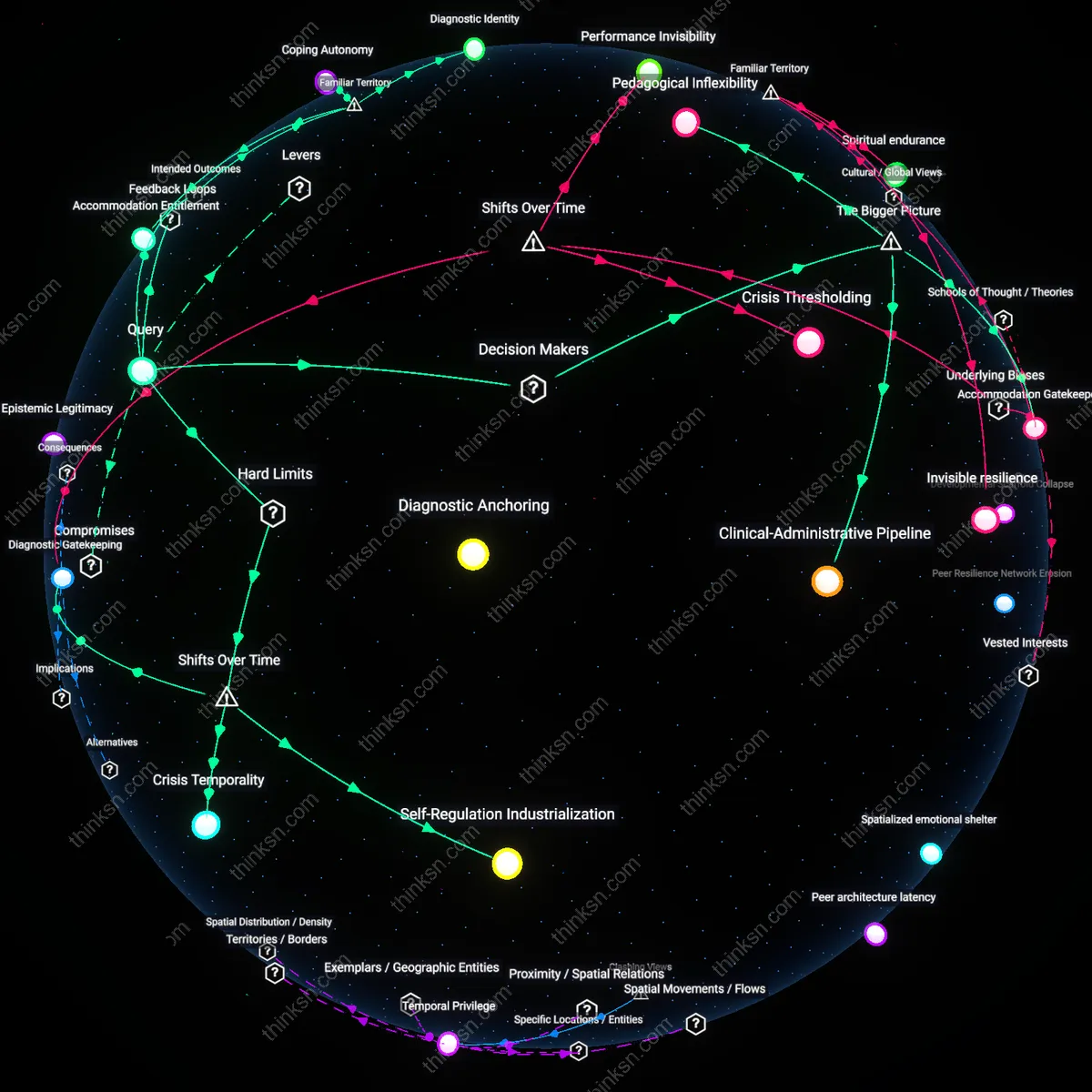
Analysis reveals 12 key thematic connections.
Key Findings
Diagnostic Gatekeeping
A college student experiencing panic attacks should seek a formal diagnosis because disability accommodation systems in U.S. higher education since the 1990 Americans with Disabilities Act Amendments have institutionalized clinical documentation as the sole threshold for access to exam modifications. Campus disability services operate under legal compliance frameworks that require DSM-based verification, rendering self-regulation initiatives invisible to administrative protocols—no matter their efficacy. This shift from informal academic leniency to legally codified eligibility reveals how therapeutic legitimacy is now contingent on biomedical validation, making diagnosis not a medical choice but a bureaucratic prerequisite.
Self-Regulation Industrialization
A college student should prioritize self-regulation techniques because the rise of campus mental health infrastructure since the 2010s—marked by wellness apps, mindfulness modules, and cognitive behavioral toolkits—has transformed psychological resilience into a privatized, scalable commodity. Universities increasingly outsource mental health management to low-cost digital platforms and short-term workshops, reducing institutional accountability while promoting individualized coping as the normative response to distress. This shift from external accommodation to internal adaptation reflects a broader neoliberal redefinition of student well-being as a skill to be optimized, not a right to be guaranteed.
Crisis Temporality
A student should delay diagnostic pursuit during acute panic phases and instead employ self-regulation to survive immediate exam cycles, as the escalation of mental health crises on campuses since 2020 has compressed academic timelines into states of perpetual emergency, where formal processes like diagnosis operate on lagging bureaucratic rhythms. Disability accommodations require weeks of documentation and review, while panic attacks disrupt real-time performance—creating a misalignment between the speed of harm and the pace of institutional response. This divergence exposes 'crisis temporality' as a governing condition in contemporary education, where systems are structured to react *after* breakdown, not prevent it.
Diagnostic Anchoring
A college student experiencing panic attacks should seek a formal diagnosis because without institutional recognition through medical documentation, accommodations like extended testing time remain inaccessible at universities such as the University of Michigan, where the Services for Students with Disabilities office requires verified diagnoses to activate support—revealing that self-regulation, while valuable, operates outside a sanctioned feedback loop, whereas diagnosis triggers a balancing loop in which academic performance stabilizes through structural intervention rather than individual will.
Regulatory Scaffolding
A student at Ohio State University who practiced mindfulness-based stress reduction without seeking diagnosis saw short-term improvement in test-related anxiety, but relapsed during midterms when campus counseling services became overburdened—demonstrating that self-regulation techniques depend on sustained access to training and monitoring resources, forming a fragile reinforcing loop vulnerable to disruption, whereas formal diagnosis embeds the individual in an institutional scaffold that buffers against systemic fluctuations in support availability.
Epistemic Legitimacy
After Columbia University’s 2019 mental health task force reported that 40% of students with undiagnosed anxiety disorders avoided clinical evaluation due to stigma, those who delayed diagnosis experienced compounding performance decline not because techniques failed, but because faculty and exam proctors discounted self-reported conditions—showing that the feedback loop of accommodation adherence is driven less by symptom severity than by the legitimacy conferred through formal diagnosis, which acts as a gatekeeping mechanism in academic reward systems.
Accommodation Gatekeepers
A college student should seek a formal diagnosis because disability resource offices hold exclusive authority to grant testing accommodations, and without documented eligibility, instructors and testing centers are institutionally prohibited from offering extended time or reduced-distraction environments. This gatekeeping power is codified in university compliance with the Americans with Disabilities Act and Section 504, which delegate evidentiary standards to campus-based disability evaluators—who then become arbiters of legitimate impairment. The non-obvious implication is that self-regulation, no matter how effective, remains invisible to and unsupported by academic enforcement systems unless mediated through certified channels.
Pedagogical Inflexibility
Self-regulation techniques should be prioritized because the dominant structure of higher education assessment rewards performance under standardized stress conditions, making accommodations an exception that reinforces norms rather than transforming them. Faculty design exams assuming cognitive endurance and emotional stability, and institutional risk-aversion discourages widespread adoption of universal design for learning. The underappreciated consequence is that diagnostic accommodation individualizes a systemic flaw—turning pedagogical rigidity into a medical problem to be managed case by case.
Clinical-Administrative Pipeline
Seeking a diagnosis activates a formal feedback loop between campus counseling centers and disability offices, where psychological evaluations produce data that institutionalize support but also embed student distress within clinical surveillance frameworks. This pipeline converts subjective experience into administratively actionable evidence, enabling accommodations while simultaneously shaping student identity through diagnostic labeling. The overlooked mechanism is that access to academic equity now flows through therapeutic documentation, making emotional regulation legible to the university only when filtered through biomedical certification.
Accommodation Entitlement
A college student experiencing panic attacks should seek a formal diagnosis to access disability accommodations because campuses operate under federal mandates like the ADA and Section 504, which legally require institutions to provide testing modifications such as extended time or quiet environments only after clinical documentation. This pathway activates institutional machinery—disability services offices, faculty notification protocols, and exam administration controls—that self-regulation cannot engage. The non-obvious truth beneath this familiar appeal to rights is that the accommodation system is not designed to respond to need alone, but to codified eligibility, making diagnosis less about personal insight and more about bureaucratic gatekeeping.
Coping Autonomy
A college student should prioritize self-regulation techniques like diaphragmatic breathing, cognitive reframing, or mindfulness because these tools are immediately accessible, do not require medical intermediaries, and align with the dominant cultural narrative that personal resilience determines academic success. Campuses widely promote counseling centers and wellness apps that emphasize skill-building over labeling, reinforcing the idea that managing stress is a learned competence, not a legally mediated right. The underappreciated consequence of this familiar focus on self-mastery is that it shifts responsibility entirely onto the individual, obscuring structural failures in academic environments that pathologize normal stress responses.
Diagnostic Identity
A student should seek a formal diagnosis not primarily for accommodations or symptom relief but because the label of 'anxiety disorder' becomes a socially recognized script that reshapes how peers, professors, and the student themselves interpret episodes of distress. Once diagnosed, panic attacks are no longer signs of weakness or lack of preparation but legitimate interruptions governed by a medical narrative, altering social expectations and self-permission around performance. The rarely stated effect of this familiar medicalization process is that it replaces moral judgments with clinical ones—transforming 'failing to cope' into 'managing a condition'—thereby granting a new form of legitimacy that self-regulation alone cannot confer.