Why Senior Managers Reject Mental Health Accommodations for Team Cohesion?
Analysis reveals 9 key thematic connections.
Key Findings
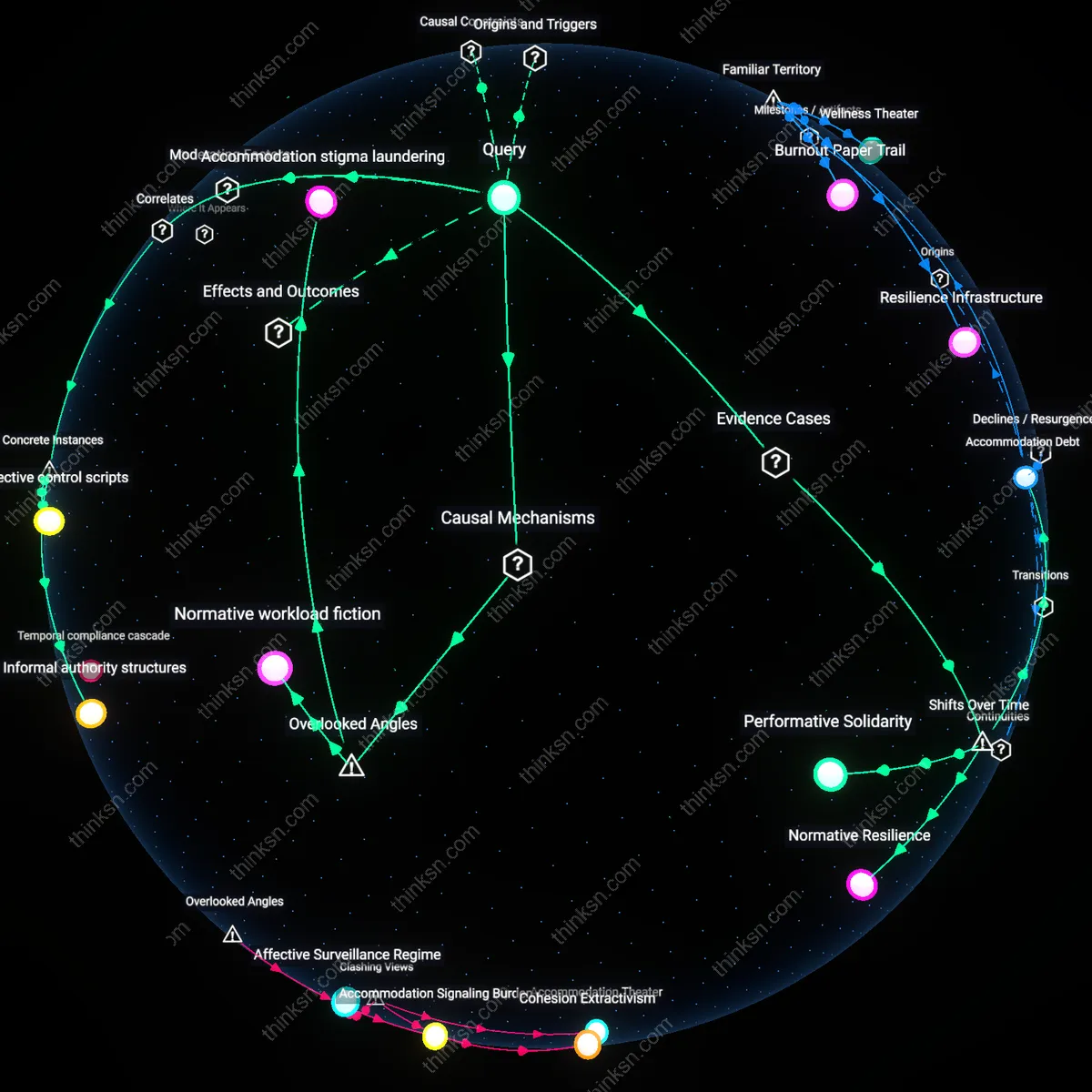
Normative workload fiction
A senior manager invokes team cohesion to block mental health accommodations because maintaining an unspoken fiction of uniformly high workload absorption preserves the legitimacy of unsustainable productivity norms. This mechanism functions through peer-enforced performance mimicry, where visible accommodations risk exposing the fiction by signaling that output levels are negotiable, thereby threatening managerial authority rooted in the illusion of equitable strain. The overlooked dimension is how accommodations act as institutional stress tests, revealing that team cohesion itself is contingent on suppressing individual variability—a dynamic rarely acknowledged in equity compliance frameworks.
Affective inertia
A senior manager resists mental health accommodations by citing team cohesion because emotional rhythms within long-standing teams create path dependencies that privilege stability over equity, making shifts in interpersonal pacing feel existentially disruptive. This operates through micro-coordination habits—such as shared stress cues or predictable response latencies—that become embedded in team functioning and are unconsciously policed as cohesion markers. The non-obvious insight is that mental health adjustments perturb not just tasks but the affective choreography that silently governs team legitimacy, a factor absent from legal models focused on tangible output parity.
Accommodation stigma laundering
A senior manager frames team cohesion concerns to deflect mental health accommodation requests because doing so transfers the stigma of exclusion from individual bias to collective necessity, thereby laundering personal discomfort through group logic. This transpires when managers lack scripts to engage psychiatric difference but possess well-rehearsed narratives about preserving unit performance, allowing them to outsource moral justification to imagined peer resentment. The overlooked mechanism is how institutional stigma is sustained not through overt discrimination but through syntactic pivots that reframe exclusion as anticipatory solidarity, evading scrutiny by mimicking prosocial concern.
Normative performance metrics
A senior manager at a manufacturing plant in Ohio in 2018 discouraged accommodation requests by citing team cohesion, explicitly referencing the need to maintain synchronized shift rotations and uniform output pacing, which were tied to productivity bonuses; the mechanism was a performance system that statistically correlated team stability with output consistency, despite no proven causal link between mental health accommodations and breakdowns in coordination, revealing how normative performance metrics become conflated with social cohesion in high-efficiency production environments.
Informal authority structures
In a 2020 case at a regional bank in Sydney, a branch manager rejected remote work requests for employees with anxiety disorders, invoking team cohesion while maintaining daily in-person stand-up meetings led by informal team leads; the dynamic functioned through an uncodified hierarchy where visibility equated to reliability, and cohesion was used as a proxy for adherence to this invisible chain of influence, exposing how informal authority structures resist formal accommodation protocols by embedding compliance in social ritual rather than operational necessity.
Affective control scripts
At a software company in Austin during a 2019 restructuring, engineering directors cited team cohesion to deny flexible scheduling for therapy appointments, pointing to the 'energy' of collaborative sprints; this rationale persisted despite no decline in deliverables from accommodated teams in other divisions, and operated through culturally embedded affective control scripts that equated emotional expressiveness with commitment, illustrating how perceived emotional synchrony becomes a non-negotiable standard even when decoupled from measurable performance outcomes.
Performative Solidarity
A senior manager might invoke team cohesion to deny mental health accommodations because post-2010 corporate diversity initiatives shifted psychological safety from an individual right to a collective performance metric, as seen in Silicon Valley tech firms like Uber during its 2017 cultural crisis; managers now conflate accommodation with disruption because cohesion became operationalized as uninterrupted workflow alignment, not inclusion. This reframing emerged as HR systems moved from compliance-driven models to culture-optimization frameworks, where the appearance of unity became a managerial KPI—rendering visible the tension between legal duty and performative belonging.
Accommodation Debt
The use of team cohesion as a rationale against mental health adjustments intensified after the 2008 financial crisis, when industries like investment banking—exemplified by Goldman Sachs’ restructuring of analyst workloads—began treating accommodations as deferred liabilities rather than immediate rights; cohesion became a proxy for maintaining pre-recession intensity levels under leaner staffing. This shift reveals how austerity-era efficiency norms calcified into cultural expectations, normalizing the accumulation of unmet accommodation needs across high-pressure sectors.
Normative Resilience
Senior managers in public sector institutions, such as the UK National Health Service post-2015 austerity reforms, increasingly cite team cohesion to resist accommodations because the professional ideal of care labor shifted from sustainable practice to heroic endurance; mental health adjustments are seen as undermining a newly entrenched culture of mandatory resilience. This transformation—codified through appraisal systems that reward overwork—exposes how fiscal constraints redefined psychological fitness as collective stoicism, erasing reasonable adjustment as a legitimate claim.