Scholarship or Status? Undocumented Students Dilemma
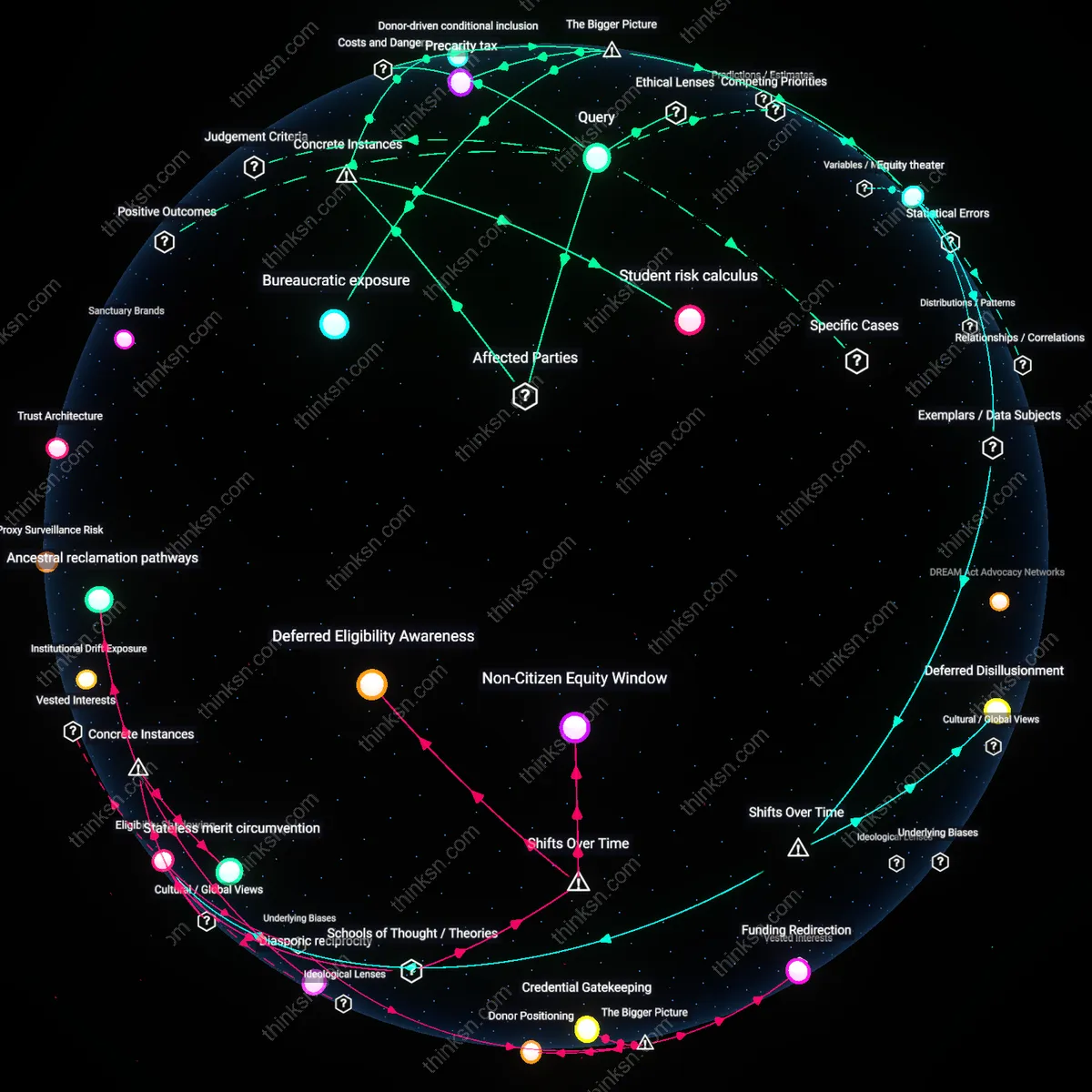
Analysis reveals 7 key thematic connections.
Key Findings
Institutional gatekeeping
At the University of California, Santa Barbara, campus financial aid administrators actively restrict undocumented students from accessing state-funded Cal Grants despite their eligibility under AB 540 because they lack Social Security numbers required in the disbursement systems—a technical barrier not mandated by law but embedded in administrative practice. This operational constraint, rooted in IT architecture and inter-agency data matching protocols, reveals how institutional procedures function as de facto immigration enforcement mechanisms even in sanctuary-state contexts. The non-obvious insight is that exclusion persists not through overt policy refusal but through mundane technical design choices made by mid-level administrators and software systems.
Donor-driven conditional inclusion
The Dell Scholars Program, while providing full tuition and support to high-achieving low-income students—including some undocumented youth—requires recipients to possess a Social Security number or Individual Taxpayer Identification Number (ITIN) to comply with federal tax reporting, effectively excluding the most vulnerable applicants despite permissive state laws. This conditionality, imposed not by government mandate but by private foundation risk-aversion, illustrates how philanthropic actors recalibrate access criteria to align with federal surveillance norms, thereby reproducing immigration hierarchies under the guise of compliance. The underappreciated dynamic is that private generosity often intensifies exclusionary logics when donors position legal vulnerability as financial risk.
Student risk calculus
In 2021, students at Phoenix Union High School District in Arizona declined to apply for private scholarships administered through district offices after a rumor circulated that award processing required ID checks that could expose family members to ICE—despite no such policy existing, the collective memory of SB 1070 enforcement shaped decision-making. This self-withdrawal, driven by institutional trauma rather than formal restrictions, demonstrates how historical state violence alters cost-benefit analysis even in ostensibly safe programs. The key insight is that risk assessment among undocumented youth is less about current legal conditions than intergenerational experiences of state betrayal.
Bureaucratic exposure
Pursuing financial aid forces undocumented students to disclose personal information to federal systems, triggering potential data sharing with immigration enforcement agencies. The mechanism—mandatory SSN collection in FAFSA processing—creates a surveillance pipeline through which student data may be accessed by DHS under existing inter-agency memoranda like SAVE. This risk is systemic, originating in the integration of education and immigration databases, and remains underappreciated because the danger is latent and probabilistic rather than immediate. The result is a deterrent effect even in states offering state-based aid, as students cannot easily distinguish between safe and risky applications.
Equity theater
Private scholarships marketed as inclusive often replicate exclusion through citizenship-based eligibility filters embedded in donor-imposed criteria. These filters are sustained by nonprofit compliance departments that default to legal risk avoidance, even when funders lack specific mandates to exclude undocumented applicants. The systemic driver is risk-averse institutional behavior within philanthropy, which amplifies marginalization by mimicking state-defined categories of personhood. This dynamic is invisible because the scholarships appear accessible, creating a symbolic gesture of inclusion that exacerbates harm by exhausting student effort without payoff.
Precarity tax
Undocumented students expend disproportionately high time and emotional labor gathering opaque, one-off scholarships with shifting requirements, as centralized aid systems exclude them by design. This burden functions as a systemic extraction of energy from marginalized applicants, driven by the absence of federal solutions and state-by-state policy fragmentation. Colleges benefit indirectly by appearing supportive while offloading access barriers onto individual determination. The cost is rarely measured, but it deepens educational inequality by rewarding those with the social capital to navigate dozens of micro-applications, effectively pricing dignity out of reach.
Sanctuary Capital
Undocumented students treat private scholarships as sites of sanctuary capital, where funding becomes detachable from state scrutiny and operates within parallel moral economies maintained by NGOs, faith groups, and philanthropies embedded in sanctuary cities. Unlike federal financial aid—which functions through Cold War-era administrative doctrines that equate eligibility with legal personhood—private scholarships replicate extrastatist governance by affirming dignity without demanding assimilation, a dynamic particularly evident in California’s private donor networks that explicitly disavow information sharing with ICE. This reveals the non-obvious reality that some private funding bodies have become de facto political actors, constructing quasi-territorial safety through selective anonymity—a phenomenon that challenges the liberal assumption that rights must flow from the state.