Medication or Natural Strategies: Navigating Anxiety Treatment for Teens
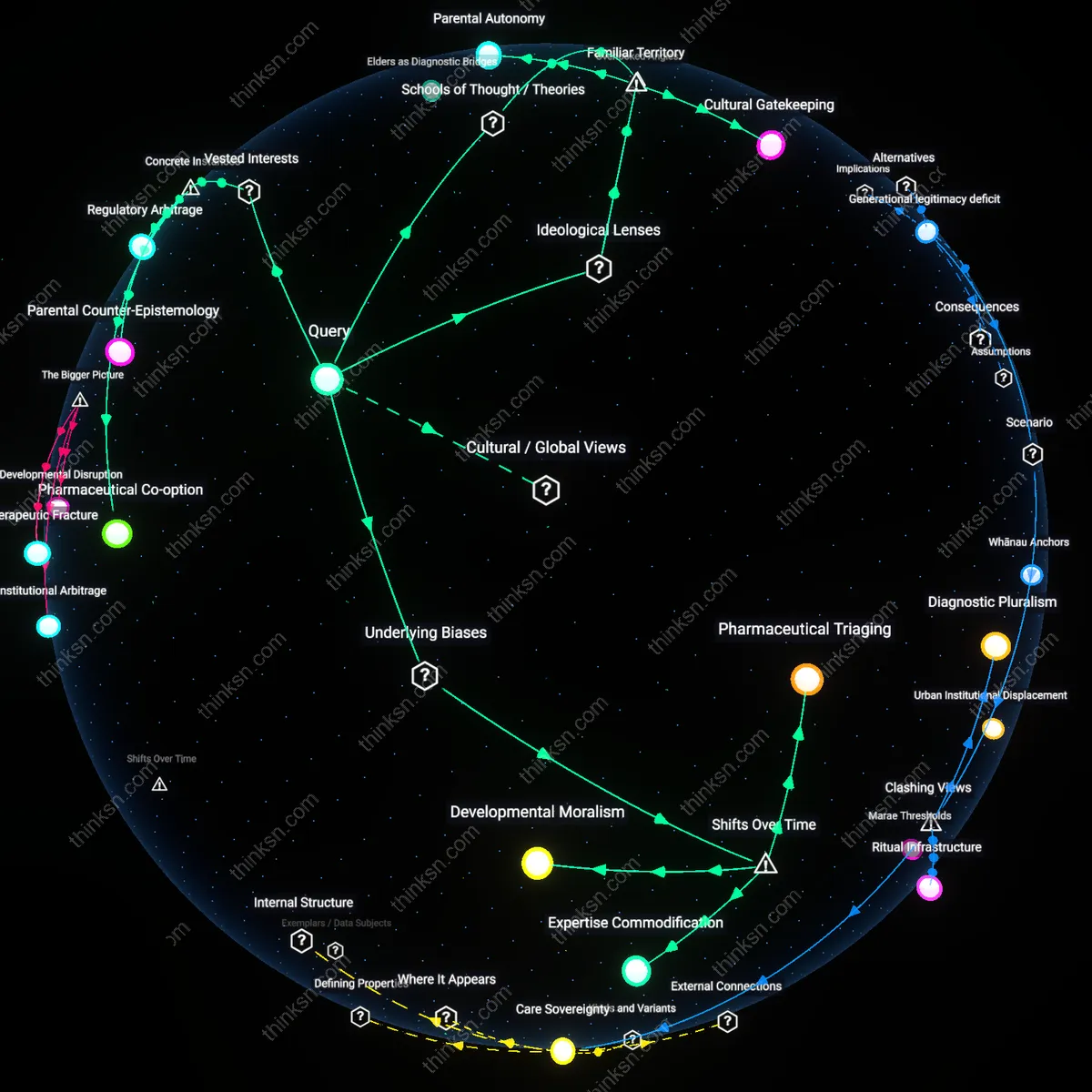
Analysis reveals 9 key thematic connections.
Key Findings
Consultation Architecture
A parent should design a structured consultation architecture that formally includes non-clinical community elders—such as spiritual leaders, coaches, or long-tenured teachers—alongside medical professionals to co-develop care plans. This system leverages institutional pluralism by creating a coordinated decision-making forum where epistemic authority is not hierarchically arranged by medical licensure but distributed across experiential domains, allowing anxiety to be reframed as both a neurological condition and a developmental signal. What is typically overlooked is that professional disagreement is less about treatment efficacy than about incompatible epistemic jurisdictions—medicine sees symptoms, while community figures interpret meaning—and the resolution lies not in synthesis but in procedural design that acknowledges these parallel validities. This transforms conflict into a structural feature of care rather than a liability.
Parental Autonomy
Parents should prioritize personal conviction over institutional consensus when navigating conflicting advice on teen anxiety, because liberal ideology frames individual choice and informed consent as paramount in medical decision-making. In practice, this means parents weigh evidence from pediatricians, therapists, and alternative practitioners through the lens of their family’s values, often opting for hybrid models that integrate medication with mindfulness or dietary changes. What’s underappreciated is how this autonomy turns the household into a site of epistemic negotiation, where legitimacy is distributed not by credentials alone but by alignment with personal definitions of well-being.
Cultural Gatekeeping
Families must defer to established medical authority to preserve social stability and intergenerational responsibility, because conservative ideology positions institutional expertise as a bulwark against moral relativism and social fragmentation. In suburban school districts and faith-based communities, this often manifests as privileging prescribed psychiatric treatment over unregulated holistic methods, with clergy and school counselors reinforcing biomedical frameworks. The non-obvious consequence is that resistance to non-medical approaches functions not just as risk management but as a symbolic act of maintaining ontological order—where anxiety is a treatable disorder, not a spiritual or systemic signal.
Pharmaceutical Triaging
Parents defer to medicalized responses because reimbursement structures in U.S. healthcare since the 1990s have systematically privileged pharmacological interventions over psychosocial or integrative care, making medication the default first-line treatment even when professionals conflict; insurance providers, in tandem with increasingly time-pressured pediatric psychiatry practices, reward efficiency over holistic assessment, thus positioning parents to interpret medical authority as singular and binding despite observable disagreement among clinicians. This shift—anchored in the managed care transformation of the 1990s—obscures the fact that non-medical approaches were once standard in adolescent mental health and reveals how economic logics in healthcare financing, not clinical consensus, now define what counts as legitimate treatment.
Expertise Commodification
Parents navigate contradictory advice by outsourcing discernment to credentialized experts, a shift intensified since the late 20th century as psychology and psychiatry became gatekeepers of legitimate knowledge about adolescent development, particularly within middle-class parenting cultures in urbanized Western settings; this transition, beginning in the 1970s with the mainstreaming of clinical psychology, reframed parental intuition as unreliable, thus making reconciliation contingent not on integrating methods but on ranking professionals by perceived institutional affiliation or academic prestige. The non-obvious consequence is that the very ideal of interdisciplinary collaboration masks a hierarchy where certain forms of training monetize uncertainty, turning diagnostic disagreement into a market for second opinions rather than a call for epistemic plurality.
Developmental Moralism
Parents gravitate toward non-medical strategies only after exhausting medical pathways, reflecting a post-1980s cultural pivot in which resilience and self-regulation became idealized as markers of authentic adolescent growth, particularly in progressive or alternative education enclaves; once behavioral medicine dominated early intervention protocols, a counter-movement since the 2000s has recast mindfulness, somatic therapy, and peer support as 'maturity-affirming,' thus positioning medical interventions as necessary but spiritually insufficient. This trajectory reveals how the temporality of treatment itself became moralized—medication is for the 'crisis phase,' while non-medical work is for the 'becoming phase'—producing a staged model of care that benefits wellness entrepreneurs more than it resolves professional discord.
Pharmaceutical Co-option
Pharmaceutical companies sustain dominance in adolescent anxiety treatment by funding clinical guidelines that prioritize FDA-approved medications, as seen in the influence of Pfizer and Eli Lilly on the American Academy of Child and Adolescent Psychiatry’s practice parameters in the early 2000s, which marginalized non-pharmacological interventions despite rising concerns over SSRI side effects in teens; this mechanism entrenches medicalized responses by aligning professional standards with drug development timelines and regulatory outcomes, revealing how corporate investment in diagnostic criteria indirectly undermines integrative care models.
Parental Counter-Epistemology
In Sonoma County, California, a coalition of parents challenged school district-mandated psychiatric evaluations for anxious students by organizing workshops based on Indigenous wellness practices and somatic regulation, directly opposing district agreements with county mental health agencies that required medical referrals; their success in establishing opt-out wellness circles revealed how grassroots caretaking networks can generate epistemic authority that resists institutional medical framing, particularly when structural incentives equate treatability with billable diagnoses.
Regulatory Arbitrage
The proliferation of CBD youth wellness clinics in Austin, Texas—operating in a gray zone between state-licensed therapy practices and cannabis dispensaries—enables families to bypass psychiatric recommendations by accessing non-medical anxiety protocols involving terpenes, breathwork, and neurofeedback, exploiting gaps between Texas’s narrow THC laws and federal telehealth therapy regulations; this spatial and legal fragmentation allows non-medical providers to scale services that mimic clinical care while evading FDA and APA oversight, demonstrating how jurisdictional misalignment enables parallel anxiety management ecosystems.