Right to Be Forgotten vs. Data Brokers Re-aggregation Power?
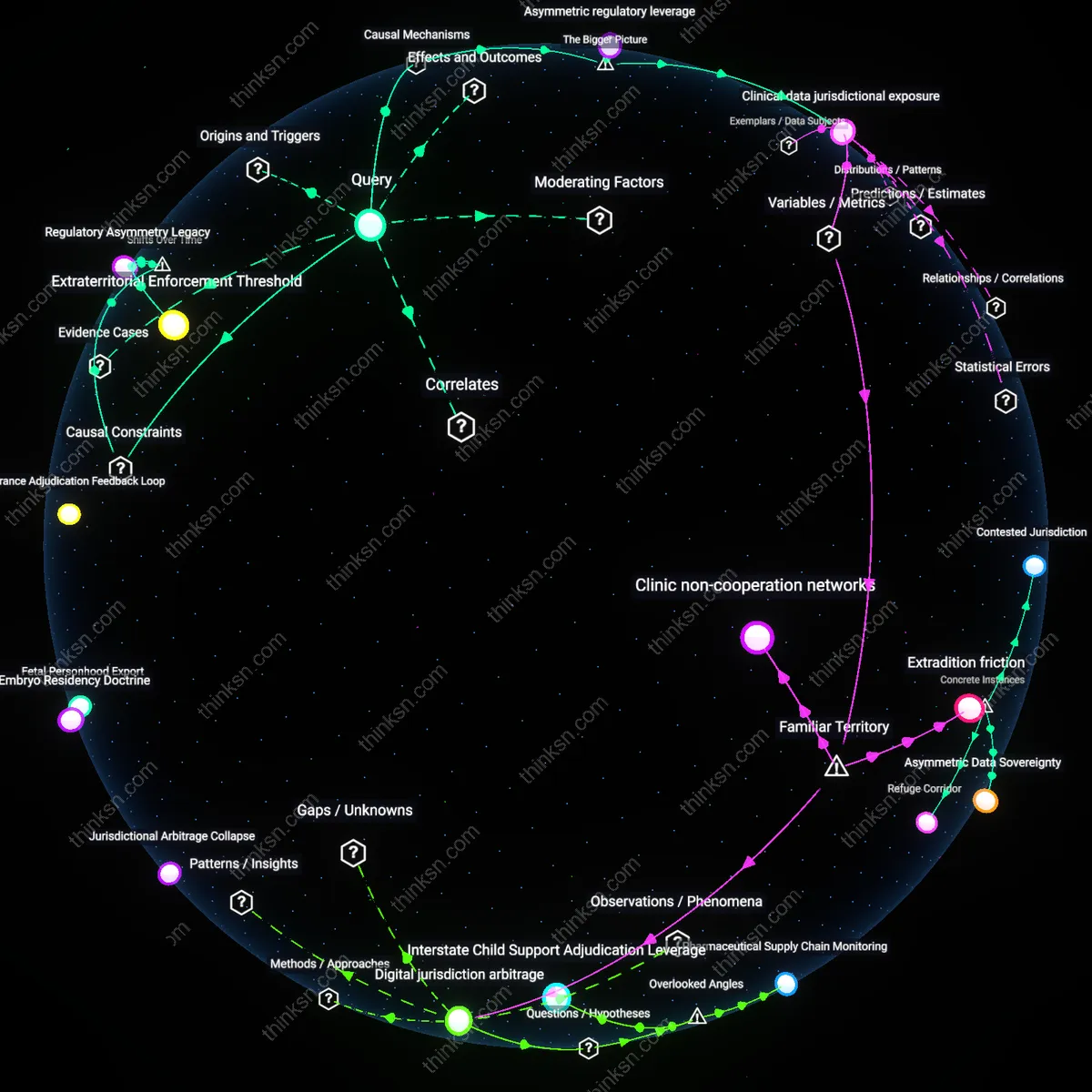
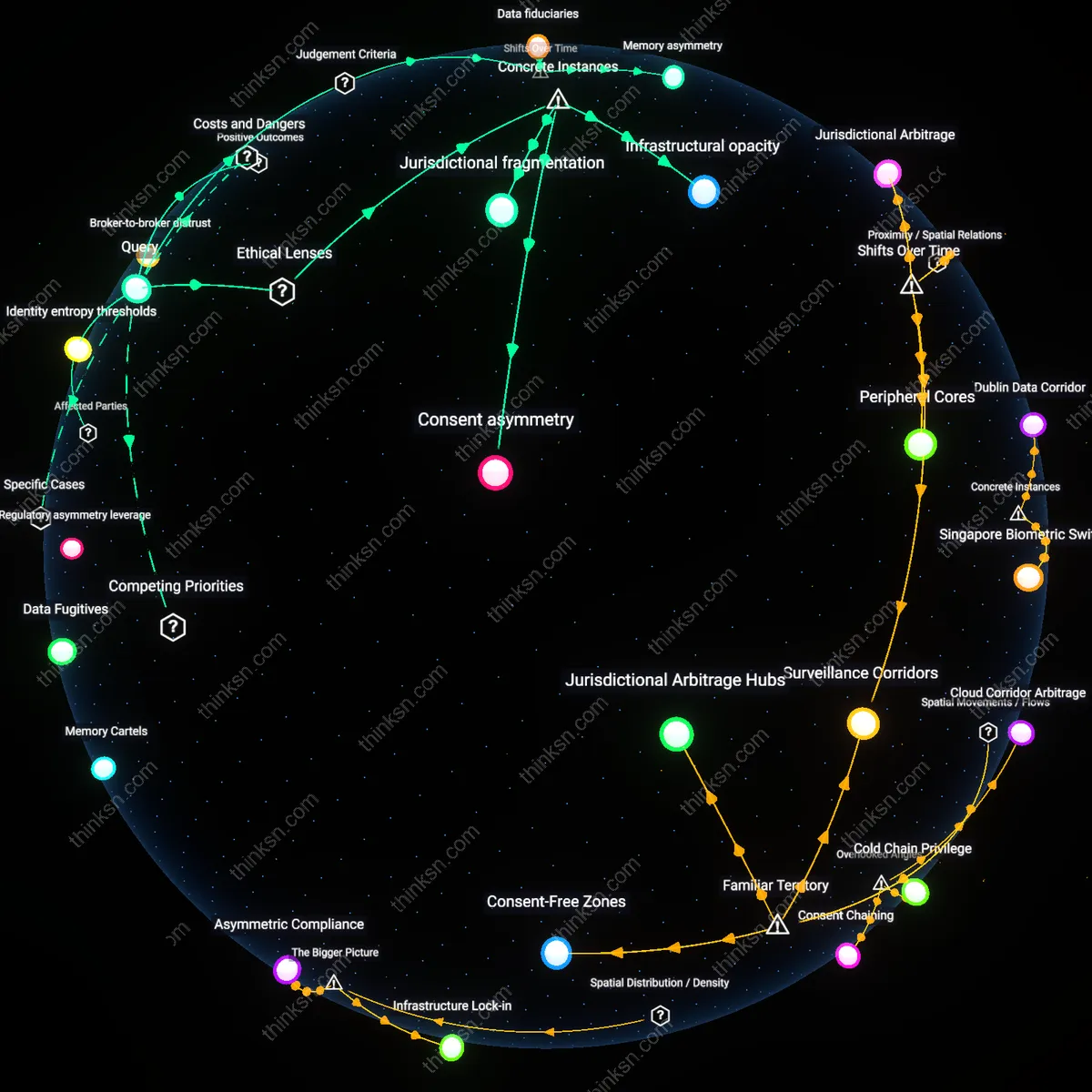
Analysis reveals 11 key thematic connections.
Key Findings
Data Fugitives
The right to be forgotten cannot be effectively guaranteed because individuals whose data persists in commercial broker ecosystems—especially marginalized populations targeted by predatory data collection—become permanent data fugitives, evading digital erasure despite legal entitlements. Data brokers like Acxiom and Oracle maintain social-graph linkages across generations of re-aggregation, using probabilistic matching to reconstitute 'deleted' identities from kinship ties, location traces, and transactional proxies, rendering individual opt-outs technically futile. This reveals that legal rights to erasure assume a singular data subject, while the system operates through relational exposure, making the fugitive status not accidental but structurally enforced.
Regulatory Arbitrage Architecture
The right to be forgotten is actively undermined by a transnational regulatory arbitrage architecture maintained by data broker alliances that shift processing through jurisdictions with weak privacy enforcement, such as data centers in Kazakhstan and Malaysia used by U.S.-based brokers to re-ingest and re-identify purged records. These entities exploit discrepancies between GDPR-style frameworks and laissez-faire regimes to reassemble social graphs from 'anonymized' shards, treating compliance as a temporary partition rather than a permanent constraint. This dynamic treats legal compliance as a logistical variable, not an ethical limit—exposing erasure as a geographically contingent performance, not a universal guarantee.
Memory Cartels
Commercial data brokers function as memory cartels that collectively preserve social-graph data beyond individual consent by treating data retention as a systemic public good for risk assessment, even when individual records are expunged. Credit reporting agencies like Experian and specialty firms like CoreLogic maintain interlinked historical models where the deletion of one node distorts predictive accuracy, incentivizing the covert re-inferral of 'forgotten' data through network imputation. This reveals that erasure is not just resisted technically but is economically disfavored by an ecosystem that treats personal memory as a shared infrastructure, making the right to be forgotten a liability to group modeling integrity.
Data fiduciaries
The right to be forgotten cannot be meaningfully enforced because commercial data brokers operate as unregulated data fiduciaries who profit from re-aggregating de-identified social-graph data into actionable profiles, a shift that crystallized after the 2010s with the rise of real-time bidding ecosystems in digital advertising. This system treats personal data as perpetually available inventory, undermining individual autonomy by design—users are not the customers but the product, and consent has been functionally replaced by obscurity and algorithmic opacity. What is underappreciated is that the erosion of the right to be forgotten was not accidental but engineered through architectural choices in data markets, where the principle of informational self-determination gave way to the efficiency of scalable surveillance.
Memory asymmetry
The right to be forgotten is destabilized by memory asymmetry—the divergence between individual erasure requests and the persistent, algorithmic memory maintained in commercial data repositories—a condition that intensified after 2016 with the widespread adoption of machine learning models trained on historical behavioral datasets. Tech platforms may delete user-facing content, but the latent patterns derived from social-graph data remain embedded in recommendation and scoring systems, silently shaping future interactions without traceable linkage to original sources. The underappreciated reality is that forgetting has become decentralized and performative, while remembering is distributed and systemic, making true erasure impossible even when procedures are followed to the letter.
Regulatory asymmetry leverage
The right to be forgotten can be effectively enforced by exploiting regulatory asymmetry between data brokers and platform intermediaries, where stringent disclosure obligations on ad-tech ecosystems indirectly compel de-indexing from shadow data repositories. Because real-time bidding systems require transparent data provenance for compliance with sector-specific privacy audits—especially in healthcare and financial targeting—data brokers face reputational and operational risks when trafficking in non-compliant social-graph derivatives, creating a backdoor enforcement channel that bypasses direct deletion mandates. This dynamic is underappreciated because most analyses focus on user-initiated takedown requests rather than supply-chain compliance pressures in algorithmic advertising, yet it transforms obscure regulatory friction into a functional deletion mechanism.
Identity entropy thresholds
Persistent social-graph data loses re-identification utility over time as cascading life events degrade the signal-to-noise ratio in commercial dossiers, making forgotten identities practically inert even if technically retained. When users change geographies, names, or social affiliations—such as after immigration, domestic violence escape, or gender transition—the probabilistic confidence of data brokers' linkage models falls below economically viable thresholds for reaggregation, rendering the data functionally forgotten regardless of retention. This dimension is overlooked because policy debates assume static identifiability, yet the real-world drift of personal identity acts as a silent expiration mechanism that deactivates data without legal intervention.
Broker-to-broker distrust
Data brokers avoid ingesting re-aggregated social-graph data from secondary vendors due to fears of regulatory contagion, creating a market-side barrier to resurrection of de-listed information. Since primary brokers like Acxiom and Experian rely on defensible provenance chains to survive audits, they systematically exclude datasets derived from scraped or reconstituted online footprints, treating them as liability hazards rather than asset enhancements. This self-policing is rarely acknowledged in discourse that presumes seamless data fusion, yet it establishes a de facto quarantine on 'forgotten' data by triggering risk-averse curation practices among competitors who otherwise have every incentive to reconstitute it.
Infrastructural opacity
The right to be forgotten cannot be effectively guaranteed because data brokers like Acxiom maintain opaque, federated databases that reconstitute de-identified social-graph data through algorithmic re-identification, as seen in the 2014 U.S. Senate investigation into data broker practices led by Senator Edward Markey—where Acxiom’s systems demonstrated capacity to reassemble user profiles from fragmented inputs without direct consent, revealing that regulatory enforcement mechanisms under EU-style data protection fail when core re-aggregation infrastructures remain invisible and unregulated, thus making erasure performative rather than material.
Consent asymmetry
The right to be forgotten is structurally undermined by the imbalance between individual consent capacity and institutional data retention, exemplified by the 2014 Google Spain SL v AEPD case, where Mario Costeja González successfully demanded de-indexing of a foreclosure notice, yet the original data persisted in commercial repositories like LexisNexis and Dun & Bradstreet, illustrating that while individuals can exercise rights against visible platforms, they lack legal standing or procedural access to compel deletion from upstream data brokers—an asymmetry that exposes the right to be forgotten as a remedial fiction when enforcement cannot scale across hidden layers of data supply chains.
Jurisdictional fragmentation
Effective guarantee of the right to be forgotten is unattainable under current global data governance because commercial data brokers operate across legal zones to evade localized privacy mandates, as demonstrated by the 2020 Schrems II ruling invalidating the EU-U.S. Privacy Shield, which exposed how Facebook (Meta) continued transferring European user data to U.S. servers where it was merged with social-graph data held by brokers like Oracle Data Cloud, revealing that extraterritorial data persistence in repositories beyond the reach of GDPR enables systemic re-aggregation, rendering localized rights unenforceable in practice and subordinating ethical privacy norms to neoliberal data territoriality.