Should You Risk It All for Renewable Energy Startup Success?
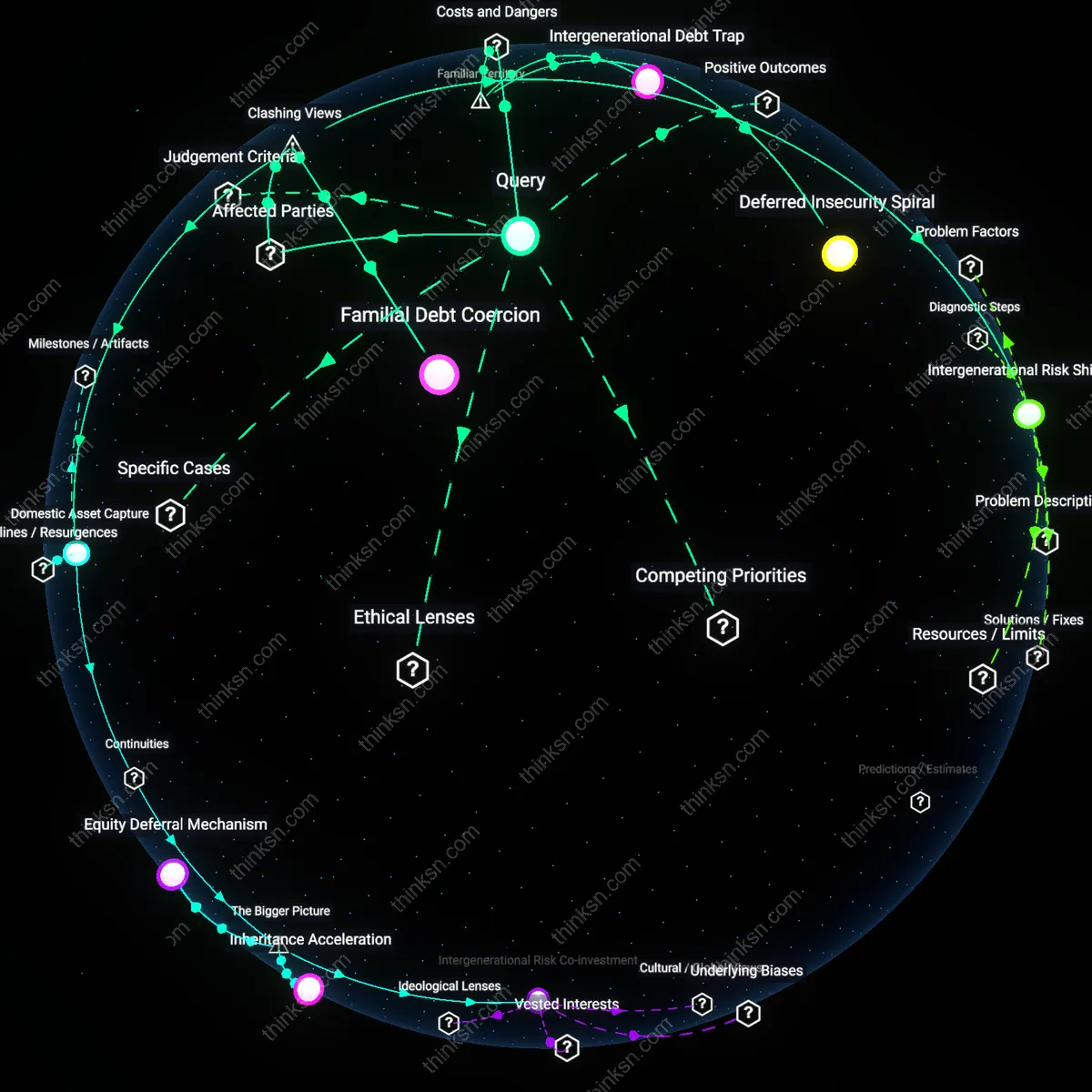
Analysis reveals 10 key thematic connections.
Key Findings
Intergenerational risk exposure
One should not launch a renewable-energy startup under such conditions, as familial financial vulnerability can transmit systemic risk across generations, exemplified by the 2011 Solyndra collapse, where investor and public funds were lost amid broader solar overcapacity, endangering not just the founders’ households but cascading into public trust in green tech—revealing how personal financial fragility, when intersected with volatile clean energy markets, becomes a conduit for wider socio-economic disruption that disproportionately impacts dependents.
Asymmetric resilience leverage
One should launch the startup despite personal financial constraints, as demonstrated by Muhammad Yunus’s Grameen Shakti in Bangladesh, where decentralized solar microenterprises were scaled by leveraging community-based financing and low-cost technical training, showing that structural support mechanisms in energy access can offset individual precarity—highlighting how marginalized entrepreneurs can achieve outsized systemic impact by exploiting institutional voids rather than awaiting personal financial security.
Distributed accountability design
Launching the venture is ethically permissible only if accountability is institutionally diffused, as seen in Denmark’s decentralized wind energy cooperatives of the 1980s, where local farmers and citizens collectively owned turbines through shared equity models, reducing individual financial exposure while accelerating national energy transition—this reveals that family responsibilities need not preclude risk-taking when entrepreneurial structures are designed to distribute liability and align stakeholder obligations beyond the individual actor.
Policy-Driven Market Asymmetry
One should launch a renewable-energy startup during favorable market conditions because policy-induced subsidies in regions like the U.S. Inflation Reduction Act create temporary cost advantages that smaller entrants can exploit before market consolidation. Federal tax credits and state-level feed-in tariffs distort energy pricing in a way that lowers break-even thresholds for new solar and battery storage ventures, enabling even undercapitalized founders to access grid-adjacent revenue streams. This mechanism allows family-responsible entrepreneurs to mitigate financial risk not through personal reserves but through systemic fiscal incentives designed to accelerate decarbonization. The non-obvious insight is that these policy windows act as risk-absorbing buffers, effectively socializing early-stage viability risks that would otherwise fall entirely on the individual.
Distributed Grid Resilience
Launching a renewable-energy startup strengthens community-scale energy resilience, which becomes critical as climate-driven grid instability increases in areas like California and Texas. By deploying localized solar microgrids or residential storage networks, small firms can integrate into utility demand-response programs, reducing systemic reliance on centralized power providers during peak stress events. This integration is enabled by smart inverter standards and open-access distribution tariffs, which allow decentralized providers to feed stability back into the broader grid. The underappreciated dynamic is that individual entrepreneurial entry enhances systemic robustness, turning financially constrained actors into inadvertent infrastructural stabilizers.
Talent Signal Amplification
Founding a renewable-energy venture under personal financial constraint signals exceptional commitment to mission-aligned investors and technical talent, particularly within the climate tech ecosystem centered in cities like Berlin and Boulder. In labor markets saturated with impact-seeking engineers and ESG-focused capital, demonstrable personal sacrifice—such as launching while supporting a family with limited savings—functions as a credibility multiplier, accelerating trust and resource access. This works because asymmetric personal risk acts as a credible screening mechanism in high-uncertainty domains, where effort cannot be easily faked. The overlooked consequence is that human capital formation for such startups is less dependent on founder wealth than on the perceived authenticity of their social contract with sustainability.
Temporal Discounting Asymmetry
One should not launch a renewable-energy startup under these conditions because the psychological discounting of future family instability is structurally weaker than the immediate allure of market opportunity, causing founders to consistently undervalue the compound interpersonal costs of time diversion. Families rely on predictable emotional and logistical presence, which erodes invisibly during intense venture-building phases—especially in cleantech, where deployment cycles stretch over regulatory timelines (e.g., interconnection queues in ERCOT or California's Rule 21), creating long latency between effort and impact while personal obligations accumulate. This asymmetry—where markets reward fast action but family systems penalize sustained absence—is rarely quantified in risk assessments, yet it determines long-term venture sustainability more than capital shortfalls. The overlooked mechanism is that time, not money, becomes the unrenewable resource.
Moral Hazard of Altruism
One should not launch a renewable-energy startup under such conditions, because doing so weaponizes climate ethics to justify personal risk imposition on dependents—a dynamic mirrored in U.S. clean-tech incubators that encourage low-asset founders to leverage familial stability as risk absorbers while investors remain insulated. This pattern reflects a distortion of utilitarian justification, where the collective good of decarbonization is used to override fiduciary duties of breadwinners, exposing a hidden transfer of moral hazard from institutions to families. The non-obvious truth here is that altruistic ventures can become ethically parasitic when structural risk is asymmetrically borne by the most vulnerable members of the entrepreneur’s circle.
Libertarian Irony
One should launch the startup despite personal vulnerability, because abstaining on the basis of financial precarity cedes market formation to capital-rich actors, reproducing a neoliberal capture of green transitions—evident in how Texas’s deregulated energy market enabled populist renewable expansion precisely through individual risk-taking under duress. This aligns with a Lockean labor-theory lens, where self-ownership of productive effort legitimizes venture even without capital reserves, challenging the paternalistic assumption that responsibility negates agency. The dissonance lies in recognizing that restraint in the name of family protection may inadvertently affirm the very systems of dependency it seeks to avoid.
Duty Entanglement
One must decline the venture not out of self-interest or prudence, but because Kantian imperfect duties to humanity’s future cannot override perfect duties to existing dependents—a conflict crystallized in German Familienlastenrecht (family burden law), which legally prioritizes immediate kin obligations over societal contributions during resource scarcity. This ethical framework asserts that moral agency is bounded by relational commitments, making the renunciation of high-risk entrepreneurship an expression of duty rather than failure. The underappreciated insight is that failing to launch can be the most ethically rigorous response within deontological systems that reject instrumentalization, even for noble ends.