Is Uncertainty About Sea Rise Valid Reason to Delay Home Flood Fixes?
Analysis reveals 7 key thematic connections.
Key Findings
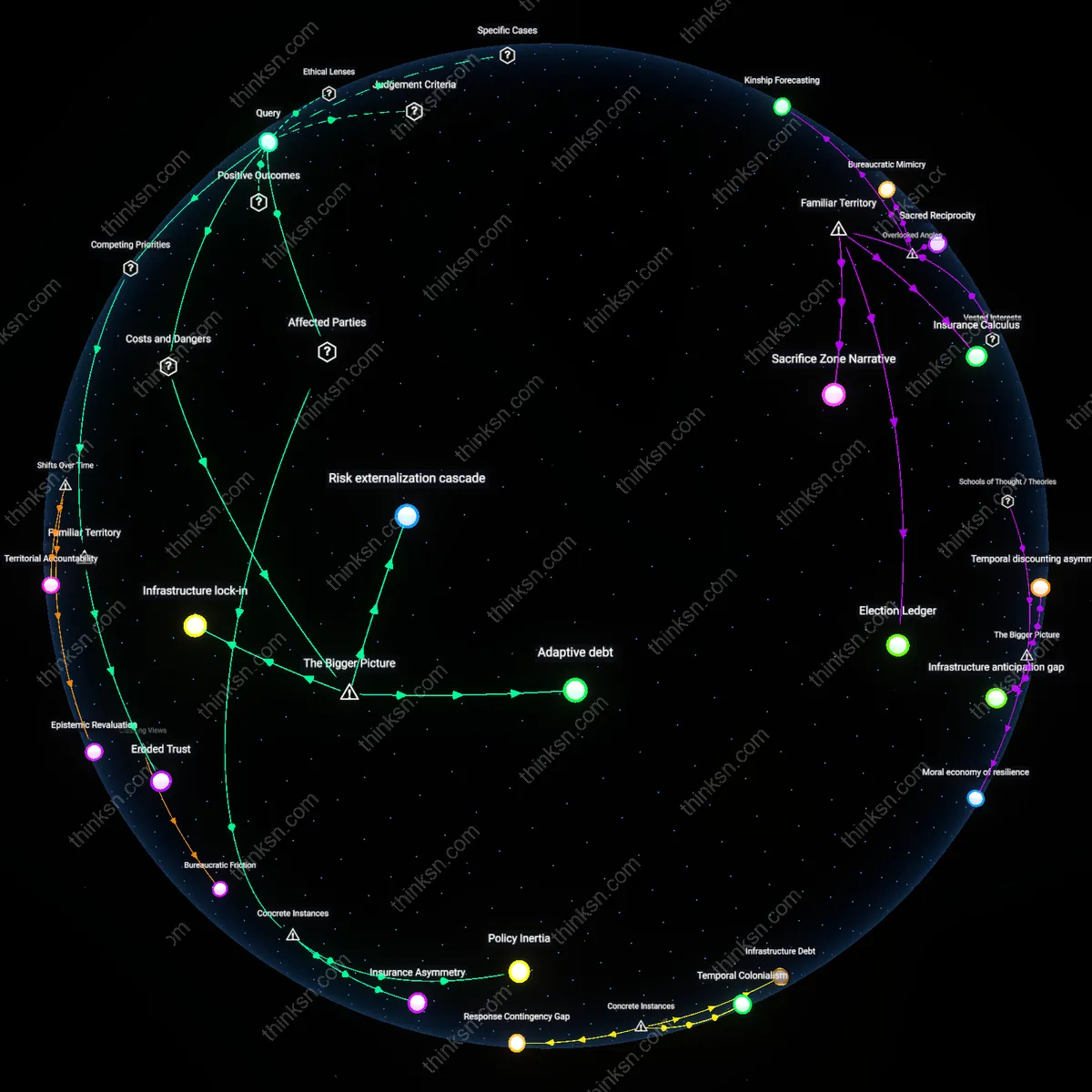
Policy Inertia
In Miami-Dade County, Florida, repeated delays in private retrofitting of homes despite clear NOAA tidal data and insurance warnings reveal that scientific uncertainty is exploited by local zoning boards and real estate lobbies to avoid mandating flood-resilient construction, privileging short-term property values over long-term habitability. This deferral mechanism operates through municipal code review cycles that require consensus on 'verified risk thresholds', which are perpetually contested by industry-backed climate skeptics embedded in planning commissions. The non-obvious insight is that uncertainty functions not as a knowledge gap, but as a procedural tool enabling powerful stakeholders to stall regulatory triggers for private investment. The dynamic reveals how localized governance structures absorb scientific ambiguity to maintain status-quo development economics.
Equity Deferral
In Norfolk, Virginia’s historic Freemason District, lower-income Black homeowners have been systematically excluded from municipal resilience grants while wealthier white residents receive tax abatements for elevated foundations and floodproofing, creating a de facto privatization of adaptation where uncertainty about SLR timelines is invoked to justify withholding public funding. The mechanism centers on the city’s 'risk tiering' system, which uses probabilistic sea-level models to classify areas as 'low-urgency', delaying infrastructure support in precisely those neighborhoods with the oldest housing stock and highest social vulnerability. What is underappreciated is that scientific uncertainty becomes a bureaucratic alibi for maintaining racialized investment patterns, transforming climate ambiguity into a lever of environmental inequality. This exposes how risk assessment protocols can reproduce historical disinvestment under the guise of technical prudence.
Insurance Asymmetry
In Charleston, South Carolina, private insurers like State Farm have quietly withdrawn from coastal ZIP codes such as 29403 while federal NFIP rates remain artificially low, creating a false signal of manageable risk that dissuades homeowners from flood-proofing even as nuisance flooding increases due to relative sea-level rise. The dynamic operates through a mismatch between actuarial models—where private carriers use granular lidar topography and tide-gauge trends to exit high-risk zones—and public programs that rely on outdated 100-year flood maps, sustained by congressional appropriations that depoliticize necessary premium reforms. The overlooked reality is that scientific uncertainty allows public-private risk segmentation to persist, shielding vulnerable homeowners from accurate price signals while deferring adaptation costs to future federal bailouts. This illustrates how fragmented risk governance exploits ambiguity to offload long-term liabilities onto taxpayers.
Infrastructure lock-in
Delaying private investments in flood-resilient home improvements entrenches vulnerable residential infrastructure, making future systemic adaptation more costly and less effective. When homeowners defer upgrades due to scientific uncertainty, municipal zoning and insurance frameworks interpret inaction as tacit acceptance of current risk levels, which in turn justifies continued permitting in flood-prone areas and sustains lending practices that finance at-risk development—this feedback loop solidifies a built environment incompatible with projected sea-level rise, particularly along the U.S. Gulf and Atlantic coasts. The non-obvious mechanism is not homeowner hesitation itself, but how private inaction becomes public policy inertia through institutional dependence on property valuation stability, locking communities into escalating exposure.
Risk externalization cascade
Scientific uncertainty enables wealthier homeowners to postpone adaptive investments, shifting long-term fiscal and physical risks onto lower-income residents and public emergency systems. As affluent households wait for definitive climate signals before acting, they retain capital while the cost of insurance and disaster recovery concentrates in overexposed municipal bond markets and federal flood programs like the NFIP, which are already insolvent in aggregate. This dynamic—visible in places like Miami-Dade County and Norfolk, Virginia—reveals how private risk assessment based on scientific ambiguity becomes a vector for redistributing systemic climate costs to the public and marginalized, not through malice but through actuarial delay.
Adaptive debt
Deferring flood-resilient upgrades accumulates adaptive debt, where the compounding cost of future retrofitting exceeds current investment by orders of magnitude due to inflation, supply chain constraints, and labor shortages in construction trades. Unlike financial debt, this form of deferred adaptation is invisible on balance sheets but manifests violently during compound events like Hurricane Ida’s inland flooding, where homes without elevation or waterproofing imposed cascading damage on power grids and wastewater systems. The underappreciated trigger is not sea-level rise per se, but the synchronization of delayed private action with critical infrastructure thresholds, turning incremental inaction into systemic rupture.
Eroded Trust
Scientific ambiguity about sea-level rise shifts accountability from private actors to public institutions, allowing homeowners to defer flood resilience investments while waiting for clearer mandates or subsidies. In places like New Orleans or Staten Island, where federal flood maps and disaster relief have historically shaped rebuilding behavior, people associate official guidance with legitimacy—so when science appears conflicted, it corrodes trust in both expert consensus and collective preparedness. This dynamic reveals that the public’s reliance on authoritative signals is so entrenched that uncertainty becomes a socially licensed reason for delay, even when self-protection is at stake.