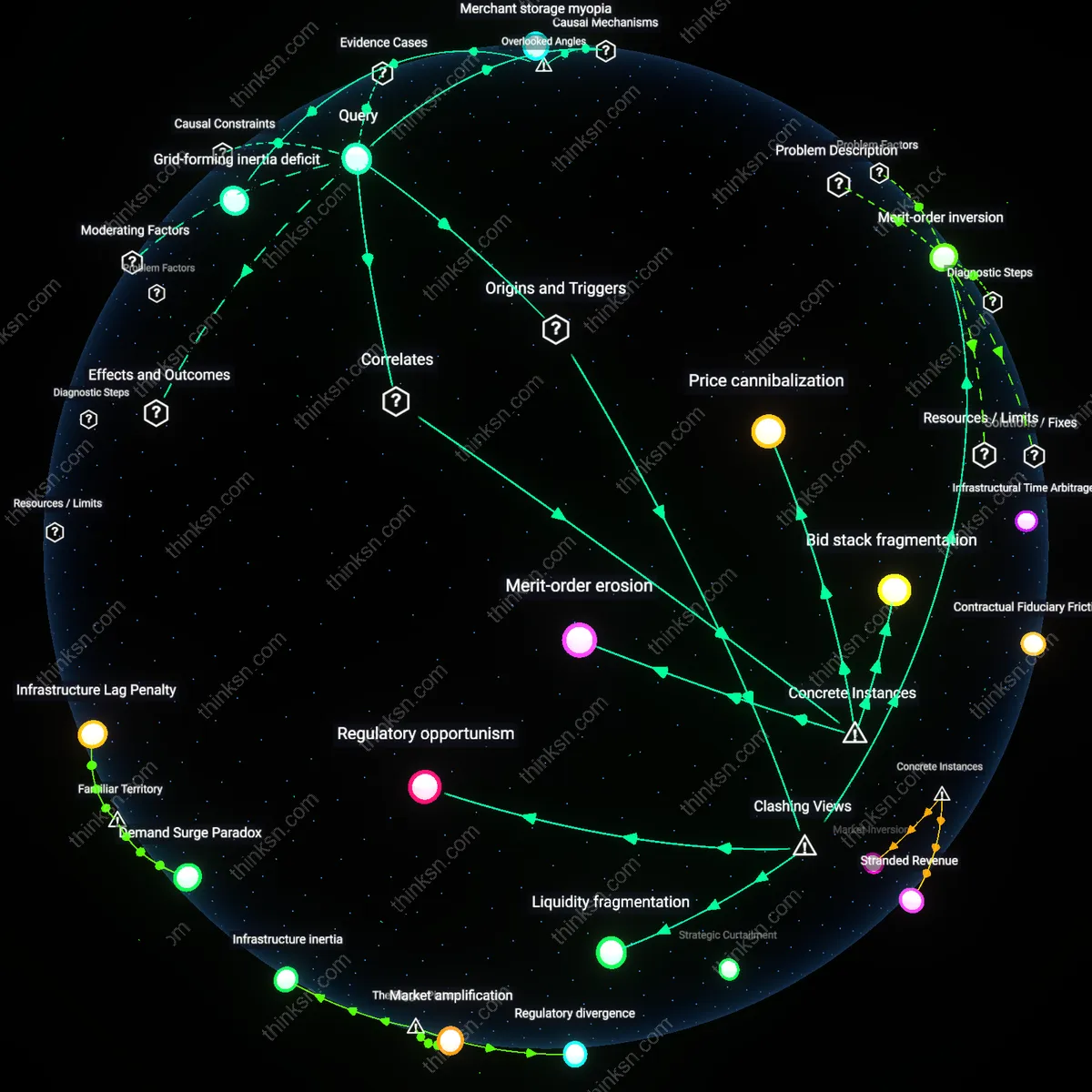
How Renewable Growth Fuels Electricity Price Swings?
Analysis reveals 9 key thematic connections.
Key Findings
Merit-order inversion
Higher renewable energy integration reduces average wholesale prices but increases price volatility by systematically displacing high-marginal-cost generators with near-zero-marginal-cost renewables, reshaping the merit-order stack in markets like Germany’s EPEX SPOT—where sudden solar surges force rapid ramping of gas plants, creating sharp price swings not due to scarcity but to residual demand shape. This dynamic contradicts the common belief that volatility stems from renewable intermittency alone, revealing instead that the core driver is the market’s structural response to inverted supply curves caused by policy-driven capacity additions. The non-obvious insight is that price instability emerges not from renewable unpredictability per se but from how legacy market designs miscalculate scarcity signals in a zero-marginal-cost dominant system.
Liquidity fragmentation
Electricity price volatility rises with renewable integration not because of technical instability but because decentralized, location-specific generation fragments market liquidity across regional nodes, as seen in Texas’s ERCOT where congestion between wind-rich West Texas and coastal load centers creates divergent price formation zones that undermine hedging efficiency. This challenges the dominant narrative that improved forecasting and storage will stabilize prices, exposing instead how spatial dispersion erodes the fungibility of electricity and weakens risk transfer mechanisms in forward markets. The underappreciated consequence is that financial market architecture—built on assumptions of national price convergence—is structurally unprepared for a world where value depends on precise locational and temporal specificity.
Regulatory opportunism
Renewable integration amplifies electricity price volatility primarily because regulators selectively intervene in price formation during scarcity events—such as California’s CAISO limiting negative pricing—creating artificial risk cliffs that distort investment signals and encourage strategic behavior by legacy generators exploiting regulatory uncertainty. This contradicts the standard view that volatility reflects physical grid fragility, instead revealing that institutional discretion in managing transitions produces more instability than the technical attributes of renewables themselves. The overlooked mechanism is that anticipatory market manipulation emerges not from market failure but from deliberate regulatory asymmetry in enforcing price boundaries during energy surplus or deficit.
Grid-forming inertia deficit
Increased renewable energy penetration reduces system-wide rotational inertia because inverter-based generators do not mechanically synchronize with grid frequency like traditional thermal plants. This undermines the grid’s passive resilience to frequency deviations, requiring active grid-forming technologies that few current market designs incentivize, exposing a hidden dependency on synthetic inertia services whose pricing and procurement remain underdeveloped. While most analyses focus on supply intermittency or storage needs, the erosion of physical synchronization dynamics—historically provided freely by spinning turbines—is a non-obvious bottleneck that destabilizes price formation during transient imbalances.
Merchant storage myopia
Battery storage operators in liberalized markets optimize for short-term price arbitrage between peak and off-peak hours, which reinforces extreme price swings rather than dampening them, because their revenue models depend on high volatility. This behavior creates a feedback loop where greater storage deployment, intended as a stabilizing solution, actually amplifies price oscillations when dispatch decisions are decoupled from system resilience objectives. The overlooked dynamic is that profit-maximizing storage algorithms interact strategically with renewable generation patterns to exploit, rather than absorb, volatility—subverting the assumed causal relationship between storage and price stabilization.
Cross-border balancing asymmetry
In interconnected European markets, countries with high wind penetration export surplus power during windy periods, but rely on neighboring countries with dispatchable capacity to balance shortfalls, creating an implicit subsidy for renewable integration that distorts price signals and delays domestic investment in flexible resources. This hidden reliance on neighboring system flexibility—routinely taken for granted in national-level analyses—means that electricity prices in high-renewable regions understate true balancing costs, fostering a false economy that collapses during regional weather extremes. The overlooked asymmetry in responsibility for maintaining grid stability across borders fundamentally alters the risk distribution of renewable integration, which market rules rarely account for in price formation.
Merit-order erosion
Higher renewable energy integration amplified electricity price volatility in Germany’s EPEX Spot market because low marginal cost wind and solar generation depressed day-ahead prices, especially during midday peaks, which in turn compressed thermal generator revenues and increased the frequency of negative pricing events between 2010 and 2015. This dynamic revealed how the merit-order effect, while reducing average prices, destabilized revenue streams for dispatchable plants, prompting greater reliance on intraday and balancing markets to manage short-term imbalances—highlighting that volatility emerged not from renewable intermittency alone, but from the interaction between market design and generation cost structures.
Price cannibalization
In Spain’s wholesale electricity market between 2011 and 2016, surging photovoltaic output during high-irradiance hours coincided with recurring price depressions in the same time slots, leading solar generators to undercut their own revenue potential—a feedback loop where added solar capacity reduced the market value of solar generation itself. This pattern exposed a self-reinforcing cycle in which renewable deployment, while statistically correlated with increased intraday price swings, primarily distorted price levels through saturation of supply during predictable windows, revealing that volatility was not random but temporally clustered and endogenous to the technology’s generation profile.
Bid stack fragmentation
During California ISO’s ramp-up of solar capacity from 2014 to 2020, the duck curve phenomenon intensified, but more significantly, the increasing number of small, distributed renewable aggregators began submitting heterogeneous and highly granular bids, fracturing the supply curve and increasing the sensitivity of clearing prices to minor demand shifts, especially during evening ramps. This shift revealed that price volatility was less a function of renewable output variability per se, and more a consequence of market fragmentation and the erosion of predictable bid stack stratification, undermining conventional price formation assumptions in centralized markets.