High-Deductible Health Plan Worth It for Self-Employed?
Analysis reveals 7 key thematic connections.
Key Findings
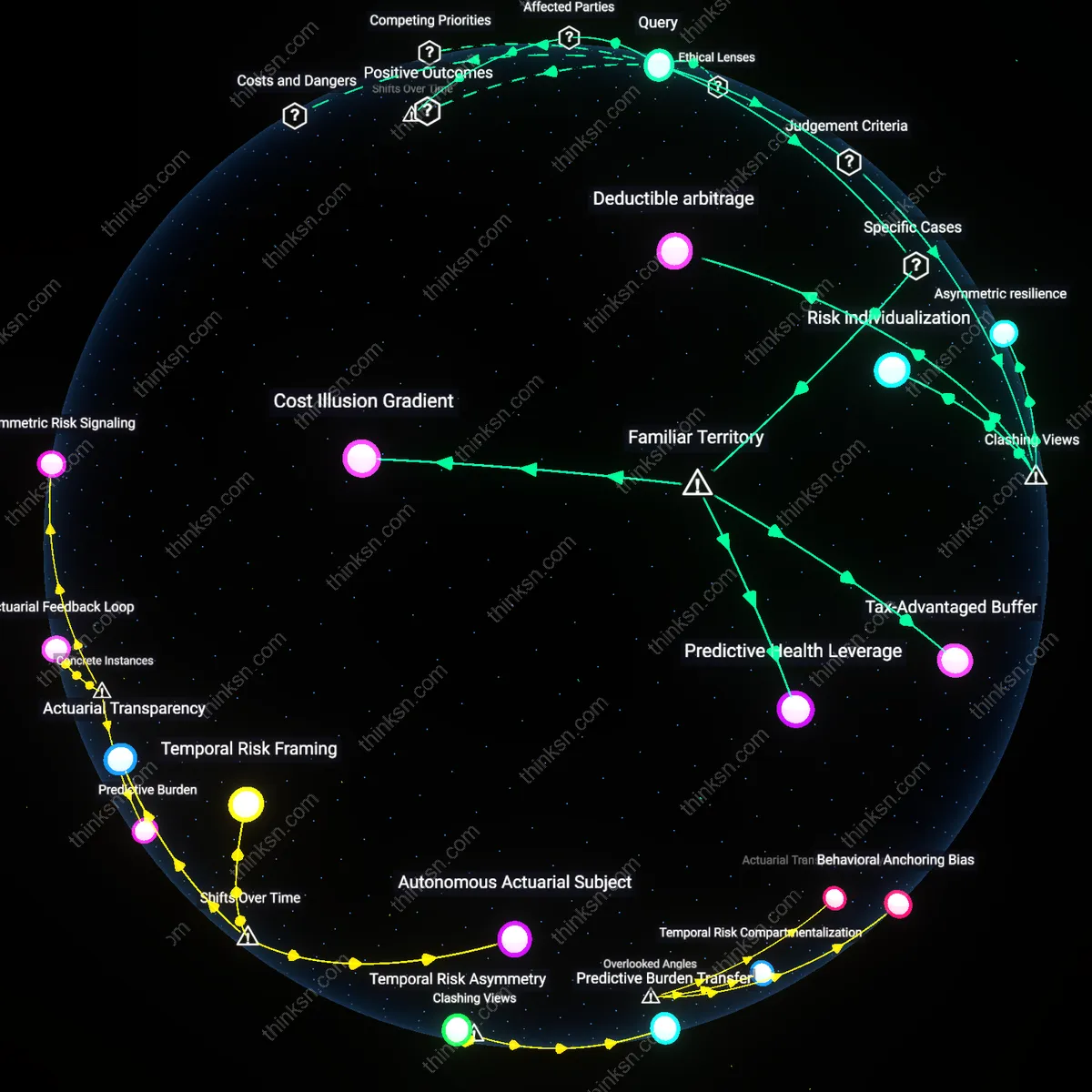
Risk Individualization
Yes, it is rational for self-employed individuals to choose high-deductible health plans because the post-1980s shift from employer-mediated to market-mediated health risk has transferred actuarial responsibility directly onto individuals, particularly affecting solo proprietors who lack institutional risk pooling. The erosion of employer-sponsored insurance as the dominant model since the 1990s—accelerated by IRS-defined Health Savings Accounts in 2003—has embedded financial logic into personal health decisions, making deductible optimization a survival mechanism rather than a mere cost comparison. This transformation reveals that what appears as a consumer choice is structurally coerced by the privatization of risk management, a condition that was historically shouldered by employers or unions in the mid-20th century. The non-obvious implication is that rationality here is not about predicting illness but about adapting to a system where financialized health planning has replaced collective protection.
Deductible arbitrage
Yes, it is rational for a self-employed individual to choose a high-deductible health plan because they can exploit the tax-advantaged structure of Health Savings Accounts (HSAs) to effectively lower their net cost of care, even with uncertain expenses. Self-employed individuals, unlike salaried employees, bear the full burden of premium costs and lack employer-sponsored tax shielding; by selecting a high-deductible plan eligible for HSA contributions, they convert taxable income into triple-tax-free funds—untaxed at contribution, growth, and withdrawal when used for medical expenses. This mechanism functions through the U.S. federal tax code’s preferential treatment of HSAs, enabling individuals to treat health spending as a tax-deferred investment rather than a pure consumption expense, a benefit that outweighs the risk of unpredictable costs for those with even moderate savings discipline. The non-obvious insight is that the decision is less about predicting medical needs and more about leveraging asymmetric tax incentives available only under high-deductible structures—a form of deductible arbitrage.
Risk individualization
No, it is not rational for a self-employed individual to choose a high-deductible health plan when their income fluctuates significantly, because the assumption of actuarial rationality collapses under conditions of financial liquidity constraints, not medical uncertainty. For example, a freelance graphic designer earning $30,000 one year and $70,000 the next cannot reliably predict HSA contribution capacity, nor absorb a $5,000 out-of-pocket cost after an emergency visit, even if actuarially improbable; the mechanism here is not risk pooling but risk individualization, where market-based health designs shift probabilistic exposure onto actors without institutional buffers. This operates through the U.S. health insurance architecture that equates choice with responsibility, ignoring that self-employed individuals face compound volatility—income, client base, and health—making high deductibles not a calculated gamble but a potential catalyst for medical debt. The dissonance lies in reframing what appears to be a rational calculation as a coerced exposure enforced by a system that moralizes financial risk as personal discipline.
Asymmetric resilience
Yes, it is rational for a self-employed individual in a state with Medicaid expansion and robust safety-net providers to choose a high-deductible plan, because the floor of public coverage and charity care de-risks worst-case scenarios, making low premiums a dominant strategy. A gig worker in Atlanta, for instance, may select a high-deductible plan knowing that Grady Memorial Hospital treats uninsured patients on a sliding scale and that Georgia’s expanded Medicaid covers emergent inpatient care regardless of pre-enrollment, creating an implicit public backstop; this operates through a patchwork of local health economics where private insurance design leverages publicly subsidized risk absorption. The analytical significance is that private plan choices are often rationally based not on individual actuarial estimates but on unpriced access to collective care infrastructures—an asymmetric resilience where middle-income self-employed individuals free-ride on systems meant for the indigent. The challenge to the dominant view is that rationality here depends on hidden cross-subsidies, not personal financial logic.
Tax-Advantaged Buffer
It is rational for self-employed individuals in states like Texas or Colorado with access to Health Savings Accounts (HSAs) to select high-deductible health plans because the triple tax advantages—pre-tax contributions, tax-free growth, and tax-free withdrawals for medical expenses—create a financial buffer that outweighs the risk of uncertain expenses. The IRS-defined HDHP-HSA linkage enables this mechanism, allowing freelancers and gig workers to treat healthcare spending as both a current expense and a long-term investment vehicle. While most people associate HSAs with cost-saving, few recognize how the account transforms out-of-pocket risk into cumulative fiscal leverage, especially when paired with stable income streams like contract consulting or recurring freelance work.
Predictive Health Leverage
A self-employed software developer in Silicon Valley with strong digital health tracking via wearable devices and telehealth subscriptions can rationally choose a high-deductible plan by leveraging personalized health predictability to minimize utilization risk. Continuous biometric monitoring and preventive access to virtual care reduce the likelihood of surprise acute events, enabling data-driven confidence in avoiding deductible thresholds. Though most view high deductibles as gambles, this group treats bodily predictability as a hedge—turning health stability into a calculable variable, much like uptime in cloud infrastructure, making the plan not a bet but a calibrated alignment of behavior and financial design.
Cost Illusion Gradient
A freelance graphic designer in Brooklyn who frequently underestimates non-emergency care costs while overestimating emergency likelihood will find it irrational to choose a high-deductible plan, not due to actual health risk but because cognitive anchoring on worst-case scenarios distorts premium-versus-deductible tradeoffs. The familiar narrative of 'catastrophic coverage' misleads many into believing they're insuring against disaster, when in reality, routine imaging, specialist visits, or prescription drugs push them into out-of-pocket maximums faster than expected under HDHPs. The illusion that low premiums equal net savings—common in gig economy forums and social media cost-cutting advice—masks the regressive burden of front-loaded spending, revealing a behavioral trap rather than a financial optimization.