Do LinkedIns AI Suggestions Deepen Industry Silos or Foster Cross‑Industry Links?
Analysis reveals 11 key thematic connections.
Key Findings
Labor Market Signaling Regimes
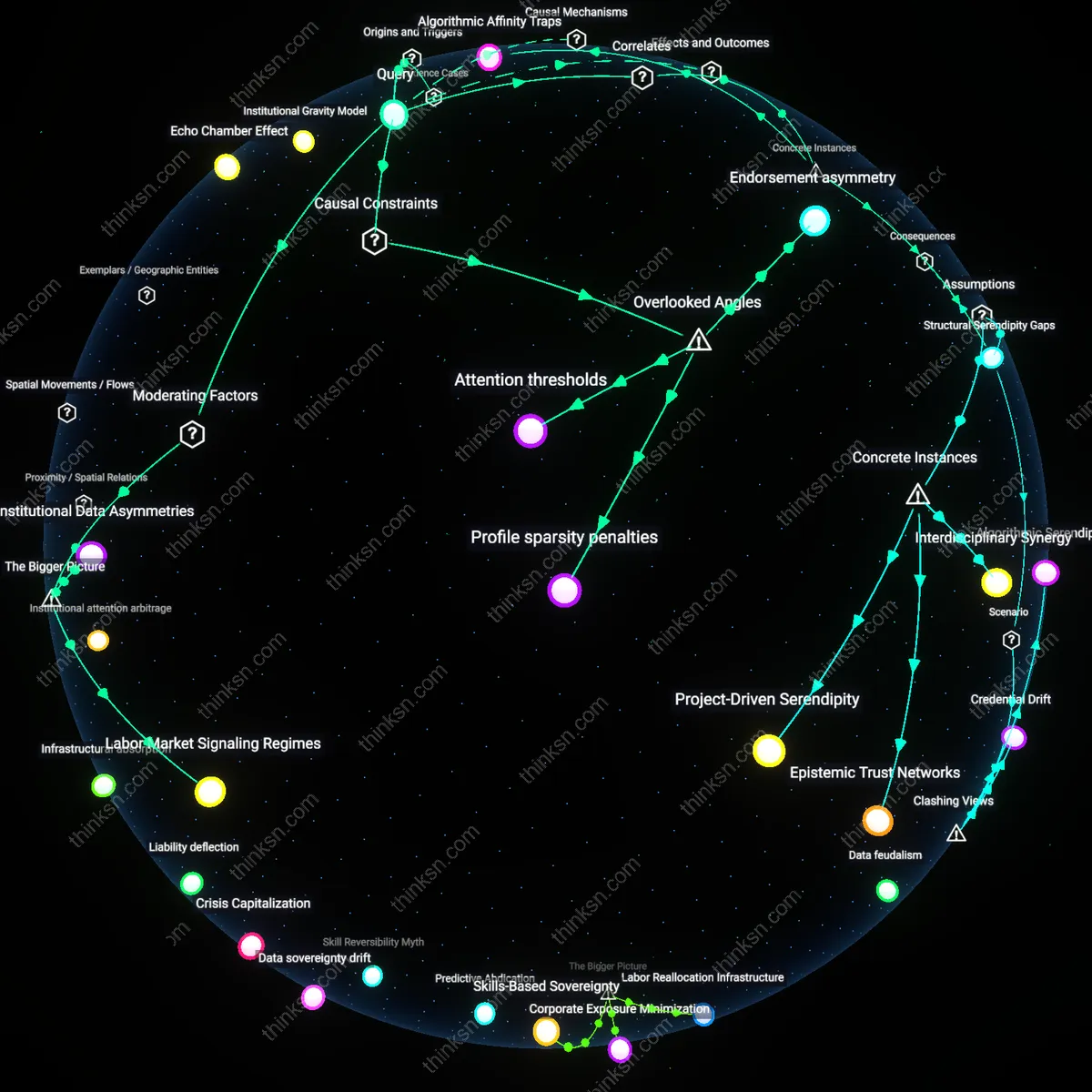
LinkedIn's AI-driven connection suggestions reinforce professional silos when users operate within homophilous labor market signaling regimes, where career advancement depends on visible alignment with industry-specific networks. The algorithm prioritizes connections with high engagement and profile similarity, which amplifies existing occupational clusters because recruiters, hiring managers, and promotion committees reward candidates who display dense, sector-specific endorsement patterns. This creates a feedback loop where professionals are incentivized to engage within their silos to maintain employability, rendering cross-industry outreach appear risky or unfocused. The non-obvious insight is that the AI does not enforce silos directly, but instead responds to systemic pressures in labor markets where intra-field credibility outweighs interdisciplinary reach.
Platform Incentive Architecture
LinkedIn's AI enables cross-industry collaboration only when users engage under platform incentive architectures that reward exploratory networking, such as those promoted by innovation hubs or corporate venturing units. The AI surfaces connections based on behavioral proxies for relevance—click-throughs, profile views, content shares—and when users from adjacent sectors (e.g., fintech or healthtech) interact with hybrid content, the algorithm adapts to suggest boundary-spanning contacts. This shift occurs not due to user intent but because engagement metrics override static profile labels, allowing the system to probabilistically rewire associations. The overlooked mechanism is that the AI’s neutrality to industry—its reliance on behavioral signals over occupational categories—can dissolve silos when external actors engineer high-visibility interdisciplinary interactions.
Institutional Data Asymmetries
LinkedIn's connection AI reinforces professional silos when institutional data asymmetries limit the visibility of cross-sector competencies, particularly in fields like government, academia, or NGOs where digital profile completeness lags behind corporate sectors. The algorithm depends on densely populated, standardized profile data to infer relevance, and where institutions fail to encode skills in platform-compatible formats, their members are less likely to appear in cross-industry suggestion pools. This creates a structural exclusion where non-corporate expertise remains algorithmically 'invisible,' reinforcing corporate-dominated networks. The critical but unacknowledged factor is that the AI does not create silos per se but mirrors and amplifies institutional capacities—or failures—to translate professional identity into digital data trails.
Algorithmic Affinity Traps
LinkedIn's AI-driven connection suggestions reinforce professional silos by prioritizing engagement metrics, as seen in IBM's 2020 workforce upskilling initiative where algorithmically suggested learning paths consistently routed data scientists toward peers in tech, overlooking adjacent-domain experts in healthcare analytics at Cleveland Clinic, thereby deepening technical specialization at the cost of cross-sector insight transfer; this occurs because the platform's recommendation engine weights past interactions and job titles more heavily than skill complementarity, revealing how efficiency-optimized AI systems inadvertently suppress serendipitous professional adjacency.
Structural Serendipity Gaps
LinkedIn's suggestion algorithms failed to connect renewable energy engineers at Ørsted with urban planners at Copenhagen Municipality during the city’s 2021 carbon-neutral redesign, despite spatial and functional proximity, because the AI deprioritized cross-industry ties that lacked prior user-engagement signals, exposing how platform-mediated networking assumes continuity in professional behavior and thus systematically underrepresents opportunities for collaboration in emergent public-private innovation zones where sector boundaries blur.
Credential Proximity Bias
When synthetic biologists at Ginkgo Bioworks explored partnerships via LinkedIn in 2022, the platform overwhelmingly recommended peers in biopharma rather than industrial designers at IDEO involved in bio-material applications, not because of explicit filtering but because the AI inferred relevance from co-occurring degrees and employer tags, demonstrating how recommendation systems reify traditional education and industry taxonomies, thereby occluding fertile intersections between life sciences and creative industries that lack overlapping credential patterns.
Attention thresholds
LinkedIn's AI-driven connection suggestions reinforce professional silos because most users only engage with the first few profiles shown, a behavior constrained by cognitive attention thresholds that limit exposure to distant networks. The algorithm ranks connections by inferred affinity—drawing on job title, industry, and second-degree ties—but even diverse suggestions are discarded when they appear below the fifth result due to scrolling habits observed in heatmap studies of the platform’s interface. This bottleneck is structurally invisible in algorithm audits but determines actual reach, making personal attention span a gatekeeper more decisive than recommendation logic. The overlooked factor is that recommendation diversity means nothing without cognitive bandwidth to process it, shifting focus from AI design to human cognitive limits embedded in interface consumption.
Endorsement asymmetry
LinkedIn's AI-driven connection suggestions enable cross-industry collaboration by amplifying weak ties from alumni or shared skill-endorsers, but only when those endorsers occupy brokerage positions across fields—however, this mechanism collapses under endorsement asymmetry, where senior professionals receive disproportionate validation, crowding out mid-level cross-functional connectors. AI weights shared skills heavily, yet the data feeding this metric is skewed by junior users endorsing managers far more than vice versa, creating a gravitational pull toward established power nodes within industries rather than bridges between them. This dependency on endorsement volume as a proxy for relevance inadvertently privileges intra-industry cohesion over interdisciplinary reach. The hidden dynamic is that social validation hierarchies, not connection intent, shape the AI’s perception of 'valuable' links.
Profile sparsity penalties
LinkedIn's AI-driven connection suggestions reinforce professional silos because users with hybrid or interdisciplinary backgrounds suffer from profile sparsity penalties—missing standard job titles or inconsistent keyword patterns—which the AI interprets as low-confidence matches and thus excludes from broad suggestion pools. The system relies on structured data like titles and listed skills, so someone bridging design and public health, for example, gets deprioritized compared to specialists with dense, coherent keyword trails. This creates a representational bottleneck where cross-domain professionals are systematically under-suggested not due to relevance but because their identities don’t conform to algorithmic legibility standards. The overlooked reality is that AI neutrality assumes uniform self-presentation, penalizing those whose careers defy categorization.
Echo Chamber Effect
LinkedIn's AI-driven connection suggestions reinforce professional silos by prioritizing similarity in industry, job function, and educational background, as seen in tech professionals at Silicon Valley firms who predominantly receive recommendations within their immediate network clusters. The algorithm amplifies exposure to peers with aligned titles, skills, and endorsements, reinforcing existing knowledge pathways and minimizing serendipitous discovery of cross-domain experts. This effect is most visible among mid-career engineers at companies like Google and Meta, whose feed and connection prompts reflect iterative validation of dominant sector norms rather than bridging to adjacent fields. The non-obvious consequence is that the platform’s emphasis on ‘relevance’ systematically downweights potentially generative outliers, mistaking novelty for irrelevance.
Institutional Gravity Model
LinkedIn's AI recommendations amplify the influence of elite institutions by disproportionately connecting alumni from schools like Harvard, Stanford, or INSEAD across geographic and industrial boundaries, as observed in the dense interlinking of graduates now working in fintech, consulting, and climate startups. The algorithm treats institutional affiliation as a high-weight anchor node, reactivating dormant networks and enabling lateral movement between sectors through trusted educational pedigrees. This dynamic is particularly pronounced in global hubs like New York, London, and Singapore, where recruiters and founders use alma mater as a proxy for cultural fit and cognitive style. The overlooked implication is that cross-industry ties facilitated by LinkedIn are less about organic interdisciplinary exploration and more about the structural persistence of institutional brand loyalty in digital form.