How Far Can We Trust Bureaucracy in an Era of Foreign Interference?
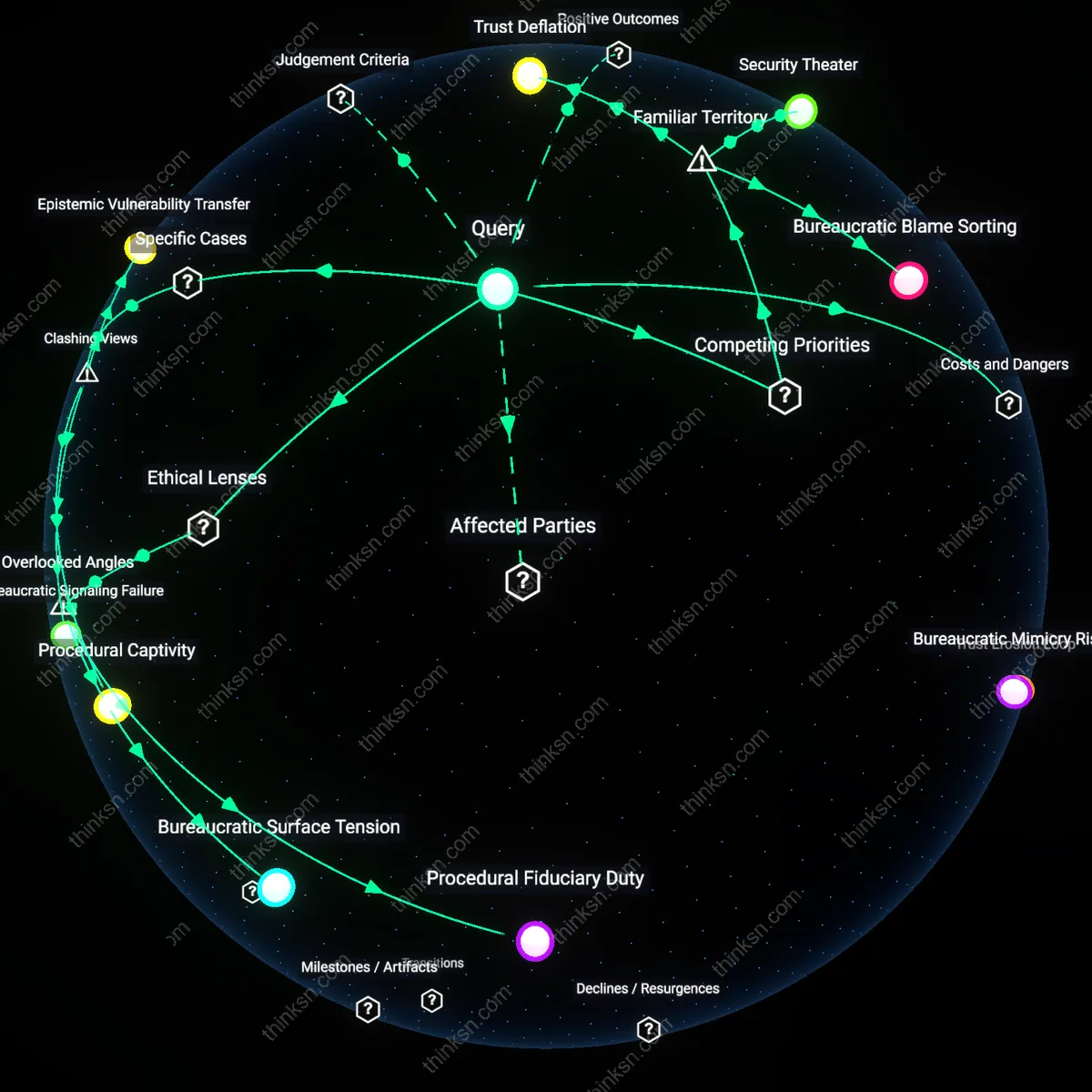
Analysis reveals 11 key thematic connections.
Key Findings
Trust Erosion Loop
Voters should reduce trust in the administrative state's procedural fairness when foreign interference exploits bureaucratic weaknesses because sustained exposure to manipulated outcomes induces a recursive diminishment of public confidence that undermines the legitimacy of electoral institutions, as seen in state-level election audits post-2020 where procedural anomalies became focal points for disinformation campaigns amplified by external actors; this self-reinforcing cycle matters because it shifts public perception from isolated vulnerabilities to systemic decay—even when remediation occurs—due to the asymmetric impact of scandal versus correction in media ecosystems. The underappreciated dynamic is that foreign actors need not alter votes to destabilize governance; they merely need to expose and exploit existing procedural ambiguities through digital leaks or fabricated audits, activating domestic polarization machinery that then independently amplifies distrust, thereby decoupling institutional credibility from actual performance.
Bureaucratic Mimicry Risk
Voters should grow skeptical of procedural fairness when foreign interference infiltrates bureaucratic systems because state-like precision in forged communications—such as spoofed election official emails or fake ballot reconciliation logs—blurs the line between authentic and synthetic administrative acts, which occurred during the 2016 and 2020 elections when hacker groups replicated state election reporting formats to disseminate misleading narratives; this mimicry perverts the epistemic function of bureaucracy by weaponizing its hallmark trait—standardized documentation—as a vector of deception, causing voters to conflate legitimate procedural signals with engineered noise. The overlooked consequence is that heightened procedural rigor, intended to increase transparency, may inadvertently provide more templates for realistic forgery, enabling adversaries to exploit the very systems designed to ensure fairness, thereby turning accountability mechanisms into instruments of confusion.
Asymmetric Scrutiny Trap
Voters should recognize that foreign exploitation of bureaucratic weaknesses triggers disproportionate investigative focus on procedural minutiae at the expense of functional outcomes, as illustrated by the congressional scrutiny of mail-in ballot handling after 2020, where narrow adversarial audits crowded out assessment of overall election integrity or voter access; this hyper-scrutiny, driven by the visibility of exploited procedures, incentivizes bureaucratic risk-aversion over responsiveness, slowing down adaptive governance and diverting resources from broader equity concerns to forensic legitimation. The systemic irony is that public institutions, in attempting to demonstrate procedural fidelity through reactive transparency, amplify the salience of exploited weaknesses, allowing foreign actors to indirectly shape domestic regulatory priorities—not through data theft or vote manipulation, but by forcing the state to perform endless rituals of self-vindication that erode operational agility and public trust in equal measure.
Trust Deflation
Voters should reduce trust in the administrative state's procedural fairness because foreign interference exposes systemic vulnerabilities in election infrastructure, revealing that even routine bureaucratic safeguards can be weaponized through digital intrusion. State election officials, cybersecurity agencies, and local canvassing boards operate within interdependent IT ecosystems that prioritize accessibility over fortification, making them susceptible to disinformation and data manipulation; this structural exposure undermines the perception that procedural rules are neutrally enforced. The non-obvious insight within this familiar concern about election hacking is that the erosion of trust stems less from actual procedural breaches and more from the demonstrable fragility of the systems upholding them, which shifts public confidence from institutional process to system resilience.
Security Theater
Voters should redirect trust toward performative accountability measures because foreign interference prompts bureaucracies to adopt visible but superficial reforms that prioritize the appearance of procedural integrity over substantive improvement. Agencies like the Cybersecurity and Infrastructure Security Agency (CISA) respond to election threats by amplifying public communications about audits, paper trails, and observer access—measures that are easily showcased but do not address backend coordination gaps or supply chain vulnerabilities in voting machines. What gets overlooked in the common focus on transparency is that these gestures satisfy the public demand for reassurance without reallocating power or correcting institutional blind spots, effectively transforming procedural fairness into a staged outcome.
Bureaucratic Blame Sorting
Voters should recalibrate trust by assigning differential credibility to specific administrative tiers because foreign interference unevenly strains federal, state, and local bureaucratic layers, exposing which levels possess adaptive authority versus those reduced to compliance roles. While federal agencies design threat response frameworks, state election directors control ballot design and certification rules, and local clerks manage physical logistics—each layer interprets mandates differently under pressure, revealing disparities in capacity and autonomy. The underappreciated reality beneath the familiar narrative of 'election chaos' is that procedural fairness becomes a negotiated outcome across jurisdictions, not a uniformly delivered service, making trust contingent on administrative scale and jurisdictional agency.
Procedural Fiduciary Duty
Voters should recalibrate trust by demanding that administrative agencies demonstrate fiduciary accountability to the public’s political identity, not just procedural regularity, because foreign interference exploits systemic gaps in impersonal rules by mimicking legitimate actors—transforming bureaucratic neutrality into a vulnerability. This shifts focus from whether processes were followed to whether agencies are ethically bound to protect the integrity of democratic will, akin to how fiduciaries must safeguard a client’s interests under liberal legal theory. The non-obvious insight is that procedural fairness alone is insufficient when the enemy looks identical to the citizen in the eyes of the system—thus, loyalty and identity become embedded variables in administrative legitimacy.
Bureaucratic Surface Tension
Voters should condition trust on an administration’s demonstrated capacity to modulate procedural rigidity in response to external stress, because adversarial actors target not just data or access but the cognitive load required to distinguish breach from normative function. The overlooked dynamic is how the same procedural consistency that ensures equality under law creates a 'surface tension'—a brittle interface easily exploited by micro-scale manipulations that don’t break rules but degrade aggregate confidence. This reframes fairness not as rule fidelity but as adaptive resilience, exposing how foreign interference parasitizes the symbolic weight of bureaucracy itself.
Procedural Captivity
Voters should trust the administrative state less when foreign interference exposes how procedural compliance can be weaponized by external actors to erode public confidence—because in the 2016 U.S. election, Russian operatives exploited FBI protocols and public records requests not to alter votes, but to amplify legitimate bureaucratic actions (like the Clinton email investigation) as instruments of perception management; this reveals that fairness rituals, when rigidly followed amid external manipulation, become channels of subversion rather than safeguards, challenging the assumption that procedural integrity inherently protects democratic resilience.
Bureaucratic Signaling Failure
Voters should recalibrate trust upward precisely when foreign interference is detected and publicly contextualized by agencies, because in Estonia’s 2007 cyberattacks, the government’s transparent post-incident overhaul of digital voting systems and real-time communication about threats strengthened public buy-in; this inverts the common narrative that breaches necessarily degrade trust, showing instead that administrative responsiveness to external exploitation can become a performative demonstration of systemic adaptability and civic inclusion.
Epistemic Vulnerability Transfer
Voters should distrust not the procedures themselves but the delegation of corrective authority to insulated technocrats following foreign interference, as seen in the European Medicines Agency’s 2020 phishing breach where hackers stole vaccine data and officials responded with closed-door audits and tightened access—measures that preserved information integrity but excluded democratic input, exposing how bureaucratic self-correction can silently shift epistemic control from publics to unelected specialists under crisis pretenses, thereby replicating the very opacity that enables interference.