Should Mental Health Screens Dictate Career Advancement?
Analysis reveals 9 key thematic connections.
Key Findings
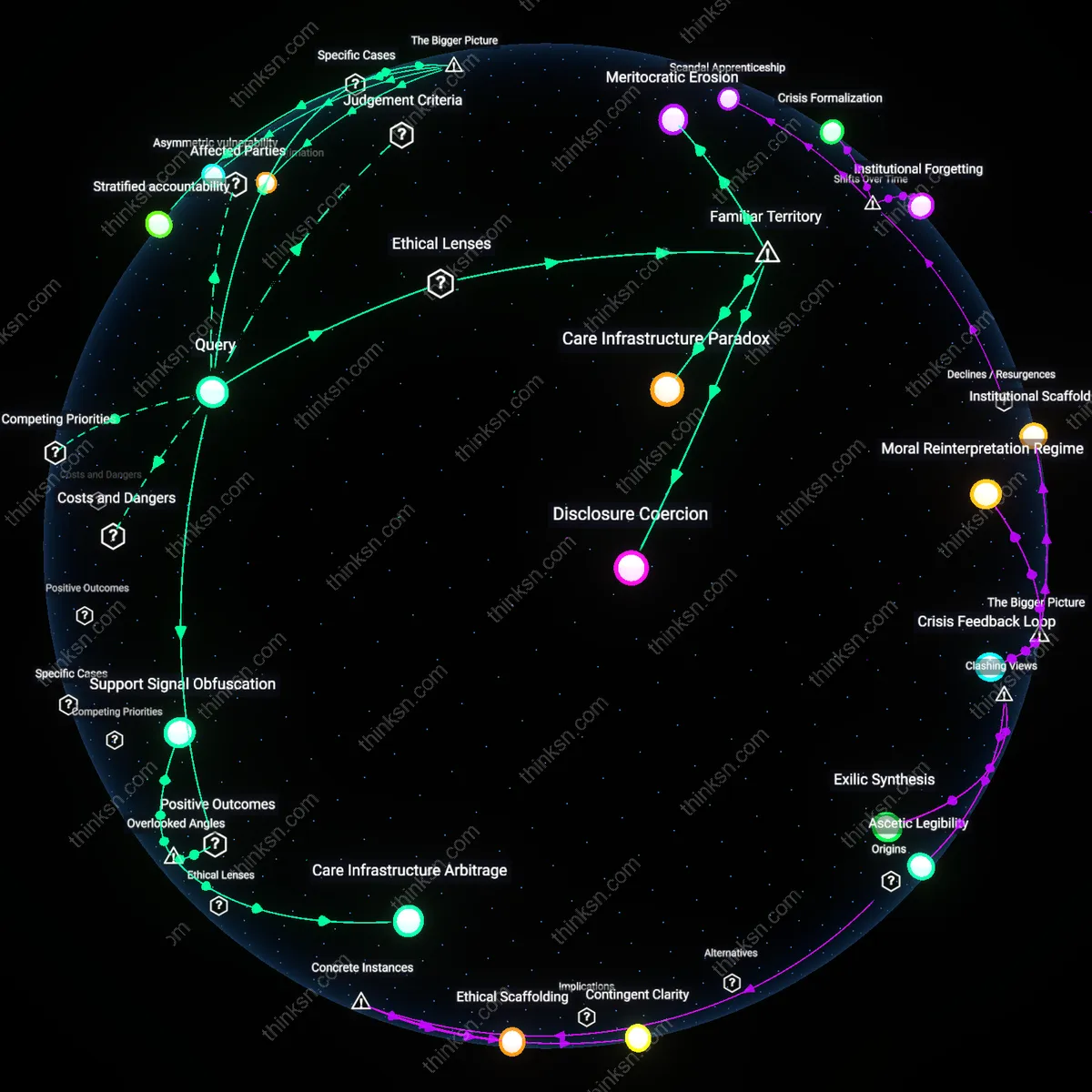
Care Infrastructure Arbitrage
Employers should use mental-health screening data in promotion decisions because doing so can redirect high-performing employees toward roles where their psychological resilience indirectly fortifies team stability, thereby freeing mental health resources for more vulnerable peers. In high-stress industries like emergency medicine or financial trading desks, resilient individuals in leadership roles can model low-reactivity decision-making during crises, reducing contagion effects of stress across teams—this systemic pressure redistribution is rarely accounted for in equity-focused resource models, which assume static vulnerability rather than dynamic organizational buffering. The overlooked mechanism is that mental health data, when used strategically in advancement, can optimize not just individual outcomes but collective care capacity—an arbitrage between talent deployment and support infrastructure.
Latent Role Fluidity
Employers should consider mental-health screening results in promotion decisions because individuals with higher psychological baseline stability can pivot more effectively into emergent leadership roles during organizational disruption, such as post-merger integration or crisis restructuring in sectors like public utilities or disaster response agencies. These employees exhibit latent role fluidity—operating seamlessly across functional boundaries when stress destabilizes role boundaries—because their cognitive bandwidth isn’t consumed by internal regulation, enabling rapid external adaptation. This dimension is typically ignored in both promotion and support frameworks, which treat roles as fixed and mental health as a static risk rather than a dynamic enabler of structural agility.
Support Signal Obfuscation
Employers should avoid using mental-health screening data in promotion decisions because doing so risks incentivizing the strategic obfuscation of distress signals among employees who depend on upward mobility for long-term security, particularly in underrepresented groups within hierarchical industries like law or academia. When career advancement becomes contingent on appearing mentally resilient, employees with legitimate needs may suppress disclosures not only to access promotions but also to ensure future eligibility for support programs—creating a feedback loop where the most vulnerable are systematically excluded from both advancement and care. The hidden dynamic is that data dual-use corrupts the integrity of screening as a support mechanism, transforming it into a performative assessment of employability rather than a diagnostic for assistance.
Meritocratic Erosion
No, employers should not consider mental-health screening results in promotion decisions because doing so undermines the foundational principle of meritocracy, which holds that advancement must derive from demonstrable competence and performance. Meritocratic systems, dominant in liberal democracies like the United States and embedded in corporate governance models, rely on the assumption that impartial criteria—such as productivity, leadership, and skill—determine mobility. Allowing mental health data, even if correlated with performance, introduces medically derived judgments that conflate capacity with clinical status, opening the door to implicit disqualification of neurodivergent or stigmatized employees. The underappreciated risk is that meritocracy, while ostensibly neutral, becomes a mechanism for laundering ableist bias under the guise of objectivity.
Care Infrastructure Paradox
Yes, employers should include mental-health screening results in promotion decisions only if those results simultaneously redirect support resources to at-risk employees, because failing to act on revealed need contradicts the logic of organizational care embedded in modern human resources frameworks. Large firms like Salesforce or Siemens use psychosocial risk assessments not just for evaluation but to trigger internal accommodations, such as counseling access or workload adjustments, reflecting a care-based ethic aligned with welfare-state principles in countries like Sweden or the Netherlands. The rarely acknowledged contradiction is that when screening reveals vulnerability, promoting someone from that group without addressing the underlying strain effectively rewards fragility while leaving systemic pressures intact—perverting care into a form of extractive inclusion.
Disclosure Coercion
No, employers should not use mental-health screening data in promotion decisions because even indirect consideration creates structural pressure to disclose conditions that legal protections like the Americans with Disabilities Act (ADA) are designed to shield. In U.S. corporate environments, where mental health programs are often administered through third-party EAPs (Employee Assistance Programs), the mere possibility of data influencing advancement incentivizes strategic self-reporting or conversely, concealment, distorting both treatment efficacy and career equity. The hidden mechanism is not outright discrimination but the normalization of voluntary exposure—where apparent support structures covertly condition access to opportunity on the surrender of medical privacy, transforming therapeutic engagement into a performative audit.
Stratified accountability
Employers should not use mental-health screening results in promotion decisions because such practices in high-pressure corporate environments like investment banks on Wall Street incentivize managers to deprioritize psychological support for top performers to avoid career-limiting labels, thereby converting healthcare data into a tool of workforce stratification. This occurs when performance-driven promotion systems interact with confidential health disclosures, creating a covert incentive to suppress mental-health service utilization among high-potential employees. The systemic mechanism is the misalignment between organizational wellness rhetoric and advancement criteria that implicitly reward emotional suppression. What is underappreciated is how legitimate resource allocation systems can become dual-use infrastructures for maintaining hierarchical control when data flows intersect with status hierarchies.
Asymmetric vulnerability
Employers that integrate mental-health data into promotion processes risk exacerbating existing power imbalances, as evidenced by public-sector agencies like the UK's National Health Service, where junior clinicians report withholding mental-health disclosures to avoid being deemed 'unsuitable for leadership roles' despite institutional wellness programs. This happens because promotion committees, though formally neutral, rely on subjective assessments that are informally influenced by perceptions of psychological resilience. The broader system is one where resource needs and career trajectories are governed by the same evaluative bodies, creating a paradox in which those most eligible for support appear least eligible for advancement. The non-obvious consequence is that mental-health data, when visible to evaluators, transforms from care coordination tool to gatekeeping mechanism due to differential exposure under bureaucratic scrutiny.
Institutional legitimation
Organizations like Google and other tech firms that use anonymized mental-health data solely for program design—not individual decisions—demonstrate how separating data use by purpose preserves both resource targeting and career equity. This works because decentralized data governance—where clinical assessments are administered by independent health providers and aggregated without identifiers—prevents downstream misuse in advancement contexts while enabling proactive support allocation. The systemic driver is the institutional commitment to procedural firewalls that insulate human capital development from medical confidentiality. The overlooked insight is that the legitimacy of workplace mental-health initiatives depends not on data collection itself, but on the structural separation of its intended consequences—care from evaluation—within organizational architecture.