Do Rent Controls and Zoning Limits Protect Tenants or Prospective Renters?
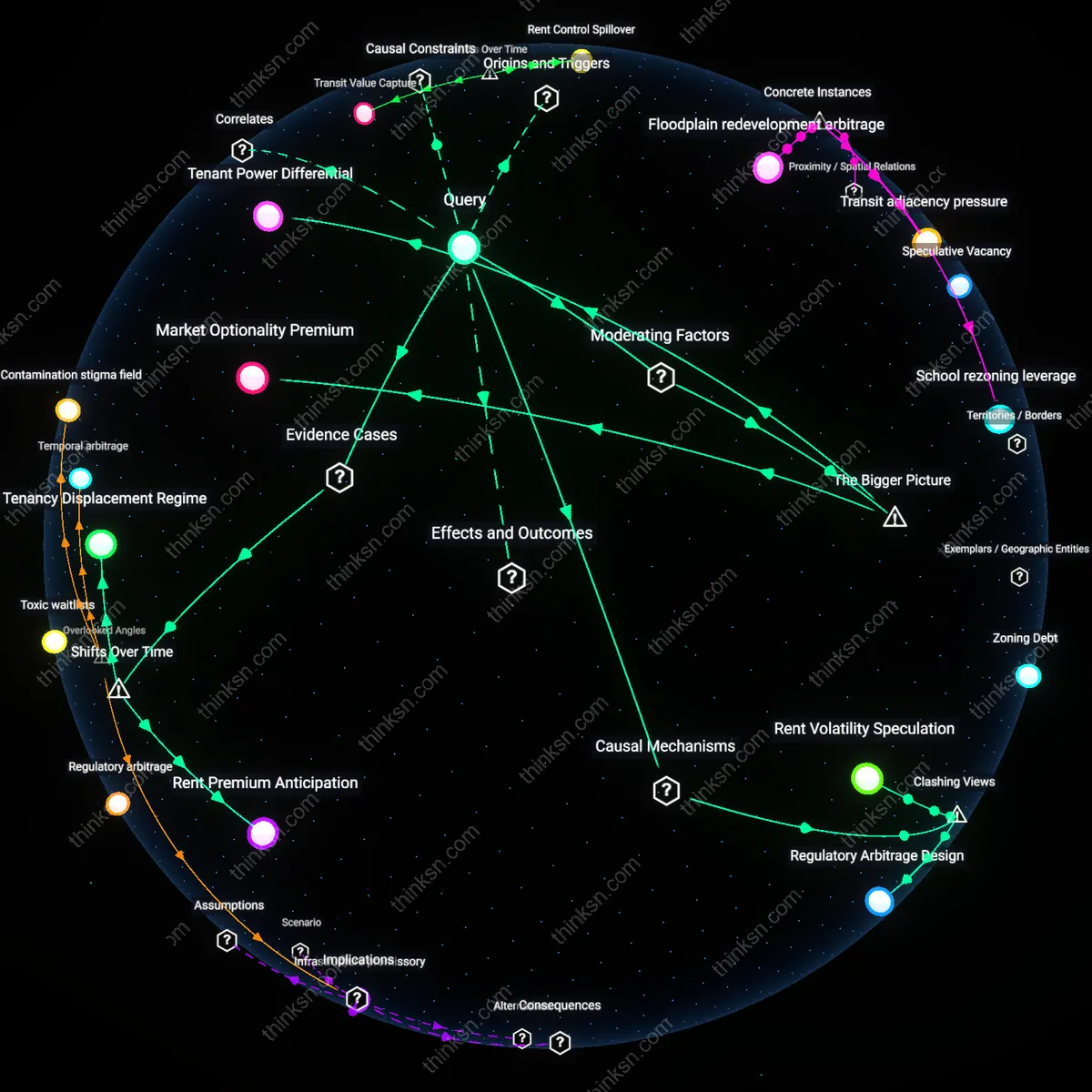
Analysis reveals 8 key thematic connections.
Key Findings
Entrenched Scarcity
Yes, combining rent stabilization with strict zoning protects current tenants at the expense of prospective renters by institutionalizing housing shortages. Strict zoning—such as single-family mandates in cities like San Francisco or Los Angeles—blocks new construction, while rent controls cap prices without increasing supply, making vacancies rare and fiercely contested. This dynamic privileges incumbent tenants with below-market leases but systematically disadvantages newcomers, especially lower-income or marginalized groups who lack intergenerational housing security. The non-obvious consequence is that progressive policies meant to shield the vulnerable can ossify access around existing occupancy, turning apartments into quasi-hereditary assets.
Rent Transfer Effect
Yes, this policy mix shifts economic surplus from future renters to current tenants by locking in price differentials. In cities such as New York, where rent-stabilized units can be decades behind market rates, the benefit is not just affordability but massive wealth transfer—current tenants gain tens of thousands in annual housing savings, effectively subsidized by excluded applicants. Strict zoning amplifies this by preventing market-rate expansion that could absorb demand. The underappreciated reality is that this creates a rentier class of tenant-insiders whose gains depend on the exclusion of others, mimicking the very dynamics of landlord exploitation they were meant to counter.
Entrenched scarcity
Combining rent stabilization with strict zoning entrenches scarcity by freezing existing housing supply in place while inflating demand pressures, which emerged decisively after 1970s urban fiscal crises when cities like New York and San Francisco adopted both policies to prevent displacement without expanding construction—locking in a low-supply equilibrium that benefits incumbent tenants but systematically excludes future entrants, especially lower-income workers and marginalized groups; the non-obvious consequence is that the very tools meant to protect vulnerable residents became mechanisms of exclusion, not due to malice but through the compound effect of static zoning and price controls over decades of population growth and income stratification.
Regulatory calcification
The coupling of rent stabilization and rigid zoning produces regulatory calcification, a shift visible after the 1990s in cities like Los Angeles and Berkeley, where community-based planning victories against 'overdevelopment' led to hyper-localized land-use control and expanded tenant protections—creating feedback loops where any relaxation of zoning is politically blocked by stabilized tenants fearing rent hikes, effectively fossilizing the housing system into a risk-averse bureaucracy that cannot adapt to demographic or economic shifts; what is underappreciated is that tenant security, when disconnected from supply-side dynamics, morphs into a veto regime maintained by current occupants against future demand.
Intergenerational rent transfer
Rent stabilization paired with strict zoning enables intergenerational rent transfer, a transformation accelerated in the 2000s as Baby Boomer tenants in high-cost coastal cities retained below-market leases through inheritance or long-term occupancy, while Millennials and Gen Z face locked-out access to stable housing—this shift reframes affordability not as a social guarantee but as a time-contingent privilege, where the policy’s initial intent to shield poor tenants has evolved, through prolonged underbuilding, into a de facto wealth transfer from younger aspirants to older occupants, revealing that the system now allocates scarcity based on timing rather than need.
Regulatory Collusion
Rent stabilization and strict zoning jointly enable landlord-tenant co-optation of housing policy, where both groups benefit from restricting new supply and entry, effectively treating the housing stock as a closed club that prioritizes stability over mobility. In cities like San Francisco, long-term tenants gain below-market leases while property owners capture scarcity rents from controlled turnover, both relying on exclusionary zoning to block market competition. This challenges the assumption that tenants and developers are natural adversaries, revealing instead a shared interest in maintaining artificial scarcity—the non-obvious alliance reframes affordability as a rationed privilege rather than a scalable right.
Temporal Inequity
The policy combination entrenches a generational imbalance where current occupancy functions as a one-time lottery win, locking in advantages for those present at policy onset while imposing permanent access deficits on future cohorts. In Berlin’s 2019 rent cap, combined with preservation zoning, the immediate effect was stability for existing renters but a collapse in new leasing activity, as developers withdrew and conversions surged—meaning those entering the market post-implementation faced a thinner, less responsive supply. The overlooked contradiction is that anti-displacement tools can become engines of intergenerational exclusion, framing housing justice as a static claim rather than a dynamic entitlement.
San Francisco's Mission District
In San Francisco's Mission District, the combination of stringent rent control and exclusionary zoning laws prevented both displacement of existing Latino tenants during the early 2000s tech boom and the construction of new housing that might have accommodated incoming workers, resulting in an underground market for sublets and de facto exclusion through skyrocketing auxiliary costs; here, nominal affordability for incumbents coexists with systemic inaccessibility for newcomers, even those with similar incomes. The zoning barrier—particularly the restriction on multifamily upzoning—meant that demand spillover intensified competition for the non-stabilized stock, inflating prices across the board. The non-obvious insight is that rent stabilization without supply elasticity functions as a rationing mechanism among lower- and middle-income groups, where the ‘winners’ are determined by historical accident of occupancy rather than need, thus transforming housing policy into a de facto seniority system.