Is Leasing Forever Smarter Than Buying in High-Cost Coastal Cities?
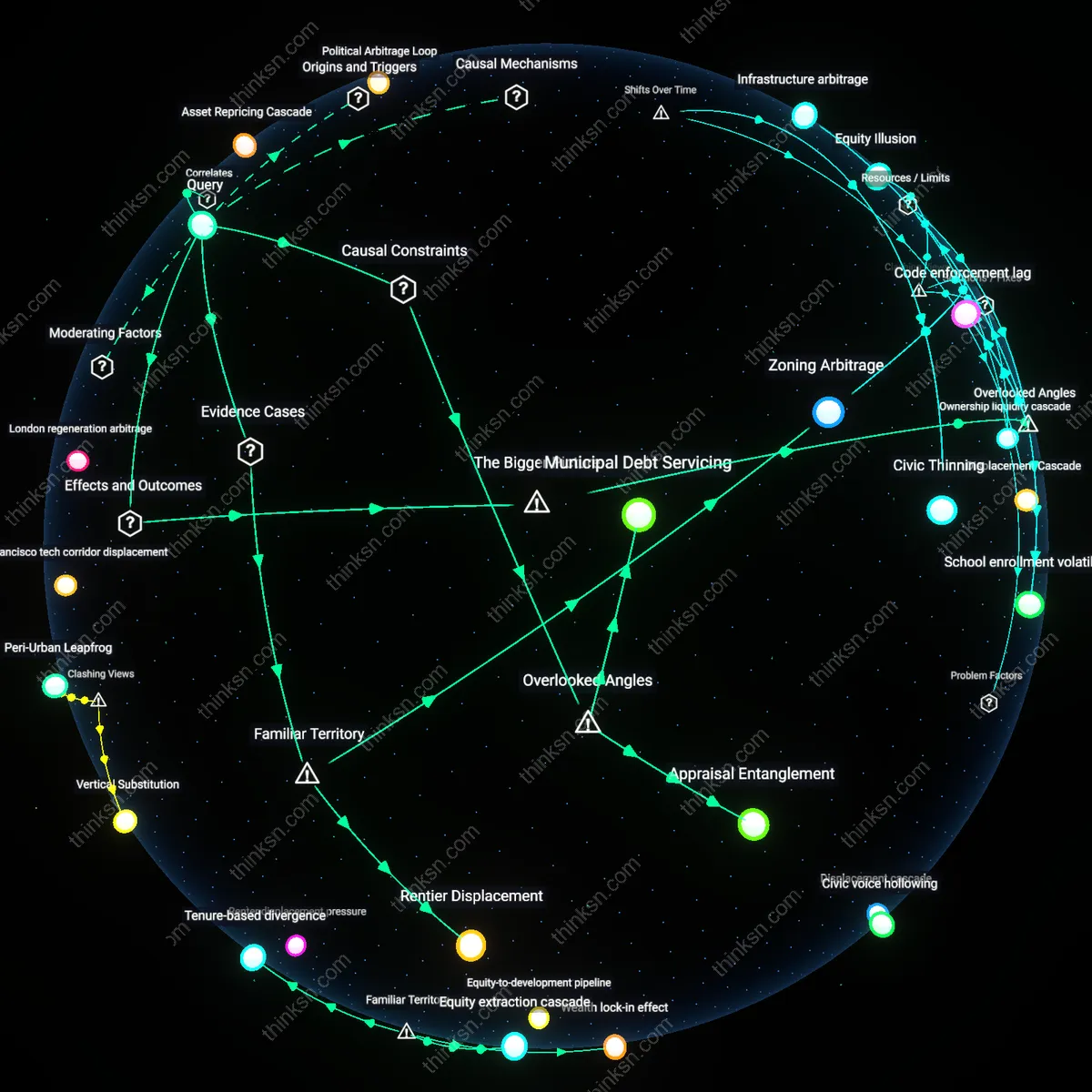
Analysis reveals 12 key thematic connections.
Key Findings
Rental lock-in
A first-time renter should continue leasing indefinitely because persistent affordability constraints in high-cost coastal metros create a self-reinforcing cycle that depresses credit accumulation and down payment growth, effectively locking individuals into tenancy regardless of intention; this mechanism is sustained by wage stagnation relative to housing costs, landlord investor consolidation, and rising insurance-embedded rents, which together recalibrate leasing from a transitional to a default life-stage status—what makes this non-obvious is that mortgage rates are not the primary barrier, but rather the systemic erosion of renter wealth-building capacity.
Metropolitan divergence
Continuing to lease is economically rational given that national mortgage rate increases are outpacing localized home price appreciation only in specific coastal metros where supply inelasticity and climate risk premiums suppress resale velocity, thereby altering traditional ownership math; institutional investors exploit this divergence by selectively acquiring properties in these markets to maximize net rental yields, which in turn distorts price discovery and discourages entry-level buying—what is underappreciated is that stalled price growth does not signal affordability but rather investor risk recalibration to sea-level rise exposure and property tax volatility.
Policy time lag
Indefinite leasing remains the prudent choice because housing policy instruments, such as first-time buyer subsidies and zoning reforms, operate on electoral and bureaucratic cycles that lag behind financial market shifts by a median of seven years in high-cost metros like Seattle or Boston, during which time rent-tier stability offers risk mitigation unmatched by ownership in volatile submarkets; this delay enables private equity landlords to expand control over mid-density housing stock under regulatory blind spots—a consequence rarely attributed to intergovernment conflit over land-use sovereignty, which systematically weakens adaptive policy capacity.
Lease Lock-in Hazard
A first-time renter in Miami-Dade County who secured a two-year lease in 2022 at $2,800/month for a one-bedroom apartment will face a 40% rent increase upon renewal due to Florida’s vacancy decontrol laws and investor-driven apartment consolidation, trapping them in escalating housing costs without equity accrual; this outcome reveals that indefinite leasing under deregulated rental markets converts temporary tenure into a long-term financial drain, disproportionately harming middle-income renters during periods of flatlining homeownership options. The overlooked risk is that lease renewals, not initial terms, become the true cost drivers, turning rental flexibility into a stealth wealth extraction mechanism.
Mortgage Rate Mirage
In San Francisco between 2020 and 2023, mortgage rates rose from 3% to 7%, deterring first-time buyers despite flat median home prices around $1.3 million, but the assumption that high rates justify indefinite renting ignores how title insurance and property tax reassessment rules in California compound ownership costs upon future purchase, creating a delayed-cost trap; renters who delay acquisition may face higher effective tax burdens when they eventually buy, due to Proposition 13’s transfer taxes and reassessment triggers. The non-obvious consequence is that deferring homeownership doesn’t just forfeit appreciation—it embeds future fiscal penalties into the act of eventual entry, distorting intertemporal equity.
Coastal Value Erosion
In Norfolk, Virginia, repeated tidal flooding events between 2017 and 2022 caused private insurers to withdraw from waterfront zones, forcing landlords to self-insure and pass hidden risk premiums into rents, with non-elevated units in ZIP code 23517 rising 32% faster than the city average despite stagnant nominal home values; this demonstrates that in climate-vulnerable coastal metros, apparent price stagnation masks underlying devaluation pressures that penalize renters through embedded climate risk premiums, while owners benefit from federal flood subsidies unavailable to tenants. The unseen reality is that ‘stable’ prices can signal declining residential quality masked by public risk absorption, harming renters more than owners over time.
Rental Entrenchment
A first-time renter in a coastal high-cost metro should continue leasing indefinitely because the post-2008 financialization of housing has transformed rental markets into permanent extractive institutions controlled by institutional investors, a shift from the mid-20th-century norm where renting was a transitional phase toward ownership. This mechanism—evident in metropolitan areas like Los Angeles and Miami, where Blackstone and Invitation Homes amassed single-family rental portfolios after the foreclosure crisis—embeds renters in a system where lease renewals generate stable returns for capital funds, not pathways to equity for tenants. The ethical lens of distributive justice, rooted in Rawlsian fairness, reveals that this trajectory creates a durable underclass excluded from wealth accumulation, not due to individual failure but through structurally reinforced market design. What is non-obvious is that today’s indefinite renting is not a temporary response to high mortgage rates but a normalized condition shaped by deliberate financial engineering after 2010.
Mortgage Penalty Regime
A first-time renter should continue leasing because the current spike in mortgage rates revives a 1980s-style credit rationing regime that functionally penalizes entry-level homeownership, reversing the 2010–2021 era of artificial affordability fueled by quantitative easing. This shift—anchored in the Federal Reserve’s post-2022 tightening cycle—recalibrates housing costs in favor of liquidity-constrained renters who would otherwise face negative amortization or refinancing traps under adjustable-rate loans, as occurred during the Volcker shock. From a legal realist perspective, doctrines like the Contract Clause and federal preemption of state usury laws enable lenders to retain high-yield portfolios without political accountability, making leasing a rational hedge against systemic risk. The underappreciated insight is that mortgage inaccessibility today functions not as a market fluctuation but as a policy-induced recurrence of 1980s financial exclusion, now embedded in expectations of housing temporality.
Coastal Value Deflation
A first-time renter should continue leasing because coastal high-cost metros are undergoing a structural devaluation of homeowner equity since 2022, marking a break from the 1990–2020 era where location guaranteed appreciation, especially in cities like San Francisco and New York, where remote work adoption and outmigration have eroded the spatial premium once tied to proximity to financial districts. This transition—mirroring the urban fiscal crises of the 1970s but driven by technological substitution rather than industrial decline—undermines the foundational assumption of homeownership as an automatic wealth engine, revealing a new political economy where tax bases shrink and public services degrade, further deterring ownership. Viewed through Ostrom’s institutional governance ethics, the unraveling of collective belief in urban permanence makes indefinite leasing a form of adaptive commons stewardship, avoiding private overinvestment in depreciating assets. The non-obvious point is that stalled price growth is not a pause but a signal of a deeper recalibration of urban value, where the coastal metro’s symbolic and financial capital is no longer self-reinforcing.
Lease Anchoring
A first-time renter in Miami-Dade County should continue leasing because rising interest rates have frozen existing homeowner mobility, reducing turnover in mid-tier condos that would otherwise open resale opportunities. Local real estate boards show fewer listings despite steady demand, indicating supply-side stagnation driven by rate-locked sellers—not declining interest—which traps renters in prolonged holding patterns. This persistence is non-obvious because public discourse focuses on mortgage affordability for buyers, not how supply compression entrenches rental dependency even when prices plateau.
Hybrid Work Discount
A first-time renter in Seattle should extend their lease because tech-sector hybrid work policies have permanently reduced price momentum in downtown housing, decoupling home values from pre-pandemic appreciation trajectories despite continued high incomes. Microsoft and Amazon’s sustained office attendance caps have curbed demand for central apartments, making mortgage commitments riskier than flexible leases for mobile professionals. The underappreciated truth here is that wage stability no longer guarantees housing ROI when spatial behavior shifts break historic income-price correlations.
Investor Anticipation Gap
A first-time renter in San Francisco should delay buying because private equity landlords like Silver Bay Realty have resumed aggressive single-family bidding in suburban transit corridors, exploiting lagging institutional mortgage refinancing to lock in long-term yield spreads. These firms anticipate Federal Reserve rate cuts in 2025, positioning now to monetize pent-up tenant demand post-recession. The non-obvious reality is that stalled home price growth reflects not equilibrium but a repricing standoff between institutional investors and risk-averse homeowners, not genuine affordability improvement for individuals.