Negotiate Lesser Workload for Sabbatical? Risking Future Promotions?
Analysis reveals 9 key thematic connections.
Key Findings
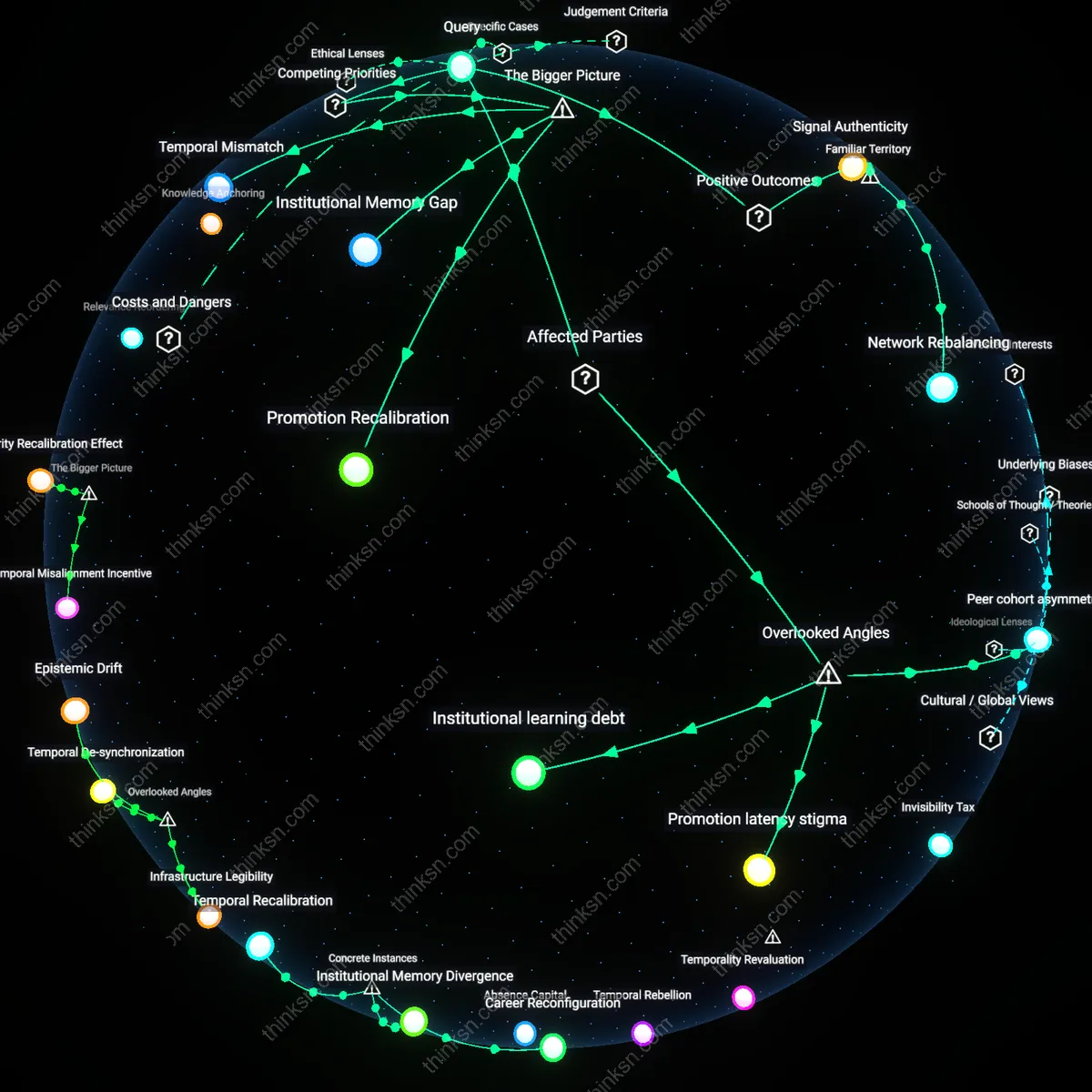
Promotion latency stigma
One should not trade a reduced workload for a longer sabbatical because senior leadership teams in knowledge-intensive firms often interpret extended absences as signals of fading commitment, even when personal development is cited, triggering subtle but cumulative exclusion from informal promotion pipelines that rely on continuous visibility and narrative presence in ongoing strategic conversations. This mechanism operates through unstructured decision circuits—such as ad hoc project staffing and succession planning discussions—where absence erodes perceived readiness, not due to formal policy but because memory decay in peer advocacy diminishes the returning employee’s salience; this dynamic is typically overlooked because most assessments focus on formal performance metrics post-return, not the erosion of social momentum during absence, which alters the standard understanding that skill gains from sabbaticals alone determine advancement potential.
Peer cohort asymmetry
One should avoid trading reduced workload for a sabbatical because team-level workload redistribution during extended leaves creates silent indebtedness among peers who absorb displaced tasks without recognition, which later manifests as resistance to supporting the returnee’s advancement when promotion committees solicit peer feedback, especially in flat organizations where lateral influence determines upward mobility. The resentment is rarely expressed directly but surfaces through subdued endorsements or omission of advocacy, functioning through informal accountability systems that balance effort and reward over time; this aspect is routinely ignored because organizational analyses assume workload adjustments are neutral administrative acts, not relational transactions that accumulate moral debt affecting future standing.
Institutional learning debt
One should reconsider reducing workload for sabbatical because prolonged disengagement weakens an individual’s embeddedness in real-time organizational learning loops—such as tacit knowledge about shifting client expectations or internal power realignments—which cannot be regained through formal updates and place returning employees at a disadvantage in promotion scenarios requiring strategic foresight. This deficit operates through the erosion of what might be called 'situational fluency,' a non-codified awareness cultivated through daily interaction, and matters because advancement often favors those who can navigate unspoken institutional currents rather than those with updated technical skills; this is overlooked because personal development is framed as an individual investment, not a withdrawal from collective cognitive infrastructure.
Renewal Dividend
One should trade a reduced workload for a longer sabbatical because sustained disengagement from operational demands allows key professionals in knowledge-intensive sectors—such as tech, academia, and consulting—to return with recharged cognitive capacity, enhancing long-term innovation output. This mechanism operates through the well-documented decline in creative productivity under continuous work cycles, where individuals in cities like San Francisco, Boston, and Berlin show observable spikes in patentable ideas and project leadership following structured breaks. The underappreciated truth is that the habitual framing of sabbaticals as costly pauses overlooks their function as compound investments in mental bandwidth, producing a measurable return in project velocity and team motivation upon re-entry.
Signal Authenticity
One should trade a reduced workload for a longer sabbatical because taking visible time away from routine performance signals deep commitment to growth rather than mere compliance, a dynamic especially influential in competitive corporate cultures like those in London financial firms or Silicon Valley startups. This works through peer and managerial perception systems that interpret deliberate absence—when framed as skill or perspective expansion—as evidence of strategic ambition and self-awareness, traits increasingly tied to leadership readiness. What’s rarely acknowledged is that in environments saturated with performative busyness, stepping back becomes a rare and thus high-value signal of confidence and intentionality, elevating future promotion prospects rather than harming them.
Network Rebalancing
One should trade a reduced workload for a longer sabbatical because time away from daily workflow redistributes relational dependency, enabling mid-career professionals in organizations like multinational NGOs or engineering firms to shift from being central nodes in execution networks to becoming strategic connectors across silos. This shift occurs as colleagues adapt to temporary absences by forging new collaboration paths, which then reconfigure upon the individual’s return into more resilient, less hierarchy-dependent teams. The overlooked effect is that familiar narratives of sabbaticals as personal retreats obscure their systemic role in weakening overreliance on single actors, thereby increasing organizational adaptability and indirectly boosting the returning individual’s influence.
Promotion Recalibration
Accepting a reduced workload to secure a longer sabbatical signals reduced near-term capacity utilization, which in performance-intensity cultures like management consulting or academia triggers organizational recalibration of promotability; senior evaluators interpret sustained low visibility as diminished commitment, even when development is the stated goal, because advancement systems are calibrated to continuous output rather than episodic growth. This mechanism operates through meritocratic tracking systems that proxy productivity with leadership potential, making breaks analytically disruptive not due to skill loss but to misalignment with promotion triggers tied to consistent performance signaling. The non-obvious consequence is that personal development becomes a liability when organizational cognition equates presence with readiness, rendering the sabbatical an act of tacit disengagement.
Temporal Mismatch
Pursuing a sabbatical for personal development creates a temporal mismatch between individual skill accumulation and institutional reward cycles, particularly in corporations with rigid annual review timelines and pipeline-driven promotion engines such as tech firms or financial institutions; skills gained during leave often mature post-return, missing the evaluative window where visibility and immediate contribution dominate assessment criteria. This misalignment persists because HR systems optimize for predictability and cohort-based advancement, not asynchronous growth, making developmental investments invisible until they manifest in later cycles—by which time peers have advanced. The underappreciated reality is that timing inefficiencies, not the value of development itself, erode returns on sabbaticals within linear career architectures.
Institutional Memory Gap
Trading workload for sabbatical time risks erosion of influence within informal decision networks that shape promotion outcomes, especially in hierarchical organizations like government agencies or law firms where advancement depends on sustained relational capital rather than formal reviews alone; absence disrupts participation in low-profile agenda-setting meetings, client allocations, and mentor alliances that cumulatively determine access to high-visibility roles. These networks operate through tacit information flows and trust-based referrals, which do not pause for development leave, making re-entry a reestablishment burden rather than a continuation. The systemic insight is that promotional momentum relies on continuous embeddedness, turning time away into a deficit of institutional memory even when formally sanctioned.