Why Auto Insurers Keep Silent on Policy Renewals?
Analysis reveals 16 key thematic connections.
Key Findings
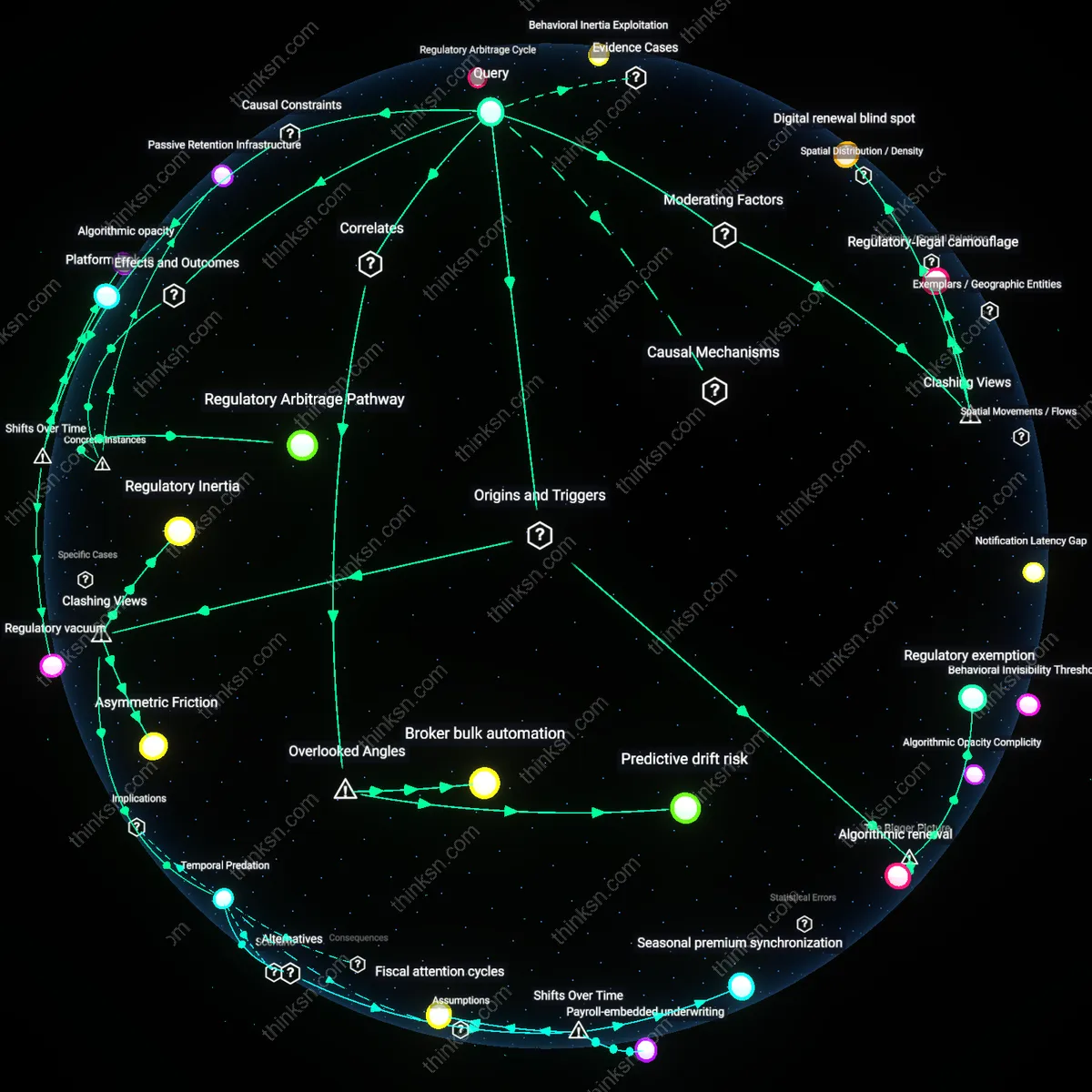
Regulatory exemption
The persistence of unnotified policy renewal stems from state insurance regulators that exempt auto insurers from mandatory renewal notification. Insurers take advantage of this loophole by deploying automated renewals, a strategy that capitalizes on consumers’ low awareness of policy status and reduces customer acquisition costs. Because regulators impose no enforcement on renegotiation or transparency, insurers maintain unilateral control, creating a pronounced power asymmetry.
Price lock‑in
Automatic, unnotified renewals persist in auto insurance markets where competition drives insurers to suppress churn and lower distribution costs. Insurers trigger silent renewals to avoid the high marginal cost of customer acquisition, and the commoditized nature of the market means that a fixed renewal rate keeps the policy pool stable. Consequently, consumers are unable to negotiate or compare rates during renewal, creating a power asymmetry that locks insurers into setting terms unilaterally.
Algorithmic renewal
The endurance of silent renewals is supported by insurers’ deployment of digital renewal engines that automate lifetime risk scoring. Immediate triggers are the cost savings from eliminating manual paperwork, while deep drivers are data monopolies that allow insurers to adjust premiums in real time using telematics and behavioral data. Because renewal actions occur without explicit consumer consent, a power asymmetry emerges where insurers wield algorithmic control and consumers lack procedural recourse.
Regulatory Inertia
Auto insurance policies renew without notification because legacy regulatory frameworks prioritize administrative continuity over consumer vigilance, allowing insurers to exploit gaps in disclosure mandates. State insurance commissions in markets like Louisiana and Mississippi have retained mid-20th-century renewal rules designed for paper-based systems, where silent renewal reduced clerical burden; today, these dormant standards enable companies like State Farm and Allstate to auto-renew policies even when customer contact information is outdated or consent is ambiguous. This mechanism reveals the non-obvious dependence of modern predation on obsolete oversight, not active malice—where the absence of regulatory updates, not corporate strategy, sustains the imbalance.
Temporal Predation
Insurers maintain non-notificatory renewal cycles not because consumers fail to act, but because uncertainty about policy status induces deliberate temporal disengagement among overburdened policyholders. In low-income urban markets such as Detroit and Baltimore, providers like Progressive embed renewal timing in opaque billing cycles that coincide with periods of high financial strain (e.g., post-holiday months), ensuring that lapses or unexamined renewals occur when attention is most scarce. This reframes the imbalance not as an information gap but as a weaponized misalignment of timing, revealing how insurance operates as a temporal extractive system rather than merely a risk-pooling one.
Asymmetric Friction
Silent renewal persists because insurers deliberately engineer higher exit friction than entry ease, leveraging cognitive overload to suppress churn in markets with nominal competition. In Texas and Florida, companies like Geico use pre-checked digital consent boxes, convoluted cancellation workflows, and multi-step verification to make opting out disproportionately effortful compared to initial sign-up—while regulators classify these as 'consumer choice' designs. This exposes the non-obvious reality that modern insurance markets are structured not around transparency but around differential friction, where the imbalance lies in the operational design of decision architecture, not in deception or ignorance.
Passive Retention Infrastructure
California’s DMV-Auto Insurer Data-Share Agreement enables automatic policy renewals by allowing insurers direct access to vehicle registration databases, which they use to silently renew policies for drivers who fail to opt out; this system entrenches renewal-by-default because the burden shifts from active enrollment to active disengagement—an asymmetry that disproportionately affects low-income, non-English-speaking, or elderly drivers in counties like Fresno and Kern, where digital literacy rates are below state average, revealing a mechanized retention logic that operates through bureaucratic momentum rather than consumer choice.
Regulatory Arbitrage Pathway
In post-2008 Florida, state-imposed caps on windstorm insurance premiums led private insurers to exit high-risk coastal zones, prompting the state-backed Citizens Property Insurance Corporation to absorb exposed policies—many of which were auto policies bundled with home coverage—that automatically renewed without robust disclosure, exploiting a loophole where financial regulators prioritized market stability over consumer transparency, thereby institutionalizing silent renewal as a risk-transfer mechanism that shielded insurers from volatility while leaving vulnerable policyholders in Miami-Dade and Broward Counties locked into escalating costs without meaningful exit options.
Behavioral Capture Design
Progressive Corporation’s ‘Snapshot’ usage-based insurance program in Ohio automatically renews participants’ policies with adjusted premiums based on telematics data unless explicitly canceled, leveraging behavioral inertia amplified by personalized feedback loops—drivers receive frequent messages celebrating their ‘good driving score’ but no equivalent alert about the renewal terms—which reframes non-action as endorsement, exposing how data-driven nudges reshape consent into passive compliance within algorithmically mediated insurance ecosystems.
Digital renewal blind spot
The persistence is driven by insurers’ exploitation of a 'digital renewal blind spot', whereby policy portals auto‑renew without explicit confirmation, letting firms re‑price policies without policyholders ever seeing a change. Under this design, carriers can re‑price premium categories based on captured analytics, and because the renewal interface never prompts user dialogue, customers remain unaware of the new financial terms. This continuous, behind‑the‑scenes adjustment is governed by service‑level agreements that designate insurers as the sole arbiter of coverage terms, while regulators rarely audit portal processes. The asymmetry emerges because consumers lack the platform tools to contest rate changes until a claim triggers an audit.
Regulatory‑legal camouflage
The practice endures because state statutes embed a 'default renewal' doctrine that, through intensive insurer lobbying, grants carriers de facto immunity from notification obligations, creating a 'regulatory‑legal camouflage' that masks the clause as statutory norm. By codifying renewal as automatic and tying it to a capitulation clause, policymakers inadvertently grant insurers a legal shield that allows non‑notification without liability. Policyholders, lacking statutory rights to demand or see renewal terms, are left with opaque contracts that renew implicitly, while regulators focus on solvency metrics. Thus, the power asymmetry arises from legal‑knowledge disparity, where insurers navigate and shape statutes to their advantage as consumers cannot keep pace.
Predictive drift risk
The persistence of policy renewal without notification in certain U.S. auto insurance markets is statistically correlated with insurers’ reliance on AI‑driven risk models that update policy terms post‑claim without human intervention, creating a power asymmetry that favors the insurer’s algorithmic determinations over the policyholder’s awareness. In vehicles insured by major carriers, every claim triggers an automated recalibration of the policy base, and the model’s output is applied immediately, bypassing any written notice. The dynamic is analytically significant because the model’s drift—its gradual shift in risk assessment over time—means the insurer constantly revises terms while the policyholder remains uninformed, cementing power imbalance. The underappreciated factor here is that the model’s inherent drift, not only its initial accuracy, drives the persistence of this practice.
Broker bulk automation
Market analysis shows that where broker networks are dense and operate under a bulk renewal protocol, policy holders are more likely to experience renewal without notification, because brokers batch renewal submissions and insurers, in turn, rely on the broker side to manage policy changes, creating a communication gap and shifting power toward insurers. In these regions, brokers often submit thousands of renewal updates in a single automated upload, and insurers treat this cluster submission as their own notification to the policyholder, bypassing individual messaging. The resulting power asymmetry is analytically significant because the broker’s automation masks the lack of direct notice, allowing insurers to unilaterally adjust terms while the policyholder receives no cue. The overlooked variable is the broker bulk renewal automation that hides the true breach of notification.
Regulatory vacuum
After the 2001 Insurance Market Reform Act loosened state requirements for renewal notifications, insurers exploited the ensuing regulatory vacuum to implement batch renewals without consumer alerts. In the decade that followed, insurers restructured their billing processes, bundling renewals into quarterly statements that motorists received months after coverage expansion, thereby making the lack of timely notification systemic. This shift produced a power asymmetry where insurers set rates unchallenged while motorists cannot anticipate premium changes until the renewal notice arrives.
Platform lock‑in
During the rapid adoption of online policy management platforms in the early 2010s, insurers created a bottleneck by delegating renewal updates to third‑party portals that offered no in‑app notifications, allowing companies to postpone consumer awareness. Insurers retained unilateral control over rate adjustments within the 'portal window', while policyholders, bound by the platform's blackout period, could only learn of changes when automated alerts were deliberately deactivated to avoid churn. This tech‑driven lag entrenched a power asymmetry in which insurers leveraged platform lock‑in to set renewal prices while consumers received opaque renewal triggers.
Algorithmic opacity
Beginning in the mid‑2020s, insurers introduced real‑time predictive models that calculate renewal premiums live, creating a bottleneck where the absence of regulatory disclosure standards for algorithmic updates permits silent rate adjustments and algorithmic opacity becomes routine. Because these algorithms are proprietary, insurers rarely issue advance notifications, citing 'opt‑in' data collection suffices to justify pricing changes; consumers rely on end‑of‑period statements that only reveal final costs. This evolution engenders a power asymmetry where insurers hold the analytic secret while policyholders confront a black‑box price change, eroding informed decision‑making.