Is Sector-Specific Regulation Enough for Cloud Infrastructure?
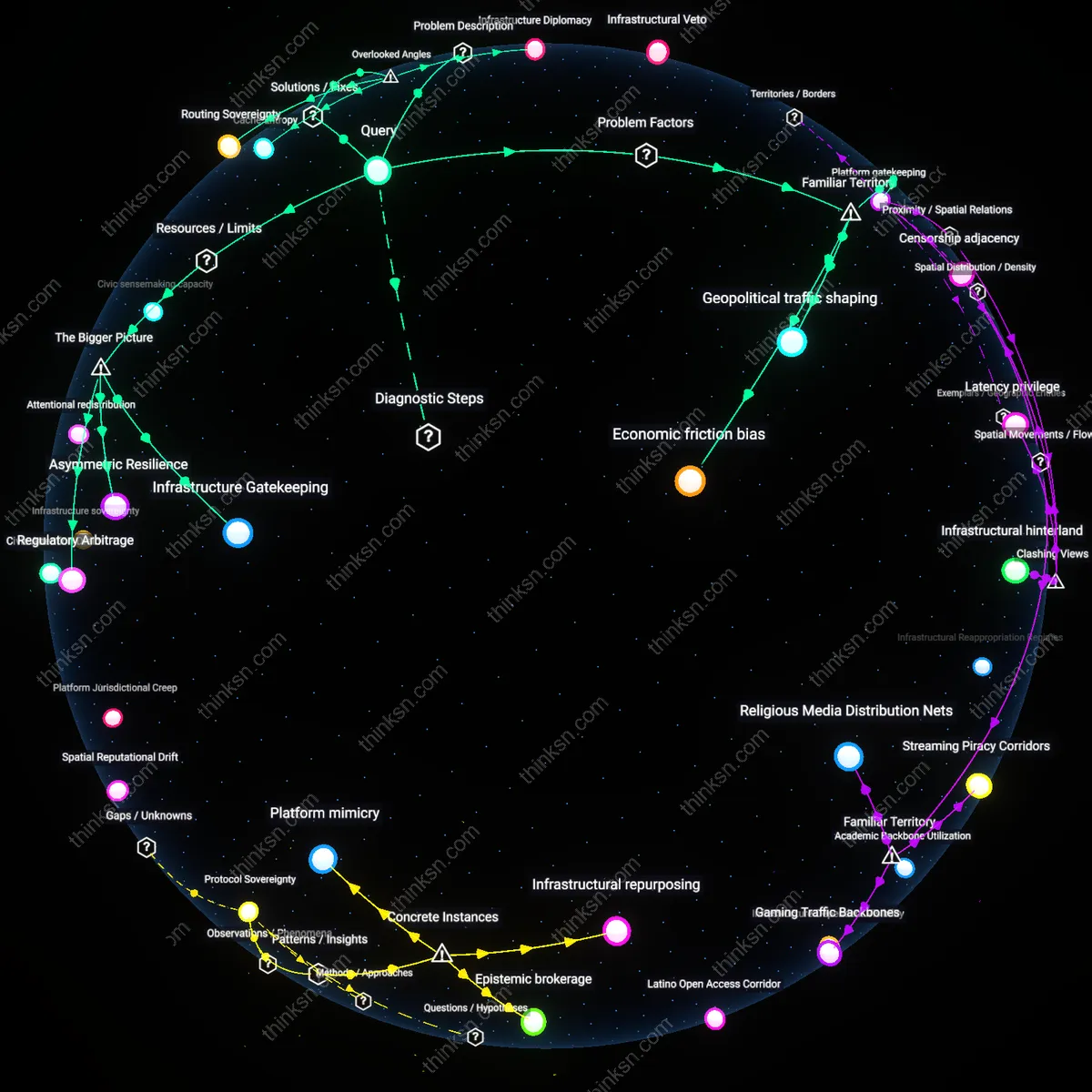
Analysis reveals 5 key thematic connections.
Key Findings
Contractual opacity
Sector-specific regulation fails to constrain cloud infrastructure providers because procurement contracts between these firms and public institutions embed opaque compliance clauses that preempt regulatory enforcement. State and local governments, particularly in health and education, routinely sign agreements with AWS, Microsoft Azure, or Google Cloud that designate the provider as the final arbiter of data access protocols, effectively shielding them from sectoral oversight bodies like HIPAA auditors or FERPA enforcers. This creates a hidden governance layer where regulatory authority is contractually ceded, not technically or legally circumvented—an arrangement rarely visible in compliance reviews but decisive in operational outcomes. The non-obvious mechanism here is not market dominance or technical complexity, but the quiet privatization of regulatory interpretation through boilerplate contract terms.
Rural digital sovereignty
Cloud infrastructure governance gaps disproportionately impact tribal nations and rural municipal governments, who lack the technical staff to negotiate customized service agreements and thus inherit default configurations that undermine local autonomy. These entities often rely on federally funded cloud solutions for basic services like emergency response or elections administration, yet sector-specific rules in telecom or election integrity do not account for how cloud default settings—such as data replication across jurisdictions—violate tribal data sovereignty principles or state election laws. The overlooked dynamic is that regulatory sufficiency depends not just on sectoral alignment but on infrastructural configurability, which is systematically inaccessible to low-capacity governments. This reveals a spatial asymmetry in regulatory reach masked by uniform national standards.
Vendor policy entanglement
Cloud providers de facto shape sector-specific regulatory outcomes by designing governance-adjacent tools—such as automated compliance checkers or AI audit logs—that become embedded in regulated institutions’ workflows, effectively outsourcing policy interpretation to proprietary systems. Hospitals using Google Cloud’s HIPAA compliance dashboard, for instance, often treat its alerts as binding, even when they deviate from HHS guidance, because the operational cost of overriding them exceeds institutional capacity. This entanglement means regulation is no longer solely imposed from above but co-produced through vendor-generated abstractions of the law, an invisible feedback loop in which compliance becomes contingent on software logic. The overlooked reality is that the regulators’ authority is being silently filtered through product design decisions made in Redmond or Seattle, not just by agencies in Washington.
Regulatory Arbitrage Capacity
Sector-specific regulation inadvertently strengthens cloud providers by enabling them to exploit jurisdictional and rulebook fragmentation across industries. Federal telecom, finance, and health regulations create siloed compliance regimes—such as HIPAA for health data or GLBA for financial records—that cloud infrastructure firms navigate selectively, using their cross-sector reach to minimize oversight exposure while maximizing operational flexibility. This capacity to arbitrage regulatory boundaries reveals a systemic advantage not of compliance, but of strategic non-alignment, where the same infrastructure can simultaneously meet—or appear to meet—conflicting standards by design. The non-obvious outcome is that fragmented regulation doesn’t constrain cloud power; it codifies a differential enforcement terrain that the most vertically integrated providers are best positioned to manipulate.
Compliance Churn Efficiency
Cloud infrastructure providers benefit from continuous regulatory change in sector-specific rules because volatility generates demand for managed compliance services, turning governance instability into a revenue stream. As agencies from the FDA to the FCC update sectoral requirements, cloud firms monetize adaptation through premium support tiers, audit automation, and compliance-as-a-service offerings—services that small cloud players or public agencies cannot replicate. This dynamic converts regulatory rigor into a recurring operational tax that only the largest providers can efficiently absorb and resell, transforming what appears to be increased oversight into a self-funding mechanism for entrenching market leadership. The underappreciated effect is that regulatory activity, even when well-intentioned, reinforces dependency on dominant platforms by making compliance itself a scalable, proprietary product.