Real-Time Translation: Convenience or Surveillance Risk?
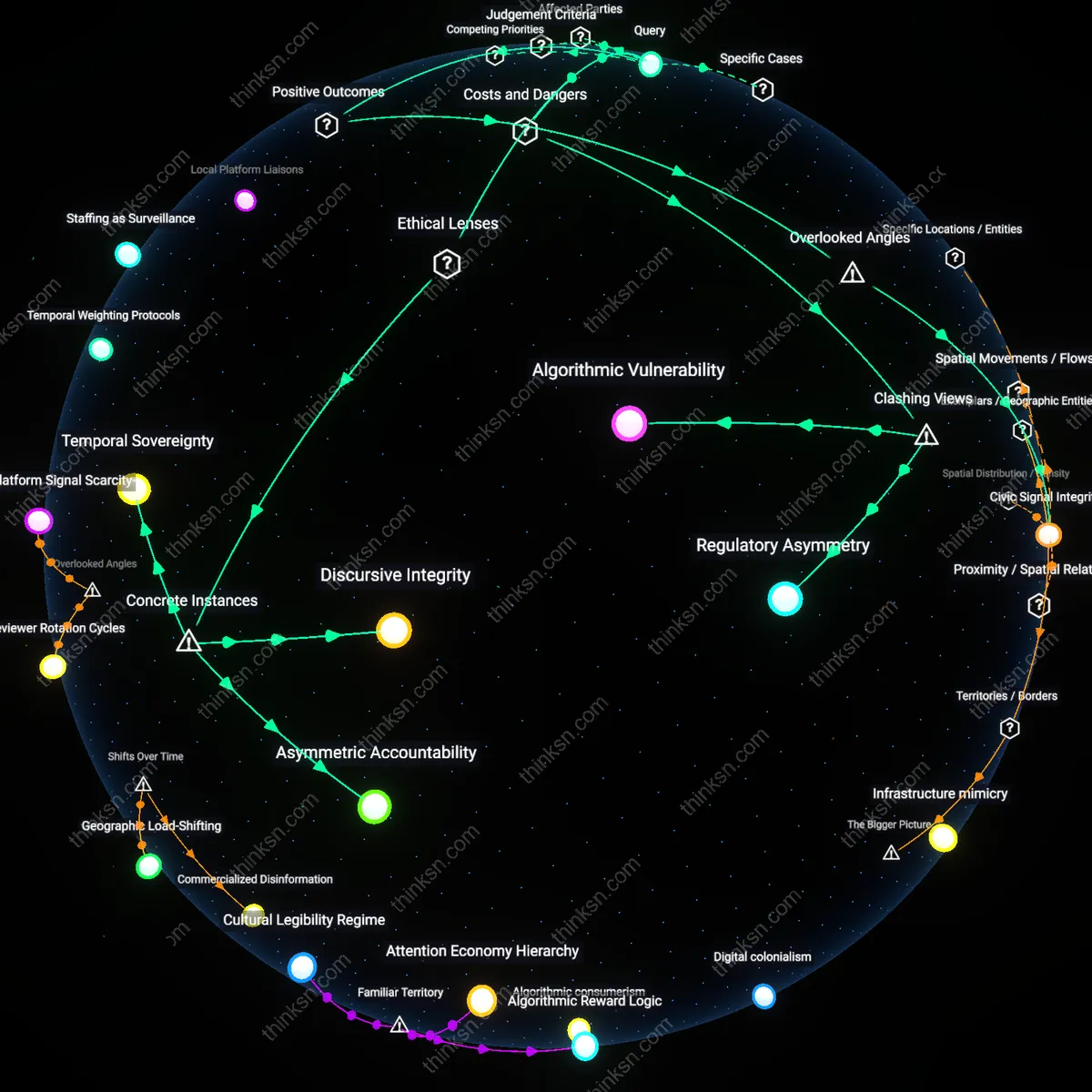
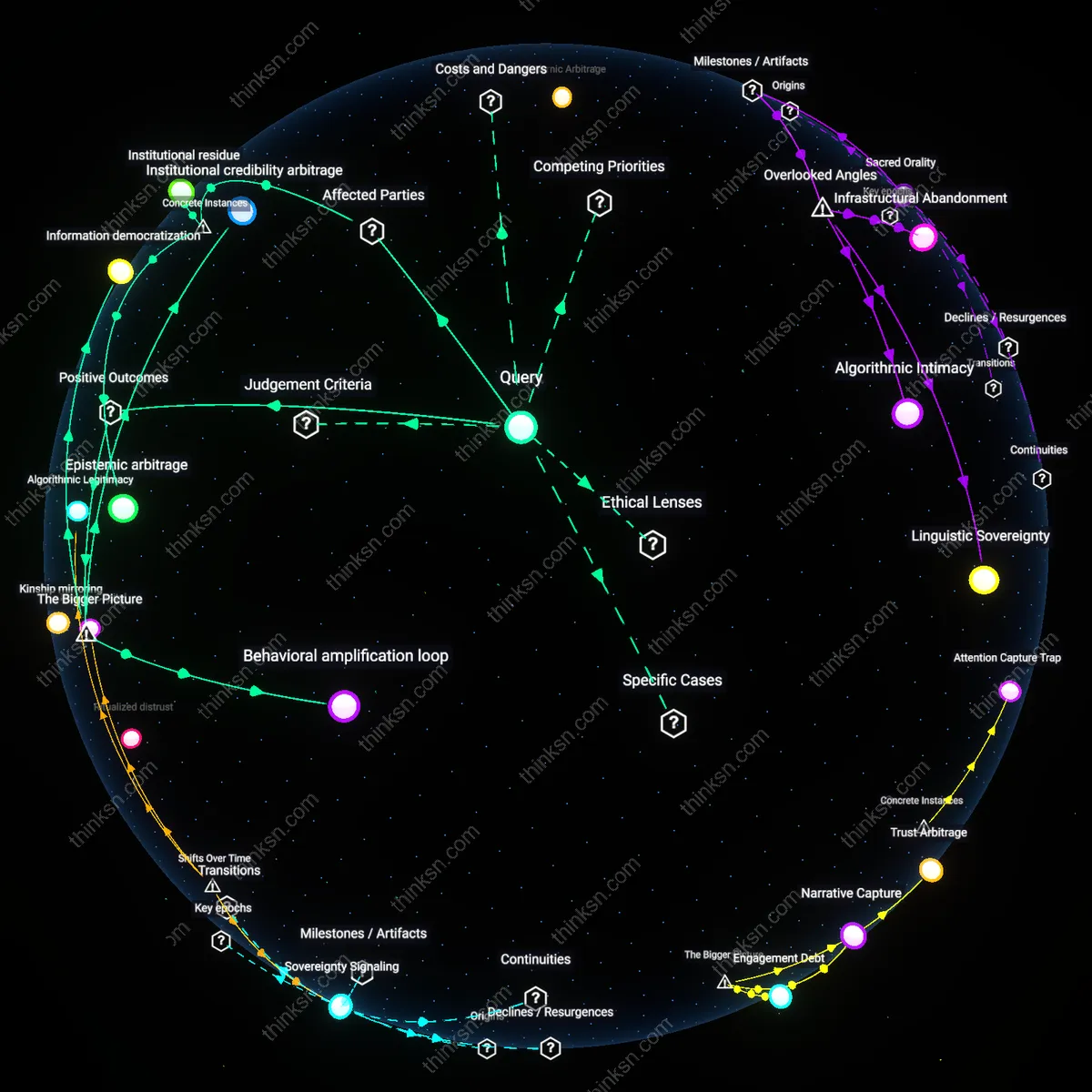
Analysis reveals 9 key thematic connections.
Key Findings
Cross-Border Solidarity Infrastructure
Real-time translation in free messaging apps strengthens transnational civic movements by enabling coordinated activism across linguistic boundaries, as seen in diaspora communities organizing during geopolitical crises. Digital platforms like Telegram and WhatsApp serve as de facto infrastructure for protest coordination when activists from different language backgrounds collaborate in real time, bypassing traditional media gatekeepers. The mechanism hinges on low-friction communication sustaining collective action under repressive regimes, where speed and inclusivity outweigh surveillance risks because the immediate utility of mobilization creates a new form of digital public sphere. This reveals how technical affordances can reconfigure political agency beyond state-controlled information flows, an underappreciated shift in power mediated by everyday tools rather than dedicated platforms.
Algorithmic Language Commodification
The convenience of real-time translation justifies linguistic data harvesting because major tech firms treat multilingual interaction as a feedback loop to refine proprietary natural language models. Companies like Meta and Google embed translation within messaging not primarily for user benefit but to capture high-value, context-rich conversational data across languages, which trains more accurate AI systems for commercial deployment in other markets. This process is driven by platform capitalism’s demand for scalable linguistic datasets, making user communication a hidden labor input in AI development—a systemic dynamic where convenience functions as bait for data extraction. The non-obvious outcome is that translation features become Trojan horses for expanding corporate epistemic control over global language use.
Erosion of Linguistic Anonymity
Real-time translation in free messaging apps enables metadata harvesting that transforms vernacular expression into identifiable behavioral signatures, a shift accelerated after 2016 when end-to-end encryption adoption forced intelligence agencies to pivot toward language-based pattern recognition. State and corporate actors now exploit translation APIs to detect dialectal deviations, migrant speech patterns, or political code-words not for immediate interception but for long-term social sorting. This systemic redirection—from content surveillance to linguistic forensics—reveals how the convenience of translation normalized the conversion of idiomatic diversity into surveillance fodder, a transformation previously masked by pre-2010 assumptions that encrypted messaging ensured full privacy.
Coloniality of Algorithmic Fluency
The integration of real-time translation in dominant messaging platforms after 2018 marked a decisive departure from earlier machine translation tools, which were largely academic or enterprise-bound and neutral in geopolitical orientation. Now, translation accuracy is systematically skewed toward Anglo-American linguistic norms, demoting regional syntax, indigenous lexicons, and postcolonial registers to 'errors' that trigger automated scrutiny. This recalibration turns translation from a bridge into a filter, where non-normative speech—once merely misunderstood—is now flagged as anomalous by design. The shift exposes how convenience functions as a civilizing proxy, repurposing linguistic difference as risk under a technologically reinforced hierarchy that mirrors 19th-century colonial classification systems.
Infrastructural Intimacy
Yes, the convenience of real-time translation in free messaging apps is justified because marginalized diasporic communities in transnational care networks—such as Filipino domestic workers communicating with children in Manila from Hong Kong—rely on frictionless translation to sustain emotional and financial survival, and the erosion of this tool disproportionately burdens those already excluded from formal linguistic sovereignty. The dependence on corporate platforms is not a consumer preference but a structural necessity shaped by the collapse of public linguistic infrastructure in migration corridors, revealing a hidden layer of digital dependency that ethical debates narrowly focused on state surveillance fail to register. The overlooked dynamic is how corporate translation tools fill voids left by the state in sustaining intimate cross-border lifeworlds, redefining privacy trade-offs not as abstract data risks but as material conditions of care. This shifts the ethical locus from surveillance avoidance to reproductive resilience.
Lexical Precarity
No, the convenience is not justified because real-time translation systems systematically flatten dialectal variation—such as African American Vernacular English or Maghrebi Arabic—into standardized linguistic outputs, making non-dominant speech patterns appear anomalous to surveillance algorithms trained on normative lexicons, thereby inflating perceived threat signals in automated monitoring systems. This process, embedded in machine learning pipelines developed by firms like Meta or Google, transforms linguistic diversity into metadata risk without user awareness, particularly affecting multilingual urban youth in cities like Marseille or Detroit whose hybrid expressions are misrepresented as suspicious. The underappreciated mechanism is not surveillance itself, but the pre-surveillant distortion of language that makes certain ways of speaking structurally legible as deviant. This reframes the risk from data collection to semiotic destabilization.
Syntax Colonialism
No, the convenience is not justified because the deep-learning architectures underlying real-time translation—such as Transformer models trained on European parliamentary corpora—embed syntactic hierarchies that privilege subject-verb-object linearity, systematically misrepresenting ergative or topic-prominent languages like Basque or Korean, and making their users appear syntactically disordered or evasive in intelligence assessments. This technical bias becomes a quiet instrument of cognitive imperialism, where non-conforming grammar is interpreted as obfuscation by security analysts using translated metadata in contexts like border control or visa screening. The overlooked dependency is the alignment of AI linguistics with Western grammatical norms as a covert standard of intelligibility, effectively marginalizing entire language families not by vocabulary but by structural incommensurability. This reveals a hidden grammatical politics in algorithmic translation that mimics colonial-era linguistic invalidation.
Algorithmic Complicity
The convenience of real-time translation in free messaging apps is not merely compromised by surveillance but actively enables it through design choices made by firms like Meta and Google, who integrate translation APIs directly into message flows on platforms such as WhatsApp and Android Messages. These companies deploy on-device translation models not to protect privacy but to generate usable linguistic data—phonetic patterns, code-switching behaviors, and syntactic anomalies—that feed broader surveillance pipelines when messages are flagged or sampled. The non-obvious mechanism here is that translation is not a neutral utility but a data-extraction vector, where linguistic 'cleaning' for machine readability produces standardized profiles ideal for automated surveillance—particularly in multilingual regions like India or Nigeria where hybrid speech is common. This reframes user convenience as participation in a covert standardization regime.
Linguistic Redundancy
The risk of linguistic profiling is neutralized in high-translation-use environments like Ukraine or Taiwan, where real-time translation has become a survival function during active hybrid warfare and population displacement, rendering surveillance concerns secondary to immediate communication needs. In these zones, apps like Telegram and Viber provide translation features that are less about enhancing global connectivity than about sustaining identity and coordination under duress, where the state or military actors themselves depend on the same tools to manage refugee flows or civilian alerts. The dissonance lies in recognizing that the same infrastructure used for surveillance is also a decentralized resistance utility—meaning linguistic data exhaust is not simply a liability but a contested resource, and its value shifts based on geopolitical extremity rather than privacy defaults.