Cutting Ties with Radical Parents: When Is It Too Much?
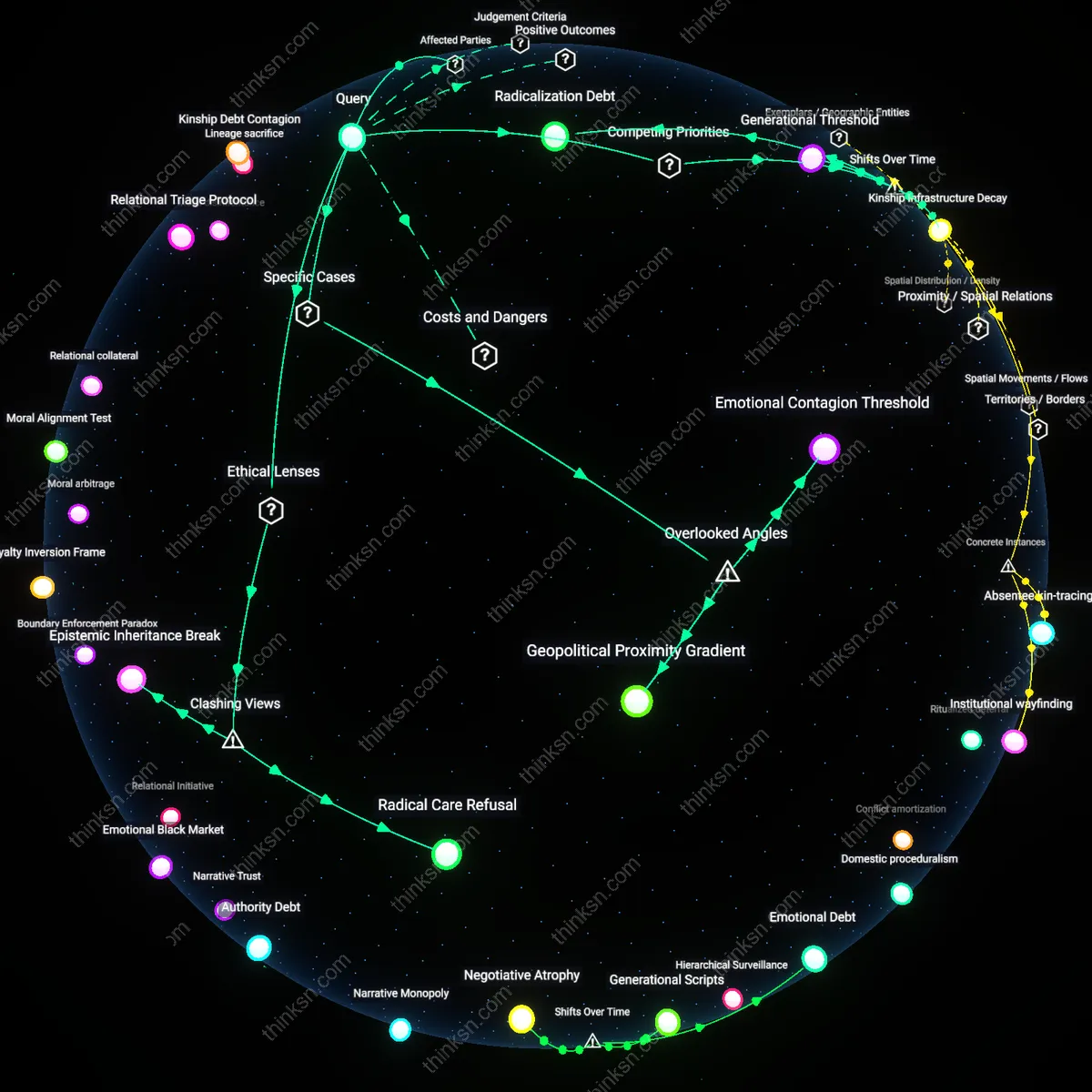
Analysis reveals 11 key thematic connections.
Key Findings
Relational Triage Protocol
An adult can determine whether severing contact with a politically radical parent is justified by implementing a relational triage protocol that prioritizes preserving connections with immediate family members who are at risk of being drawn into ideological conflict. This mechanism operates through family systems dynamics where the adult acts as a boundary manager, absorbing the destabilizing force of radical discourse to prevent contagion to siblings, cousins, or children who lack developed coping frameworks. The non-obvious insight is that estrangement can function not as a failure of filial duty but as a strategic intervention to preserve the coherence of a wider kinship network under ideological siege, making the decision less about personal boundaries and more about structural containment within familial ecosystems.
Ideological Overburden Threshold
Severing contact becomes justified when the parent’s political radicalism exceeds the ideological overburden threshold—the point at which their discourse systematically disrupts family gatherings, coerces relatives into taking sides, or recruits vulnerable members into extremist networks. This condition emerges under the pressure of affective polarization, where partisan identity becomes so entrenched that neutral interaction becomes impossible, and family events devolve into performative allegiance checks. The significance lies in recognizing that alienation is not primarily caused by ideological difference itself but by the parent's instrumentalization of family space as a battleground for recruitment or validation, triggering defensive disengagement by others to protect relational autonomy.
Kinship Debt Contagion
The decision to cut contact is validated when continued engagement risks activating kinship debt contagion—the process by which obligations to one family member generate cascading loyalty demands that fracture alliances across the extended family. This dynamic is amplified in communities with strong collectivist norms, where public alignment with a radical parent can be interpreted as tacit endorsement, forcing cousins, aunts, or in-laws to choose between social cohesion and truthfulness. The underappreciated reality is that radicalism functions not only as belief but as a social tax, extracting relational capital from the family unit; severing ties then becomes a fiscal-like measure to halt the spread of insolvency in trust and mutual recognition.
Radicalization Debt
An adult justifies estrangement from a politically radical parent by calculating the cumulative social cost of maintaining ties in the context of post-2016 polarization, where family cohesion becomes unsustainable under the weight of repeated ideological breaches. This mechanism emerges not from a single event but from an accumulation of boundary violations—such as public affiliations with extremist groups or coercive proselytizing—that transform kinship from a default support system into a vector of reputational and psychological risk, especially within professional or multiracial communities. The analytically significant shift is the normalization of political identity as a litmus test for moral belonging, a departure from late 20th-century norms where partisan differences were often compartmentalized from family life, revealing how digital amplification of radical rhetoric has recast private relationships as public allegiances.
Generational Threshold
Estrangement becomes a rational act when an adult crosses a developmental threshold—typically in their late 30s or early 40s—where their role as a parent to the next generation supersedes filial obligation, intensifying conflict with radicalized elders whose views threaten the ideological safety of young children. This transition crystallizes during eras of rapid social change, such as the post-2020 reckoning with racial justice and gender identity, when parents perceive their own children’s education and social integration as vulnerable to ideological contamination or modeling from the radical grandparent. The non-obvious insight is that alienation is not primarily a rupture with the past but a preemptive investment in the future, where the mechanism of boundary-setting operates through the household as a semi-sovereign unit defending its normative integrity.
Kinship Infrastructure Decay
Severing contact is justified when extended family networks—once mediating forces that absorbed political tension through geographic proximity, shared rituals, and economic interdependence—collapse under the strain of ideological sorting accelerated by suburban flight, digital fragmentation, and the decline of local institutions since the 1990s. In this context, the radical parent no longer functions as one node among many in a buffering web but becomes a focal disruptor, as weakened kinship infrastructure eliminates third-party reconciliation mechanisms like aunts, uncles, or shared religious communities that once diffused conflict. The pivotal shift is the transition from analog, place-based family systems to digitally mediated, choice-based kinship networks after 2008, revealing that estrangement is less a personal decision than an adaptive response to systemic atrophy.
Radical Care Refusal
An adult justifies severing contact with a politically radical parent by enacting care ethics not as abandonment but as a redirected moral responsibility to protect the psychological integrity of vulnerable family members, particularly children, when continued exposure normalizes authoritarian logics within the household; this operates through feminist ethical frameworks that prioritize relational well-being over filial obligation, revealing that the dominant narrative of familial duty often masks the coercion of emotional labor imposed on non-consenting kin. The non-obvious mechanism here is that refusal to engage becomes an ethically active stance—care expressed through boundary rather than proximity.
Loyalty Subversion
Severing contact is justified not despite but because it disrupts the parent’s ideological recruitment strategy, which functions as a form of political grooming that exploits familial trust to extend radical movements into intimate life; viewed through the lens of republican political theory, this act counters the covert establishment of domination by preventing the parent from using domestic authority to erode others’ capacity for free judgment. This reframes disconnection not as personal failure but as civic resistance, exposing how liberal tolerance norms falsely equate engagement with neutrality when disengagement may be the only means of preserving pluralistic agency within the family.
Epistemic Inheritance Break
The adult severs contact to halt the transmission of a distorted epistemic framework that positions the radical parent as the sole legitimate interpreter of reality, a condition identifiable in families influenced by conspiratorial or extremist ideologies operating under systems of epistemic closure; utilizing critical theory, particularly from Fricker’s work on epistemic injustice, the break becomes a necessary epistemological autonomy move, enabling younger family members to develop independent reasoning capacities free from hermeneutical smothering. The underappreciated point is that cutting ties functions less as emotional defense than as cognitive liberation, revealing that continuity of relationship does not ensure truth access but may instead enforce interpretive dependency.
Emotional Contagion Threshold
An adult can determine if severing contact is justified by assessing whether the parent’s political radicalism triggers observable emotional contagion in other family members, which escalates intergenerational conflict—observed in families of former Proud Boys affiliates in Alberta, where siblings’ anxiety and withdrawal in family gatherings preceded full estrangement. This mechanism operates through limbic resonance networks in group settings, where one individual’s ideologically charged affective state spreads non-verbally, destabilizing relational homeostasis. The overlooked angle is that justifications for severing contact are often treated as moral or communicative acts, but the actual tipping point occurs below conversational awareness, in somatic reactivity that precedes speech—making the emotional contagion threshold a hidden governor of family cohesion.
Geopolitical Proximity Gradient
Severing contact may be justified when the parent’s radical affiliations create measurable geopolitical entanglements that reposition the family within surveillance or risk matrices, as seen in Turkish-German families in Cologne where parents’ ties to DHKP-C factions led to secondary monitoring of adult children by German intelligence. The mechanism here is not ideological disagreement but the spillover of state-level security protocols into domestic privacy, altering the family’s legal exposure. Most analyses overlook how radicalism alters a family’s ontological security not through belief but through bureaucratic adjacency to proscribed entities, rendering disengagement less a personal choice than a jurisdictional recalibration.