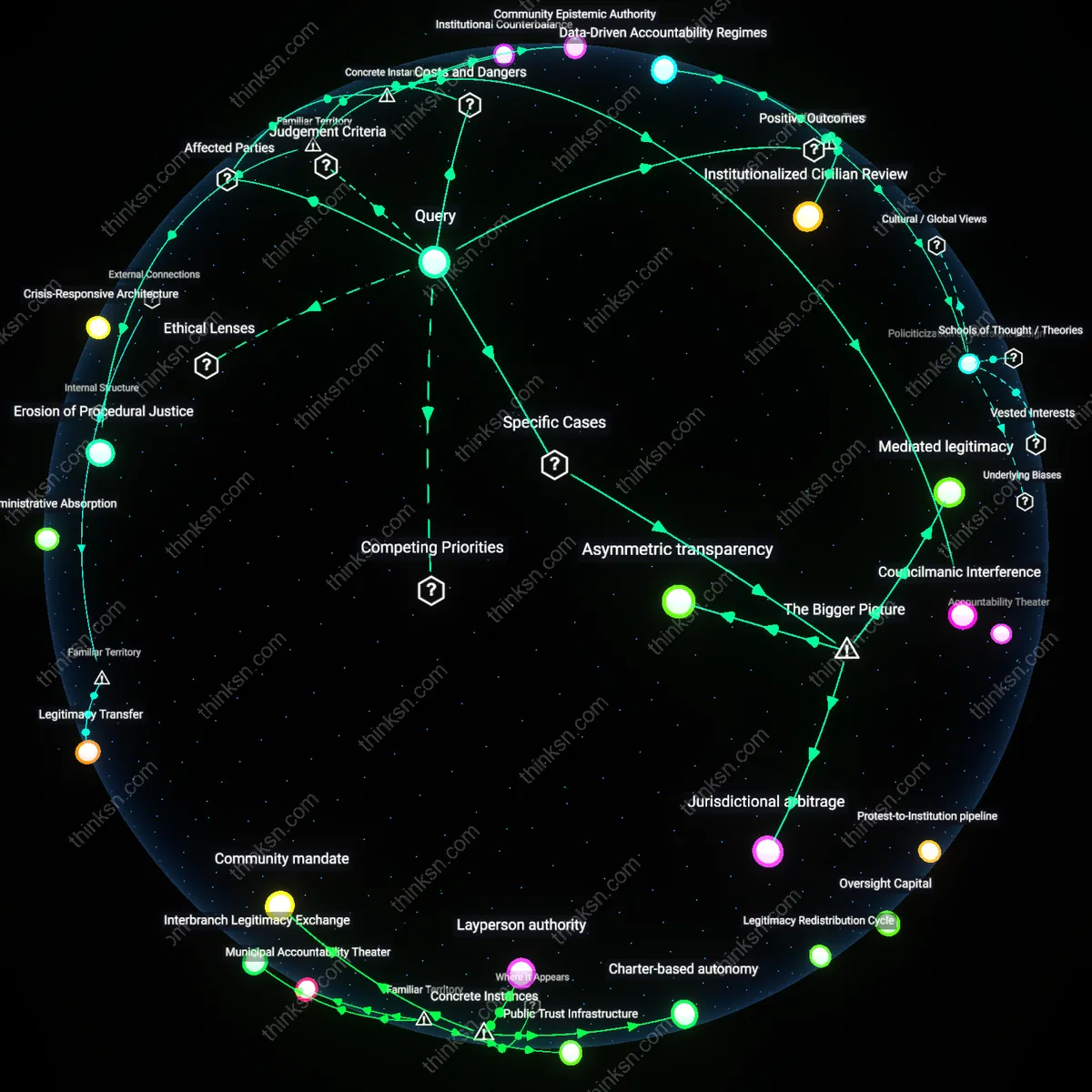
Does Community Policing Truly Legitimize While Marginalizing?
Analysis reveals 9 key thematic connections.
Key Findings
Legitimacy Tradeoff
Community policing enhances institutional legitimacy by aligning police visibility with procedural justice norms, but this gain is predicated on normalized surveillance of marginalized neighborhoods where trust-building serves as a mechanism for data accumulation. Police departments in cities like Chicago and Oakland deploy foot patrols and dialogue-driven initiatives to signal responsiveness, thereby satisfying public expectations of accountability—yet these interactions systematically register civilian routines, associations, and residences into informally tracked databases. The state gains perceived legitimacy not despite surveillance, but because of its coupling with service, creating a feedback loop where marginalized communities accept monitoring as the price of inclusion. This reveals a foundational tradeoff where the moral principle of justice is subordinated to the practical imperative of institutional endurance, rendering consent fungible within disadvantaged locales.
Surveillance Normalization
Frequent police presence in daily community life, such as in New York’s historically over-policed public housing developments, gradually embeds law enforcement into contexts like school events or neighborhood cleanups, making observation and information gathering feel routine rather than intrusive; this softens resistance to monitoring because surveillance becomes associated with visibility and care rather than suspicion—what often goes unnoticed is that this normalization, while increasing data collection on marginalized groups, is publicly framed and internally experienced as inclusion, thereby masking the expansion of control under the guise of partnership.
Legitimacy Threshold
In cities like Camden or Cincinnati, where reform efforts followed major scandals or disbandments, community policing acts as a public demonstration of institutional change, signaling that police are accountable and responsive, which allows residents to recalibrate their minimum expectations for acceptable state behavior; legitimacy rises not because problems vanish but because the bar for perceived legitimacy is lowered and then met through visible gestures—what is rarely acknowledged is that this recalibration enables institutions to regain public buy-in without necessarily altering deeper structural practices, effectively stabilizing the system even if equity gaps persist.
Data Infrastructural Drift
Community policing undermines institutional legitimacy by embedding surveillance logics into ostensibly relational systems, where routine data collection during neighborhood engagements migrates into predictive policing databases used against the same populations—such as when New York City’s Neighborhood Policing Program feeds stop-and-talk metadata into Patternizr, a tool identifying repeat suspect patterns. This transformation of trust-building interactions into digital dossiers is rarely transparent to residents, rendering consent meaningless and converting goodwill into intelligence assets; the non-obvious risk is not overt coercion but the quiet re-purposing of social infrastructure for surveillance expansion, subverting legitimacy through betrayal of relational expectations.
Legibility Burden
Community policing damages marginalized communities by demanding they make themselves legible to state actors in exchange for protection, forcing residents in places like Chicago’s South Side to disclose familial conflicts, housing instability, or informal economies during wellness checks that later inform policing priorities. This institutionalizes a form of performative vulnerability where safety access is contingent on self-exposure, disproportionately exhausting already overtaxed civic energy in Black and Brown neighborhoods; what goes unrecognized is that legitimacy is eroded not through police absence but through the compulsory emotional and informational labor exacted when communities must interpret and narrate their own risks to agents who retain unilateral power to act upon that knowledge.
Third-Party Proxy Enforcement
Community policing increases surveillance by deputizing non-police actors—such as housing maintenance staff, faith leaders, or school counselors in Los Angeles’ Gang Reduction and Youth Development centers—to report 'suspicious' behaviors under the guise of collaboration, expanding the surveillance net while insulating police departments from accountability. Because these actors lack formal oversight yet operate under implicit or explicit performance incentives tied to crime reduction metrics, their observations become unregulated inputs into policing operations, effectively privatizing suspicion; the overlooked danger is that legitimacy is compromised not through police visibility but through the diffused, untraceable accumulation of community-sourced intelligence that escapes public audit and due process.
Legitimacy through surrender
Community policing erodes institutional legitimacy by conditioning state protection on the informality of marginalized communities, as seen in Chicago’s CAPS program, where residents in predominantly Black neighborhoods exchange surveillance labor for minimal public safety gains, revealing a system where legitimacy is manufactured through coerced participation rather than mutual trust—this dynamic reframes cooperation not as empowerment but as institutional extraction.
Surveillance reciprocity
Community policing intensifies surveillance while destabilizing legitimacy, exemplified by the NYPD’s Strategic Response Teams in Harlem, where officers embedded in community outreach simultaneously mapped social networks for predictive policing, demonstrating that the very mechanisms designed to build rapport are repurposed for intelligence gathering—this undermines the assumption that face-to-face engagement inherently reduces state overreach.
Trust arbitrage
In Oakland’s Ceasefire program, law enforcement leveraged community-based organizations to deliver violence intervention services while rerouting non-criminal data to gang databases, proving that institutional legitimacy can be strategically inflated through selective service delivery that masks expansive surveillance—this reveals legitimacy not as an outcome but as a tactical resource exploited to deepen monitoring under the guise of inclusion.