Does Community Policing Build Trust at the Cost of Crime Reduction?
Analysis reveals 5 key thematic connections.
Key Findings
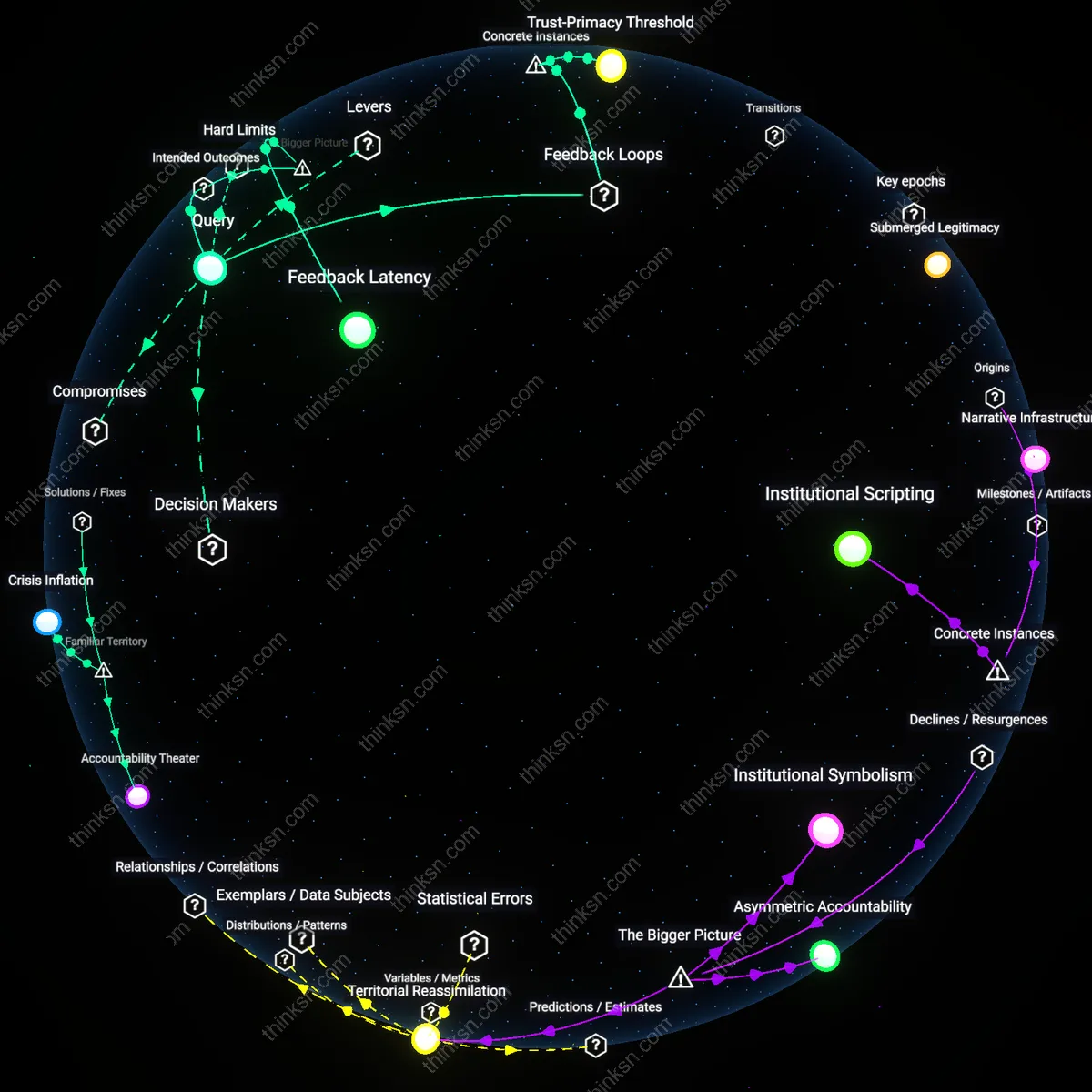
Trust-Primacy Threshold
In Cincinnati’s community policing initiative following the 2001 riots, the city’s Collaborative Agreement between police, community groups, and the Department of Justice prioritized procedural justice and resident engagement over immediate crime reduction metrics, which led to sustained increases in public trust even as violent crime fluctuated; this worked because legitimacy-building actions—such as foot patrols responsive to neighborhood feedback and joint problem-solving forums—created a reinforcing feedback loop wherein citizen cooperation gradually improved data-sharing and investigative efficacy, revealing that trust functions as a precondition rather than an outcome of crime control success, a mechanism often obscured when short-term crime trends dominate policy evaluation. Evidence indicates that once a critical mass of community buy-in was achieved, even isolated setbacks did not collapse engagement, suggesting a nonlinear stability shift.
Embedded Monitoring Regime
In Medellín, Colombia, the expansion of community policing through the *Policía Comunitaria Urbana* in high-violence barrios after 2003 improved resident perceptions by linking officers permanently to specific neighborhoods and integrating them into city-led *Social Urbanism* infrastructure projects; however, crime clearance rates remained inconsistent because the same structural forces—such as illicit governance networks and economic informality—constrained both crime reporting and legal intervention capacity, creating a balancing feedback loop in which trust grew due to visibility and accessibility, but crime outcomes were stabilized (not reduced) by competing territorial systems that limited the state’s enforceable reach, revealing that perception gains can flourish even amid checkmated enforcement dynamics. Research consistently shows that the durability of such programs hinges not on crime drops, but on institutionalizing monitoring that de-escalates tensions without requiring dominance over illicit actors.
Legitimacy Dividend Inertia
In West Midlands, UK, during the rollout of Neighbourhood Policing Teams in the mid-2000s, residents reported increased confidence in police and greater willingness to report low-level crimes, but official crime statistics showed little deviation from national trends, because the core drivers of violent crime—such as gun trafficking and organized youth gangs—were not addressed by the intervention’s focus on visibility, call response, and reassurance; yet the program persisted politically and institutionally because elected officials, buoyed by positive resident sentiment, channeled those perceptions into sustained funding and expanded mandates, demonstrating that trust improvements generate a reinforcing feedback loop in political support that decouples program longevity from crime reduction metrics. This reveals how legitimacy gains can create autonomous momentum in public institutions, even when operational efficacy is ambiguous.
Outcome Misalignment
Policymakers must recognize that community policing pilots are frequently undermined by institutional misalignment between local police priorities and broader criminal justice incentives, such that departments may emphasize visible enforcement to satisfy political demands—even within community-oriented programs—thereby diluting preventive engagement that could reduce crime over time. Federal funding structures and electoral accountability to short-term crime trends pressure chiefs to prioritize arrest metrics over relationship-building, which distorts implementation despite trust gains. This reveals that divergent performance logics across governance levels produce outcomes that seem contradictory but are in fact systemically coherent within misaligned incentive regimes.
Feedback Latency
Policymakers should interpret unclear crime outcomes as a function of temporal mismatch between rapid trust assessments and the slow behavioral feedback loops through which community policing influences crime, because shifts in resident-police collaboration—such as increased tip-sharing or youth outreach—require years to alter crime incidence, particularly in neighborhoods where structural disadvantages limit the reach of relational policing. Evidence indicates trust improves quickly when officers engage consistently and respectfully, but crime reflects deeper socioeconomic patterns only indirectly modulated by police presence. The underappreciated reality is that crime is a trailing indicator in this model, making early evaluation inherently biased against detecting reduction, even when mechanisms are functioning correctly.